
Skoltech's DiffusionRL Teaches Robot Hands to Grasp at 80% Without Human Demos
A new pipeline uses reinforcement learning to fix flawed grasps in the DexGraspNet dataset, then trains a compact diffusion policy that hits 80% success.
 Pro
Takeaways
- DiffusionRL trains a diffusion policy for dexterous grasping using RL-refined DexGraspNet data, no human demos needed. Paper
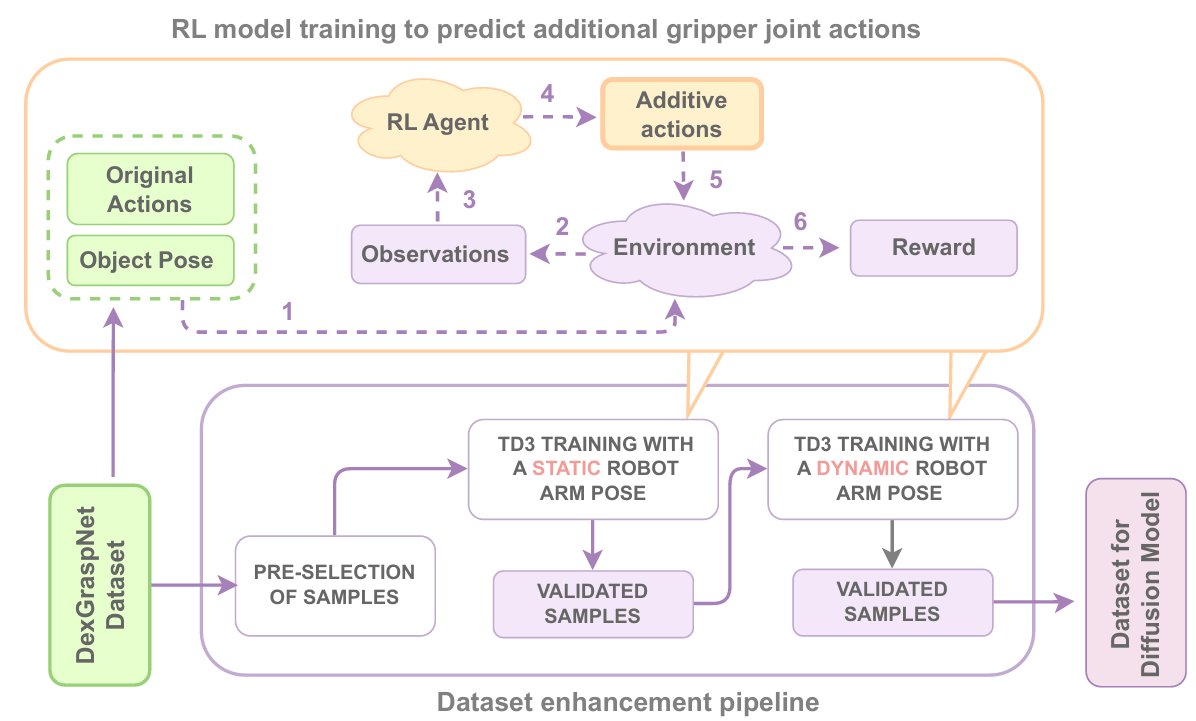
- A TD3 agent predicts corrective joint actions on top of replayed DexGraspNet trajectories to filter out failing grasps.
- Validation uses a gravity-based test: object stays in hand equals success, then that trajectory is saved.
- Achieves 80% success on three DexGraspNet objects with a simulated UR10e plus 24-joint ShadowHand.
- Conditional diffusion model uses a U-Net with FiLM conditioning on observations to denoise action sequences.
- Submitted to CoRL 2025 and ICRA 2026; no official public code release located yet.
Training a robot to grasp objects with a five-fingered hand usually comes down to a painful choice: spend weeks teleoperating demonstrations, or accept that your policy will fail whenever the scene changes. A team from Skoltech and Dalian University of Technology proposes a way around that tradeoff by letting a reinforcement learning agent do the demonstration collection for you, using a dataset that already exists.
Their paper, DiffusionRL, shows that a lightweight diffusion policy trained on an RL-refined slice of DexGraspNet reaches an 80% success rate on dexterous grasping with a simulated ShadowHand mounted on a UR10e arm. No human demonstrations, no teleoperation rig.
Why diffusion policies keep hitting a data wall
Diffusion policies have become one of the more interesting ideas in robot learning because they model the full distribution over action trajectories rather than picking one "best" action. That matters for manipulation, where many valid ways exist to close a hand around a mug. Prior work has shown that switching to a diffusion model at the moment of grasp can push success rates above 80%, compared to under 40% when a vision-language-action model tries to do everything itself.
The catch is that those diffusion models were trained on only 30 to 40 samples per scenario, which does not generalize. Meanwhile, large-scale grasp datasets like DexGraspNet exist, but the grasps in them assume a specific object placement and gripper configuration. Dropping DexGraspNet directly into a simulation to train a diffusion model is problematic because most of those grasps fail when replayed against a different arm base or with gravity turned on.
RL as a dataset janitor
The core trick in DiffusionRL is treating reinforcement learning as a way to repair and adapt an existing dataset rather than as the final policy. Training was based on the Twin Delayed DDPG (TD3) algorithm with lightweight Actor and Critic networks. TD3 is an off-policy actor-critic method that keeps two Q-value estimators to avoid the overestimation bias that plagued its predecessor DDPG.

The per-episode workflow is a concrete recipe:
- Place an object and set the UR10e plus ShadowHand to a randomized starting pose sampled from DexGraspNet statistics.
- Replay the joint trajectory from a DexGraspNet grasp sample.
- Let the TD3 agent predict corrective joint deltas on top of that trajectory.
- Enable gravity and validate the grasp: if the object does not fall out, the sample is a success.
- Dump successful trajectories to a new database that becomes the diffusion policy's training set.
The action space is nontrivial. The UR10e has 6 joints and the ShadowHand has 24, giving the RL agent a high-dimensional control problem. To keep things tractable, only 8 joints are randomized at episode start using a fixed schedule of angular ranges around a nominal vertical-palm pose.
Inside the diffusion policy
Once the RL agent has produced a curated set of working trajectories, a conditional diffusion model is trained on it. The architecture is a U-Net style encoder-decoder with skip connections and FiLM conditioning, where observations condition the denoising of noised action sequences into clean ones. FiLM (feature-wise linear modulation) is a simple way to inject conditioning signals: it applies a learned scale and shift to intermediate features rather than concatenating vectors.

For fair evaluation, the authors also built a pose sampling algorithm that generates random but statistically realistic object placements drawn from DexGraspNet's distribution, so the diffusion policy is tested on poses it has never seen.
Results and caveats
A compact diffusion model trained on three different objects reached roughly 80% success in randomized grasping scenarios. What makes the number interesting is what it took to get there: no teleoperation, no human demonstrators, and a diffusion model small enough to be called lightweight.
Some honest limitations are worth flagging:
- The evaluation covers only three objects from DexGraspNet, so category-level generalization is unproven.
- Everything runs in simulation with a fixed UR10e plus ShadowHand embodiment. Sim-to-real transfer is not addressed.
- The RL agent still needs to run against a physics simulator to filter grasps, so "no data collection" really means "no human data collection."
- The paper does not appear to have an official public code release at the time of writing, though it is listed as submitted to CoRL 2025 and cited elsewhere as an ICRA 2026 submission.
The broader takeaway for anyone working on manipulation: existing grasp datasets are not throwaway just because their kinematic assumptions do not match your robot. An RL agent can be a cheap adapter that turns a mismatched dataset into a usable one, and diffusion policies are a good downstream consumer because they thrive on the diversity that RL exploration naturally produces.