
SJTU's OpenSeeker Beats Alibaba's Search AI With Just 11.7K Training Samples
A Shanghai Jiao Tong team released a fully open-source search agent whose 11.7k-sample dataset beats industrial pipelines built on continual pre-training and reinforcement learning.
 Pro
Takeaways
- Shanghai Jiao Tong University released OpenSeeker, the first search agent open-sourcing both weights and 100% of training data.
- Fine-tuned from Qwen3-30B-A3B on just 11.7k synthesized samples via plain SFT in a single run.
- Scores 48.4% on BrowseComp-ZH, beating Alibaba's Tongyi DeepResearch (46.7%) trained with CPT + SFT + RL.
- Reaches 29.5% on BrowseComp, 74.0% on xbench-DeepSearch, and 59.4% on WideSearch, SOTA among open ~30B models.
- QA synthesis reverse-engineers the web graph, using entity obfuscation to force genuine multi-hop reasoning.
- Model and dataset released on Hugging Face under MIT license.
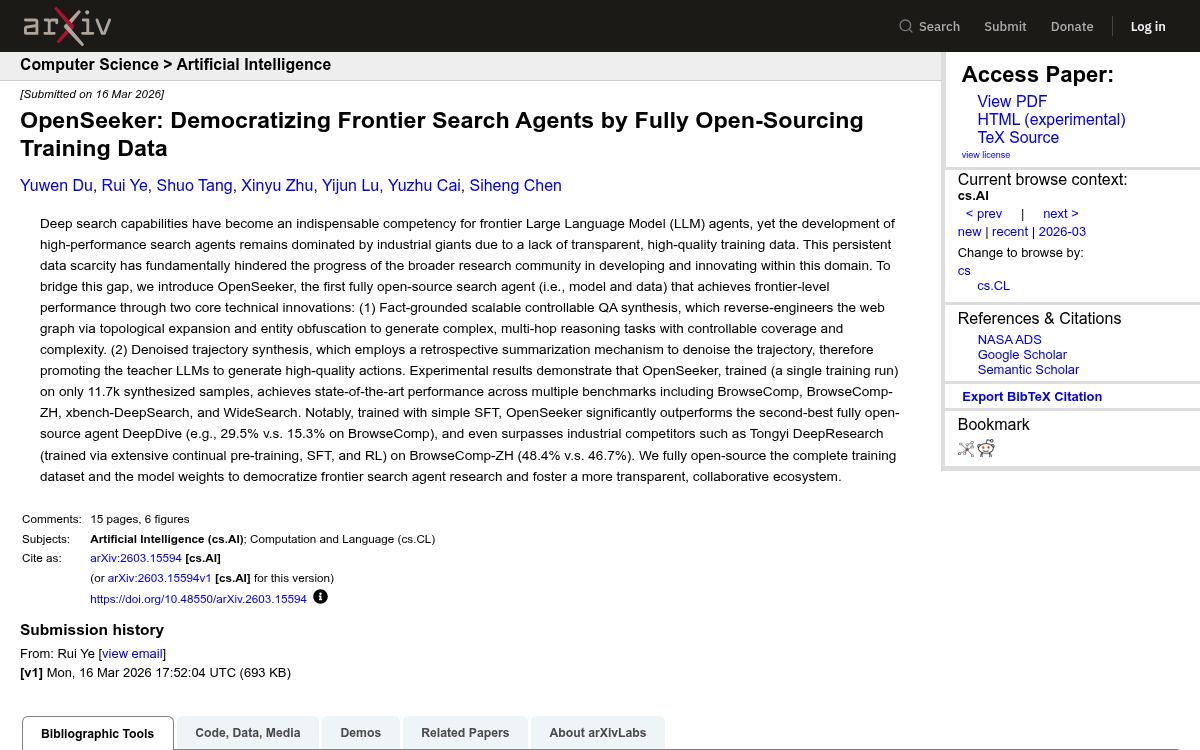
For roughly a year, the strongest deep search agents have come exclusively from well-funded labs, and the reason has less to do with model weights than with the browsing trajectories those labs refuse to publish. A team from Shanghai Jiao Tong University just released OpenSeeker, which they describe as the first search agent to open-source both the model and 100% of its training data, and it lands with numbers that punch well above the compute that produced it.
OpenSeeker-v1-30B-SFT is fine-tuned from Qwen3-30B-A3B-Thinking-2507 on only 11.7K training examples, and on English benchmarks it scores 29.5% on BrowseComp, 74.0% on xbench, and 59.4% on WideSearch, all state-of-the-art for open models of comparable size. On the Chinese-language BrowseComp-ZH, the model hit 48.4%, beating Alibaba's Tongyi DeepResearch at 46.7%, which went through a three-stage process of extended pre-training, supervised fine-tuning, and reinforcement learning. OpenSeeker did it with plain SFT in a single training run.
The data moat, not the weight moat
Deep search agents follow the ReAct loop: the model reasons, calls a search or browse tool, reads the observation, then decides the next action. Training one requires long trajectories of these interactions grounded in real web content, and that is exactly what industrial labs guard. Powerful AI search agents have so far been big tech's territory. OpenAI, Google, and Alibaba keep their training data locked down. Even projects that publish their model weights stay quiet about the data behind them.
The paper frames this bluntly: prior open efforts either release model weights without data, provide only a fraction of the data, or generate low-fidelity samples that fail to reach competitive performance. OpenSeeker's contribution is a recipe for synthesizing that missing data.
Reverse-engineering the web into multi-hop puzzles
The first innovation is fact-grounded QA synthesis. Rather than asking an LLM to invent questions (which invites hallucination) or scraping existing benchmarks (which are easy to solve by keyword lookup), the authors treat the web as a directed graph of pages linked by hyperlinks and reverse-engineer reasoning paths through it.

The pipeline works in four steps:
- Graph expansion. Pick a random seed page and traverse its outgoing links to build a small subgraph of connected pages.
- Entity extraction. Distill that subgraph into a dense entity graph, stripping textual noise while preserving the topological connections between facts.
- Question generation. A generator model writes a question whose answer requires traversing multiple edges in the entity subgraph, forcing multi-hop reasoning rather than single-page lookup.
- Entity obfuscation. Concrete names like a specific person or product are rewritten as vague descriptive references, so the agent cannot shortcut the puzzle by pasting a keyword into a search box.
Every candidate is then run through two rejection filters: a strong base model must fail to answer it from parametric memory (proving external tools are needed), and the same model must succeed when given the full entity subgraph as context (proving the reasoning path actually exists).
The asymmetric trick behind clean trajectories
The second innovation targets the trajectories themselves. Raw HTML observations are noisy, and stuffing them into a teacher's context window degrades the quality of its next action. OpenSeeker uses a retrospective summarization scheme: at each step the teacher sees the raw output from the immediately previous tool call, but older observations further back in history are compressed into short summaries.
The clever part is the asymmetry between generation and training. During data generation, a teacher model gets a cleaned-up summary of previous search results and makes better decisions based on that. During training, the student model then sees the raw, uncleaned data but is still expected to reproduce the teacher's high-quality decisions. This forces it to figure out on its own how to separate signal from noise. In other words, the final agent internalizes denoising as a skill rather than relying on an external summarizer at inference time.
Numbers that matter
Under identical SFT protocols in the ~30B parameter class, OpenSeeker's advantage is stark:
| Model | Samples | BrowseComp | BC-ZH | xbench |
|---|---|---|---|---|
| MiroThinker-32B-v0.1 | 147k | 10.6 | 13.8 | - |
| DeepDive-32B (SFT) | 4.1k | 9.5 | 23.0 | 48.5 |
| WebSailor-V2-30B (SFT) | ? | 24.4 | 28.3 | 61.7 |
| WebLeaper-30B | 15k | 27.7 | - | 66.0 |
| OpenSeeker-v1-30B-SFT | 11.7k | 29.5 | 48.4 | 74.0 |
The Chinese subset is particularly striking, and the difficulty statistics explain why. The authors' synthesized Chinese data averages 46.35 tool calls and 76.1k tokens per trajectory, versus 26.98 tool calls and 15.1k tokens for BrowseComp-ZH itself, meaning training samples are harder than the benchmark being tested.

What you actually get, and what it's for
The full release under MIT license includes the QA synthesis pipeline, the 11.7k trajectory dataset (10.3k English + 1.4k Chinese), and the fine-tuned 30B model. Weights are on Hugging Face and the dataset is available here. The base is a mixture-of-experts with 3B active parameters at inference, so it is realistic to serve on a single node.
This is most useful if you are building a research agent that has to chain many search-and-read steps to answer complex factual queries, or if you want a reproducible baseline for experimenting with RL, curriculum learning, or filtering on top of a known-good SFT starting point. It is less useful for general chat, code generation, or tasks that require reasoning outside the web-browsing tool loop, and the authors note the English data is one version behind the harder Chinese set, leaving room for a stronger v2. The team has already teased OpenSeeker-v2 with 46.0% on BrowseComp and 78.0% on xbench, still using pure SFT.
The broader signal is that the gap between academic labs and industrial search agents was never really about compute. It was about who could generate multi-hop, tool-necessitating trajectories at scale, and that recipe is now public.