
SJTU's FIRM Fixes the Broken AI Image Editor Scoring That Fools RL
A new framework fixes hallucinating reward models that were quietly sabotaging RL fine-tuning for image editing and text-to-image generation.
 Pro
Takeaways
- FIRM tackles hallucinating reward models that misguide RL for image editing and text-to-image generation.
- Two 8B critics released: FIRM-Edit-8B and FIRM-Gen-8B, trained on 370K and 293K scored samples.
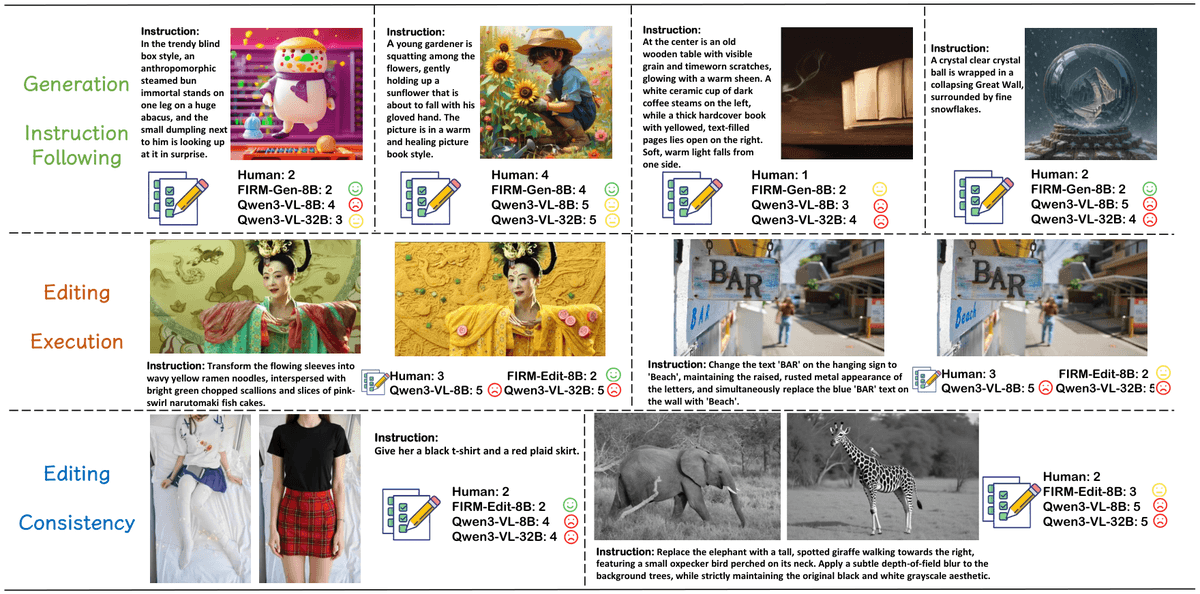
- Editing scored on execution plus consistency; generation on instruction following plus quality.
- Base-and-Bonus rewards (CME and QMA) prevent policies from copying the source image to game the score.
- FIRM-Bench measures critic-human alignment, showing gains over existing metrics.
- Code, datasets, and models fully open at firm-reward.github.io.
Reinforcement learning has become the go-to trick for squeezing better instruction-following out of image editors and text-to-image models. But there is a dirty secret behind the leaderboard gains: the critic that scores each generated image is often wrong. Reward models, which act as critics during RL, often suffer from hallucinations and assign noisy scores, inherently misguiding the optimization process. A team from SJTU VisionXLab is now proposing a fix called FIRM, and they are releasing the datasets, models, and benchmark that go with it.
The lazy-editor problem
When you fine-tune an image editor with RL, the policy learns to maximize whatever the reward model likes. If that reward model rewards a generic notion of similarity to the source image, the policy discovers a cheap hack. This flawed reward structure incentivizes the editing model to become lazy, opting to simply output the original input image, which ultimately results in poor editing performance. The critic gives a high score for preserving the scene, misses the fact that the requested edit never actually happened, and the policy converges on doing nothing.
The same failure mode shows up in text-to-image generation. A critic that focuses too narrowly on prompt keywords will happily reward blurry, malformed images as long as they contain the right nouns. That is the gap FIRM tries to close.
Splitting the reward into two questions
The core insight is that a single scalar reward cannot capture what makes an edit or a generation good. FIRM evaluates editing using both execution and consistency, while generation is primarily assessed via instruction following. Execution asks whether the requested edit actually happened. Consistency asks whether everything else was preserved. For generation, instruction following is paired with a separate quality signal.
Rather than asking a multimodal model to score the whole image end-to-end, FIRM builds structured evidence first. For editing, it describes the visual differences between the source and edited image, then scores execution and consistency from that description. For generation, an LLM expands the prompt into a checklist and a multimodal evaluator scores the output dimension by dimension.

Two datasets, two 8B critics
Those pipelines are used to generate training data at scale. The team collected the FIRM-Edit-370K and FIRM-Gen-293K datasets, and trained specialized reward models (FIRM-Edit-8B and FIRM-Gen-8B) that accurately reflect these criteria. Both critics are 8B parameter multimodal models trained specifically to score edits and generations along the axes above, rather than trained on generic aesthetic preference data.
To measure whether the critics are actually better critics, the authors also built FIRM-Bench, a comprehensive benchmark specifically designed for editing and generation critics. Evaluations demonstrate that the models achieve superior alignment with human judgment compared to existing metrics. This matters because the field has been chasing generation benchmarks while quietly ignoring how noisy the underlying scoring is.
Base-and-Bonus: making RL play fair
Having good scores is only half the battle. The other half is combining them into a reward that the policy cannot game. FIRM proposes a Base-and-Bonus formulation with two variants:
- CME (Consistency-Modulated Execution) for editing:
R = Execution * (0.6 + 0.4 * Consistency) - QMA (Quality-Modulated Alignment) for generation:
R = InsFollowing * (0.4 + 0.6 * Quality)
The multiplicative structure is the key. If execution is zero, no amount of consistency saves the reward, so the lazy-copy shortcut collapses. If instruction following is zero, a pretty but off-prompt image gets nothing. The bonus term still incentivizes the second objective, but only conditional on the primary one being satisfied. As the project notes, both formulations are designed to stop the policy from maximizing the easiest sub-score while ignoring the real task objective.
Downstream results
The authors used their critics to fine-tune two popular generative backbones with RL, producing FIRM-Qwen-Edit and FIRM-SD3.5. These resulting models achieve substantial performance breakthroughs, and comprehensive experiments demonstrate that FIRM mitigates hallucinations, establishing a new standard for fidelity and instruction adherence over existing general models. Qualitatively, the editing model stops returning near-identical copies of the source and starts making the edits it was asked for while leaving the rest of the scene alone.

What is actually shipping
Everything is public. The project page links to the paper, the GitHub repo, and a Hugging Face collection with the reward models and the fine-tuned generators. There is also a follow-up called FIRM-Video that extends the same checklist-then-score idea to text-to-video reward modeling.
If you are running RL on top of a diffusion or flow-matching image model, the practical takeaway is straightforward. Swapping a generic preference model for a task-specific critic that separates execution from consistency, and shaping the reward so the policy cannot pick off just one, is doing more work than another round of prompt engineering. And unlike a lot of RL research, the critics themselves are downloadable, so you can drop FIRM-Edit-8B or FIRM-Gen-8B into your own PPO or GRPO loop without retraining a reward model from scratch.