
Simplex AI's LiteResearcher Beats Claude 4.5 Sonnet Training on a Fake Internet
A 4B search agent trained in a fully offline virtual web beats 30B open-source rivals and matches Claude 4.5 Sonnet on GAIA and Xbench.
Takeaways
- LiteResearcher-4B hits 71.3% on GAIA and 78.0% on Xbench-DS, matching Claude 4.5 Sonnet.
- Trained entirely in a local 32M-page synthetic web with 73.2M zero-cost tool calls.
- Live-web equivalent would have cost $59K to $243K in API fees.
- Decomposes deep research into five atomic capabilities: direct, aggregation, enumeration, cross-verify, statistics.
- Strictly on-policy GRPO plus a difficulty-aware curriculum prevents the usual RL plateau.
- Code and model weights are open source.
A team from Zhejiang University and Simplex AI has released LiteResearcher, a training framework that questions one of the core assumptions behind recent deep research agents: that you need to hook your RL loop up to the live internet to teach an agent how to search it. Their 4B-parameter model, trained entirely inside a synthetic replica of the web, matches or beats systems eight times its size and lands on par with Claude 4.5 Sonnet on standard benchmarks.
The code and the 4B checkpoint are both open source, and the paper argues that the real bottleneck for deep research agents is not model scale but the training environment itself.
Why live-web RL keeps hitting a wall
Agentic RL for reasoning tasks like coding has scaled cleanly because you can run everything inside a deterministic sandbox. Deep research has not been so lucky. Online RL frameworks interact directly with the live internet, introducing significant training variance and prohibitive costs that limit continuous capability growth, while local retrieval systems built on narrow corpora like Wikipedia cannot reproduce the messy dynamics of the open web.
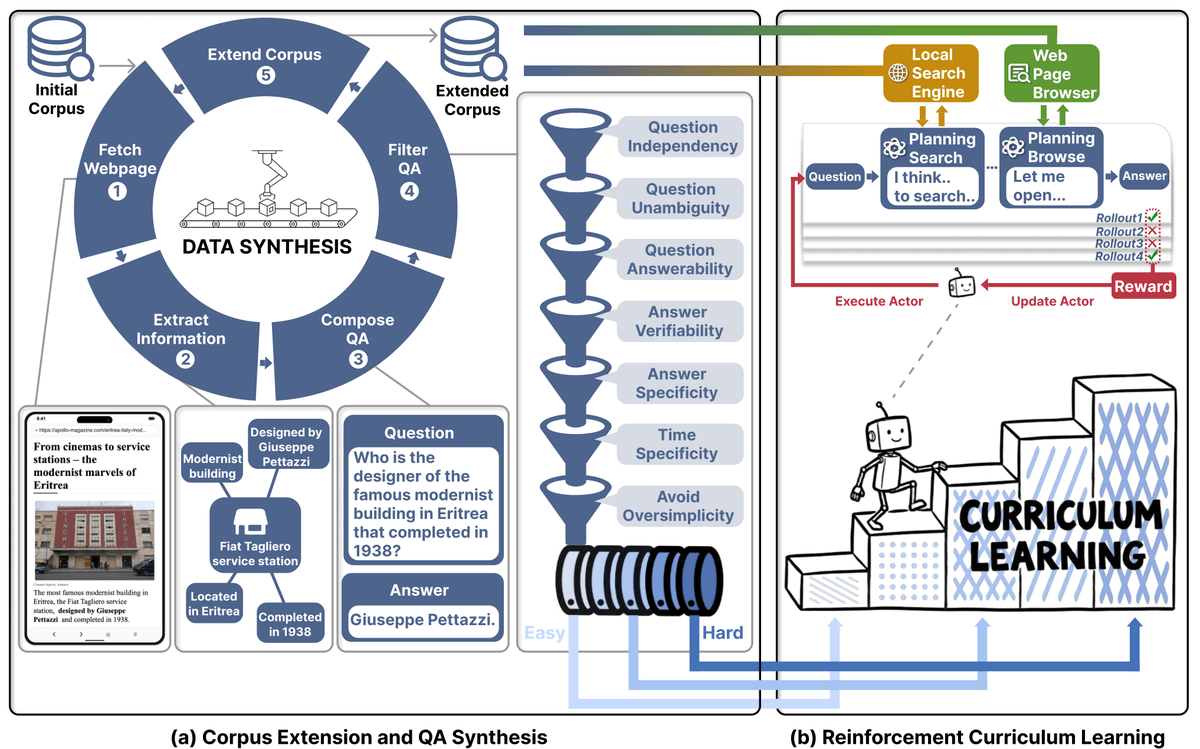
The authors also push back on the current trend of generating training data with elaborate hand-crafted reasoning templates. Those pipelines, they argue, over-engineer logic while missing the actual atomic operations a research agent needs to perform. Their fix is a twin architecture: a virtual world structurally similar to the live internet, but isolated from its noise.
The five atoms of deep research
LiteResearcher starts by decomposing complex research trajectories into five primitive search capabilities that any competent agent has to master:
- Direct information: finding a single fact via one search.
- Aggregation: locating a target that satisfies multiple identifying attributes at once.
- Enumeration: listing and counting all entities matching a constraint.