
Simon Fraser's TurboMap Speeds Up Robot Mapping 1.6x Without Losing Accuracy
A redesigned local mapping backend for ORB-SLAM3 shifts three bottleneck stages onto the GPU, cutting keyframe latency by up to 1.6x with matching accuracy.
 Pro
Takeaways
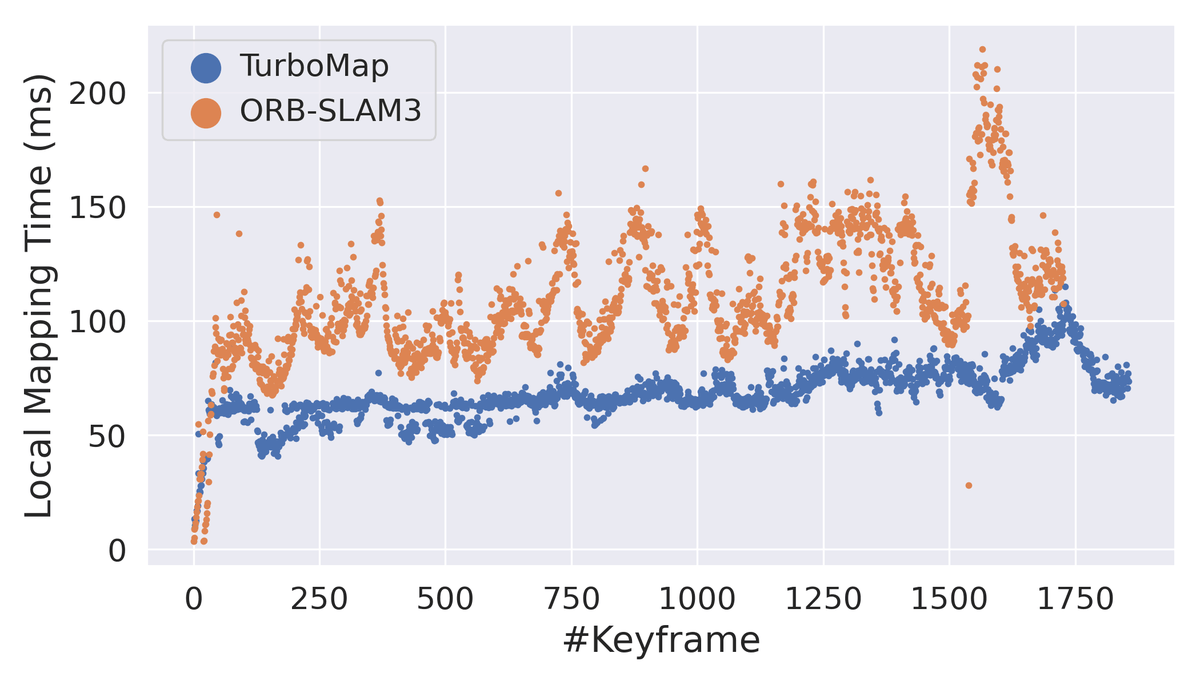
- TurboMap accelerates ORB-SLAM3 local mapping by 1.3x on EuRoC and 1.6x on TUM-VI.
- Restructures Map Point Creation and Fusion to decouple parallel search from serial map updates.
- Persistent GPU-resident keyframe storage eliminates repeated 1MB-per-keyframe transfers to the GPU.
- Keypoint Correspondence Search alone gets up to 5.2x faster on Jetson with TUM-VI sequences.
- Under high keyframe insertion stress, cuts trajectory error from 10.1m to 0.045m versus ORB-SLAM3.
- Open source at github.com/sfu-rsl/TurboMap, works on desktop RTX and Jetson Xavier NX.
Real-time visual SLAM systems live and die by latency. If the local mapping thread falls behind, the map degrades, tracking drifts, and the robot can lose its position entirely. A team from Simon Fraser University and the University at Buffalo just published TurboMap, a redesigned local mapping backend for ORB-SLAM3 that pushes the slowest stages onto the GPU while keeping trajectory accuracy intact.
Experiments on the EuRoC and TUM-VI datasets show average local mapping speedups of 1.3x and 1.6x respectively, with no loss of accuracy. The code is open source, and the techniques generalize to any visual SLAM system that maintains a global map.
Why local mapping is a stubborn bottleneck
A visual SLAM pipeline typically splits into three threads: tracking (estimating camera pose from features), local mapping (refining and expanding the map), and loop closing (correcting drift on revisited locations). Local mapping is the one that tends to hold everything else up.
Local mapping frequently reads and modifies shared map structures while other modules are running concurrently and accessing the same data. To ensure consistency, these operations use synchronization such as locks, forcing many computations to wait for exclusive access and thereby serializing execution. Keyframes and map points are also large: each keyframe occupies approximately 1 MB and tens of neighboring keyframes may be involved, so naively shipping data to the GPU each iteration wipes out any speedup you would gain from parallel execution.
That is why prior GPU work on SLAM has almost exclusively targeted Local Bundle Adjustment (LBA), which is naturally data-parallel. The other stages, Map Point Creation, Map Point Fusion, and Keyframe Culling, remained CPU-bound because they mutate shared state.

Four moves that unblock the pipeline
Roughly 95% of computation time in local mapping is spent on Map Point Creation, Map Point Fusion, Local Bundle Adjustment, and Keyframe Culling. TurboMap tackles each one differently:
- Persistent GPU keyframe storage. Each keyframe is copied to the GPU only once when it enters local mapping and kept resident until removed. Data is partitioned into immutable and mutable components, with only the immutable data stored on the GPU. Descriptors and keypoints never change after creation, so they live on the GPU with no synchronization cost.
- Parallel Keypoint Correspondence Search. The original code interleaves matching with triangulation, which mutates the shared map and forces serialization. TurboMap decouples the two stages, batches all match candidates, and lets thousands of GPU threads run descriptor comparison and epipolar validation independently.
- Parallel Map Point Fusion. Same trick: identify all candidate duplicate pairs in parallel first, then do the actual merging sequentially afterward. Each GPU thread handles one map point against one neighboring keyframe.
- CPU-side Keyframe Culling optimization. The team tried moving this to GPU but the observation lists change too often. Instead they add a lightweight counter array tracking how many times each map point is observed at each scale, which avoids re-iterating over every keyframe's observations.
For LBA itself they integrate an existing GPU-accelerated solver from Gopinath et al. that serves as a drop-in replacement block solver for g2o, the optimization library ORB-SLAM3 already uses.
The numbers
Evaluated on a desktop with an RTX 3090 and an embedded Jetson Xavier NX, TurboMap delivers consistent gains across both. The per-component speedups tell the interesting story:
| Component | EuRoC (Desktop) | TUM-VI (Desktop) |
|---|---|---|
| Keypoint Correspondence Search | 2.2x | 3.3x |
| Map Point Fusion | 1.5x | 2.3x |
| Keyframe Culling | 1.8x | 3.3x |
| Local Bundle Adjustment | 1.2x | 1.4x |
TUM-VI gains more because it uses fisheye cameras processed as two independent monocular streams, so sequences contain roughly twice as many map points as EuRoC, giving the GPU more work to spread across threads.

Where it really shines: high keyframe pressure
The headline speedup understates what happens under stress. Under normal load, ORB-SLAM3 has a queue-management trick: when the queue is not empty, it skips LBA and Keyframe Culling for the current keyframe and starts processing the next one to save time and avoid keyframe drops. Skipping those stages tanks trajectory accuracy.
In a stress test with high camera motion and denser keyframe insertion, TurboMap keeps up. On the corridor1 sequence, ORB-SLAM3 skipped LBA and keyframe culling on 343.8 keyframes on average and produced a trajectory error of 10.136 meters, while TurboMap skipped only 9.2 and stayed at 0.045 meters. That is the difference between a robot that knows where it is and one that has fully diverged from ground truth.
When to use it
TurboMap is a practical drop-in for anyone building on ORB-SLAM3, especially on embedded platforms like Jetson where every millisecond matters. It is most useful for:
- Robots operating in feature-rich or rapidly changing scenes where keyframes are inserted frequently
- Systems using wide field-of-view or fisheye cameras that generate many map points
- Applications where trajectory drift under load is a real failure mode, such as aerial vehicles or fast ground robots
One caveat: gains scale with map point count. Small, sparse environments where LBA already dominates will see smaller improvements, since the LBA solver was already the most optimized component to start with.