
simFOL Beats SBERT at Argument Similarity With Explainable Logic Scores
A four-level framework compares first-order logic arguments using SBERT embeddings, context weights, and symbolic structure, with axiomatic guarantees baked in.
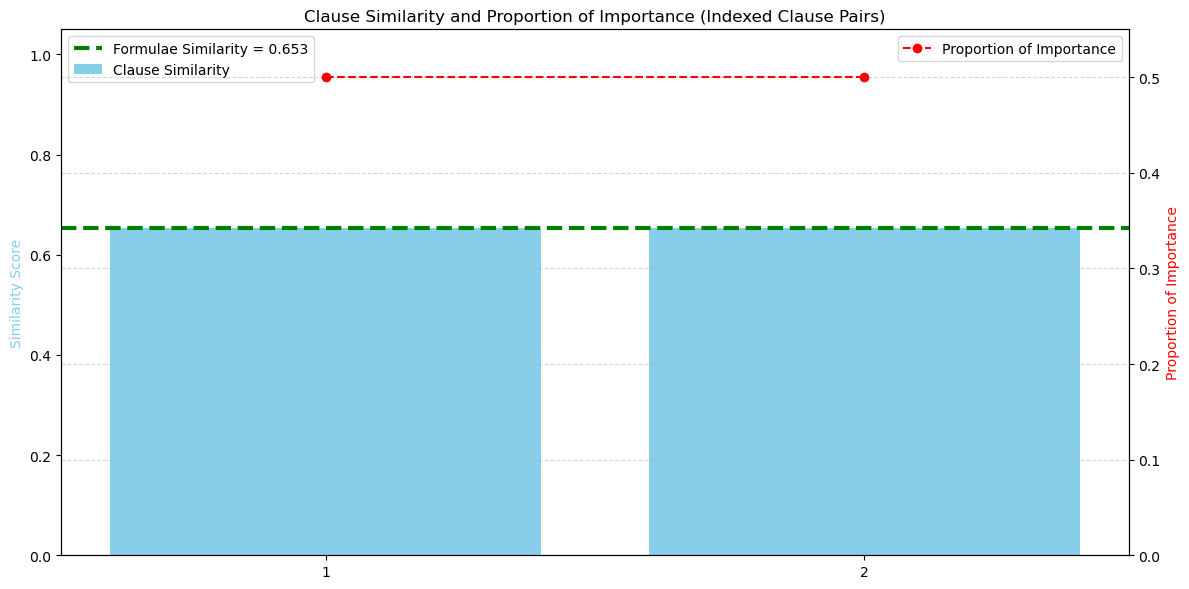
Takeaways
- simFOL introduces a four-level similarity framework for first-order logic arguments: predicates, literals, clauses, formulas.
- Combines SBERT embeddings with symbolic CNF structure and per-symbol contextual weights, like a symbolic attention distribution.
- Uses Skolemization to avoid variable grounding, keeping FOL comparison tractable on open-domain natural language.
- On an STS-B agent/patient reversal pair, scores 0.628 versus a 0.630 human average; SBERT gives 0.985.
- Two model families satisfy 13 of 14 proposed axioms, missing only Non-Zero, which humans also violate.
- Targets enthymeme decoding, gradual argumentation semantics, and argument clustering; CNF generation and weights still manual.
Most modern sentence-similarity tools tell you two texts are close, but not why. A recent technical report from Victor David, Jérôme Delobelle, and Jean-Guy Mailly pushes back on that opacity by proposing a similarity framework for arguments written in first-order logic (FOL), where the score comes with a symbolic decomposition you can actually inspect.
In formal argumentation, systems reason over graphs of arguments that attack or support each other. Existing approaches focus on propositional logic, but the authors address the richer setting of FOL, where similarity must account for structured content. Two attackers making essentially the same point should not double-count against a target. And when someone leaves half an argument unsaid, called an enthymeme, similarity is what tells you whether a reconstruction preserves the original meaning.
Why propositional tools break on FOL
Prior FOL similarity work stumbled on two fronts. It struggled with syntactic proximity between symbols like house and apartment, and it hit scalability walls because comparing quantified formulas often requires grounding variables into concrete instances, which explodes combinatorially over open domains like all people or all locations.
The proposed fix, called simFOL, sidesteps grounding entirely. Formulas are compiled into conjunctive normal form using Skolemization, which replaces existential quantifiers with fresh function symbols instead of enumerating cases. The authors are explicit that this is a trade: Skolemization only preserves satisfiability, not full logical equivalence, but it gives a canonical, bounded representation that is good enough for structural comparison and cheap enough to run on natural language at scale.