
SimDist Doubles Robot Success Rates With Just 30 Minutes of Real-World Data
SimDist trains a world model in simulation, then adapts to reality by finetuning only the dynamics, cutting real-world data needs to under 30 minutes.
 Pro
Takeaways
- SimDist pretrains a latent world model in simulation and finetunes only the dynamics on real hardware, from UT Austin, UW, and FieldAI.
- Freezes encoder, reward model, and value function during real-world adaptation, reducing the problem to supervised system identification.
- Reaches roughly 2x baseline success rates using only 15 to 30 minutes of real-world data across four robot tasks.
- Handles peg insertion, table leg threading, slippery slopes, and memory foam locomotion; beats RLPD, IQL, Diffusion Policy, and pi-0.5.
- Uses transformer-based chunked latent dynamics with MPPI planning; skips pixel reconstruction, which hurt manipulation performance.
- Code released at github.com/CLeARoboticsLab/simdist, accepted to RSS 2026.
Robots trained in simulation almost always trip on their first day in the real world. Contact physics, friction, and sensor noise never match perfectly, and reinforcement learning finetuning on the actual hardware tends to be slow, unstable, or outright catastrophic. A new framework called Simulation Distillation (SimDist), from researchers at UT Austin, University of Washington, and FieldAI, proposes a cleaner split of labor: do the hard learning in simulation, and let the robot handle only a narrow system identification problem once it hits reality.
The paper, accepted to RSS 2026, shows that with 15 to 30 minutes of real-world data, SimDist roughly doubles success rates over strong baselines on precise manipulation and quadruped locomotion tasks. The code is public on GitHub.
Why sim-to-real finetuning keeps breaking
Existing end-to-end reinforcement learning methods often collapse when finetuning policies in new domains, indicating catastrophic forgetting of pretraining priors. The reason is structural: standard RL entangles state representations, reward estimation, value estimation, and action selection into one giant network. When you push a few thousand real-world samples through it, the whole decision-making stack shifts, and long-horizon credit assignment (figuring out which action ten steps ago caused the current failure) becomes intractable with so little data.
Model-based methods instead learn dynamics and reward models to reason about unseen trajectories, but must carefully avoid exploiting model inaccuracies. The usual defenses, like uncertainty-aware dynamics or conservative value estimation, still assume you have to bootstrap most of the model from scratch on the robot.
The insight: not every piece needs to transfer perfectly
The SimDist team argues that a world model naturally decomposes a task into pieces with very different sensitivity to the sim-to-real gap. The encoder, reward model, and value function encode the global structure of a task: what states matter, what counts as progress, and what looks like success. Only the dynamics model, which ties actions to next states, is truly sensitive to physical mismatches like friction or compliance.
Reward and value models only need to define an accurate ranking over real-world states to enable the planner to distinguish promising futures from poor ones. That is a much weaker requirement than predicting exact returns, and it turns out to survive the sim-to-real jump remarkably well.

How the pipeline works
SimDist runs in four stages:
- Expert policy training in simulation. A state-based expert policy is trained with standard RL, saving the final policy, intermediate checkpoints, and the learned value function.
- Diverse data generation. Rollouts alternate between the expert and suboptimal checkpoints, with Gaussian action noise injected in short contiguous windows. This deliberately produces failures, near-misses, and recoveries, so the planner later has coverage of off-policy behaviors.
- World model pretraining. A latent world model with a shared encoder, transformer-based dynamics, reward head, value head, and a base policy head is trained on the simulated dataset from raw perception.
- Real-world adaptation. On the robot, everything except the latent dynamics model is frozen. New data is used only to correct the dynamics via a supervised prediction loss in latent space.
Because rewards and values are frozen and computed on latent states, the robot never needs dense reward labels in the real world, which are usually impossible to get anyway. Planning uses Model Predictive Path Integral (MPPI) control, a sampling-based Model Predictive Control (MPC) method that samples candidate action sequences, scores them through the world model, and importance-weights them by predicted return.

Architecture choices that matter
A few design decisions made planning fast enough to run on real hardware:
- Chunked prediction. Instead of autoregressive unrolling, the transformer predicts T future latent states in one forward pass using cross-attention between history tokens and a candidate action sequence. This fully exploits GPU parallelism when scoring hundreds of candidate rollouts.
- Sequence-to-sequence return heads. Reward and value models are transformers that attend over the entire predicted latent trajectory rather than per-timestep MLPs. Ablations show this matters: swapping to MLP heads drops peg insertion from 0.90 to 0.82 and table leg from 0.85 to 0.60.
- No pixel reconstruction. The team found reconstruction losses actively hurt manipulation because visual domain randomization forces the latent to encode irrelevant texture and lighting variation. Ablations dropped peg insertion to 0.32 with reconstruction enabled.
- Minimal history representation. Only the most recent high-dimensional image is fed into the encoder, while proprioception carries the temporal history, cutting planning latency substantially.
Real-world results
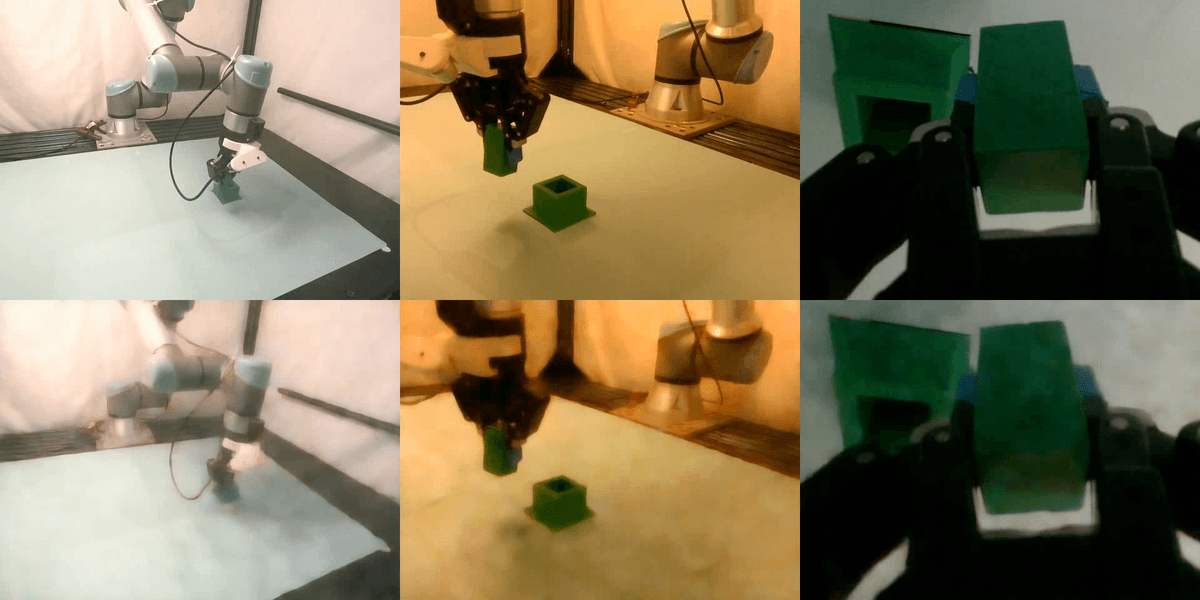
The team ran four hardware tasks: peg insertion and table leg threading on a UR5e arm, plus slippery slope (PTFE panels with thermoplastic-wrapped feet) and memory foam traversal on a Unitree Go2 quadruped. Across all tasks, SimDist consistently outperforms prior approaches, achieving substantially higher success rates with far greater sample efficiency than online RL baselines, while autonomously improving well beyond the performance of behavior cloning methods. Across the board SimDist typically reaches scores around 2 times higher than any baseline.
On the slippery slope task, after 35.7 minutes of real-world data, SimDist hit 5/5 success at both 0.3 and 0.5 m/s while IQL and RLPD stayed at 0/5. On the foam pads, SimDist scored 5/5 at all three commanded speeds, and RLPD actually destabilized the robot during adaptation. Baselines compared included RLPD, IQL, trained from sparse rewards to reflect common manipulation settings where dense rewards are difficult to specify, plus SGFT-SAC, Diffusion Policy, and Physical Intelligence's pi-0.5 vision-language-action model.
What the ablations reveal
Freezing components matters. Unfreezing the encoder during real-world finetuning caused complete performance loss because the frozen reward and value heads suddenly saw latents outside their training distribution. Unfreezing the value function reintroduced long-horizon credit assignment on limited data and caused the familiar catastrophic forgetting pattern. Data diversity also matters: training on expert-only trajectories with the same data volume collapsed peg insertion from 0.90 to 0.10, confirming that the deliberately injected noise and suboptimal checkpoints are what give the planner meaningful coverage.
When to use it, and where it stops
SimDist is a good fit if you already have a physics simulator good enough to train an expert policy with privileged state, and your bottleneck is closing the last-mile dynamics gap on a specific robot. It handles heterogeneous data sources cleanly: since dynamics learning is just supervised system identification, you can throw in teleoperated demonstrations, play data, or previous rollouts without off-policy corrections.
The authors are candid about limitations. Freezing reward and value models can cap performance when the transferred value function saturates or no longer distinguishes high-performing real-world trajectories. That means on tasks where sim rewards or values are qualitatively wrong, not just miscalibrated, you will need to selectively unfreeze them. SimDist also does not use internet-scale video pretraining, so it depends entirely on the breadth of the simulator you already have. If your sim cannot represent a phenomenon at all (say, deformable objects or highly stochastic contacts), the world model will not learn it just from 30 minutes of hardware data.