
SIL Teaches Robots to Push Back and Remember, Hitting 90% Task Completion
A new framework flips language-conditioned robotics from one-way commands to a shared belief loop, hitting 90.4% task completion and cutting clarifications.
 Pro
Takeaways
- SIL replaces one-way command execution with bidirectional co-adaptation between a human and robot in a shared latent belief space.
- Hits 90.4% task completion and belief alignment ρ ≈ 0.83, roughly 20 points above the best ablation and 30 above static GPT-4o.
- Uses episodic and semantic memory plus Elastic Weight Consolidation to prevent catastrophic forgetting of learned aliases and preferences.
- Triggers clarification when confidence-weighted cosine alignment between human and agent embeddings drops below threshold.
- Ensemble LLM sampling with linguistic uncertainty features gates unsafe execution of ambiguous instructions.
- Open-source on GitHub; accepted to IEEE RO-MAN 2026, paper here.
Most language-driven robots today behave like obedient interns. You give a command, they try to execute it, and if something is ambiguous they either guess or fail. A new framework called Symbiotic Interactive Learning (SIL) from the Technical University of Leoben tries to change that dynamic by giving the robot its own evolving belief state, letting it push back, clarify, and remember, while a human collaborator co-adapts in return.
Today's language-conditioned human-robot interaction largely follows a master-apprentice pattern where knowledge flows one way from the human to the machine, with the robot expected to absorb and apply instructions without questioning or contributing back. That works fine for short, structured commands like "move forward 1.5 meters," but breaks down the moment instructions get fuzzy or span multiple turns. Interactions remain fragile to linguistic ambiguity, and the inferential burden rests entirely on the human to compensate for the agent's static understanding.

Two brains, one latent space
SIL's core idea is that both the human and the agent maintain belief states that live in a shared latent task space and evolve with each turn. Each actor keeps a structured belief containing a latent task embedding, a confidence scalar, an uncertainty representation, a bounded memory buffer, and auxiliary actor-specific parameters. The human's belief tracks personal preferences and communication style; the agent's belief tracks its running estimate of what the human actually wants.
These beliefs are pulled toward each other through learned influence matrices. The update rule is deliberately asymmetric: when the agent fails to execute a task, the human is given a stronger nudge to adapt, encoding the intuition that failures carry more information for belief revision than successes. After every turn, SIL computes a confidence-weighted cosine similarity between the two embeddings, giving a single scalar ρ that measures how well aligned the two partners are.
When ρ drops below a threshold, SIL triggers a clarification protocol instead of blindly executing. The agent inspects its uncertainty map to identify whether the ambiguity lies in intent, parameters, or destination, samples candidate interpretations from an LLM ensemble at varying temperatures, retrieves semantically similar past episodes from memory, and presents ranked options to the user. The chosen option then updates both belief states.
Memory that does not overwrite itself

To make co-adaptation stick across long sessions, SIL uses a dual memory system. Episodic memory is a fixed-size buffer that stores raw user input, agent response, latent representation, belief states, alignment score, success signal, and timestamp for each interaction, while semantic memory consolidates episodes into abstract patterns such as recurring successes, recurring failures, and common clarification triggers.
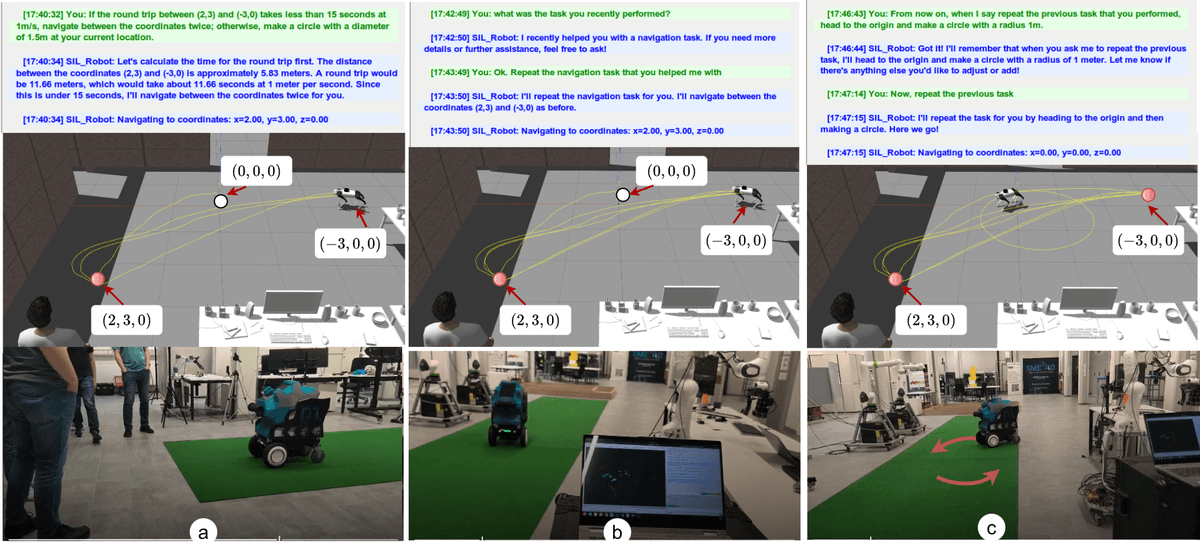
Continually fine-tuning a neural encoder on new interactions carries an obvious risk: catastrophic forgetting, where newly learned tasks can wipe out earlier ones. SIL borrows Elastic Weight Consolidation to handle this. It estimates a Fisher information matrix over recent gradients to figure out which encoder weights matter most for prior tasks, then penalizes changes to those specific parameters during future updates. In practice, when a user teaches the agent that "patrol now means navigate between the corridor and the kitchen," that alias survives even after a burst of unrelated distractor tasks.
Ensemble reasoning with an uncertainty gate
Command parsing runs through GPT-4o, though not in the usual single-shot fashion. For each user command, SIL samples K distinct interpretations from the LLM at varying temperatures and encodes each candidate into a dense vector. It then computes the average pairwise cosine distance across those interpretations. High dispersion means the model is genuinely unsure, and combined with rule-based linguistic features (hedging expressions, parameter specificity, contextual novelty), it produces an uncertainty score that decides whether to execute directly or ask a question.
Perception is handled by SAM for instance segmentation and CLIP for open-vocabulary classification, with 2D masks projected into 3D coordinates using camera intrinsics and depth data. Everything runs through the ROS stack for navigation and localization.
The numbers
The team ran 350 interaction episodes across five task categories on a Unitree Go1 quadruped and a custom Segway robot. SIL hits a 90.4% task completion rate with a belief alignment of ρ ≈ 0.83, versus 60.1% for a static GPT-4o baseline with no memory or adaptation.
The ablation study is where the design choices earn their keep:
- Ablating the co-adaptation mechanism causes the largest drop, sending task completion back down to 61.7%, essentially matching the static LLM baseline.
- Disabling EWC induces catastrophic forgetting, most visible on memory tasks where previously learned command aliases are lost after distractor tasks.
- Removing episodic memory drops TCR to 68.3% and belief alignment to 0.59.
- Removing the human preference model costs about 24 points of TCR and hurts personalization tasks hardest.
Full SIL converges rapidly toward a stable equilibrium around ρ ≈ 0.83, while ablations fluctuate between 0.52 and 0.65 and never achieve sustained alignment.
Where it fits
SIL is aimed squarely at long-horizon, multi-turn embodied tasks where instructions are underspecified and preferences matter: assistive robots in homes, warehouse or office robots that operate around the same people every day, and any setting where "go there and come back" needs to resolve to something sensible without a rigid grammar. The authors evaluate it on five domains covering direct instruction following, memory-based retrieval, deductive and hypothetical reasoning, proactive dialogue, and long-term preference learning.
The caveats are worth noting. The current system assumes a single user, and the authors plan to extend SIL to multi-user settings with conflicting or shifting preferences, alongside addressing computational efficiency for resource-constrained robots. The reasoning backbone is GPT-4o, so the loop depends on cloud LLM latency. While the framework generalizes over task types, the physical perception stack is still tied to SAM, CLIP, and classic ROS localization, which caps how novel the environments can get.
Code is available on GitHub, along with the encoder architecture, hyperparameters, and demo videos on the project page. The paper has been accepted for RO-MAN 2026.