
SHREC Solves Cryo-EM's Chicken-and-Egg Problem Without Knowing Symmetry
A new spectral embedding method reconstructs helical cryo-EM structures without needing pre-supplied symmetry parameters, avoiding the trial-and-error that derails many reconstructions.
 Pro
Takeaways
- SHREC recovers cryo-EM helical projection angles via spectral embedding, no rise or twist priors needed.
- Only requires the axial symmetry group Cn and approximate tube radius as inputs.
- Projections of helical segments provably lie on a 1D closed manifold diffeomorphic to a circle.
- Validated on EMPIAR-10022 (TMV, 3.66 A) and EMPIAR-10019 (VipA/VipB, 3.66 A).
- Recovered rise and twist match published values within 0.01 A and 0.1 degrees.
- Pipeline integrates with RELION; code not yet publicly released.
Reconstructing helical biological assemblies from cryo-electron microscopy (cryo-EM) data has always come with a chicken-and-egg problem: you need to know the helical symmetry parameters (the rise and twist that describe how subunits stack along the filament) before you can build a 3D structure, but you often can't determine those parameters accurately without a decent 3D structure to start from. A new algorithm called SHREC (Spectral Helical REConstruction) attacks this problem by recovering projection angles directly from 2D images using spectral embedding, requiring only the specimen's axial symmetry group as input.
Why helical reconstruction breaks the usual cryo-EM playbook
In cryo-EM, molecules are flash-frozen in random orientations, imaged by an electron beam, and the resulting noisy 2D projections are computationally aligned to reconstruct a 3D density map. For helical assemblies (viruses like Tobacco Mosaic Virus, bacterial secretion sheaths, amyloid fibrils, toxin filaments) the standard single-particle pipeline needs an extra ingredient: the helical symmetry parameters that describe how identical subunits repeat along the filament.
Traditional approaches require an accurate initial estimation of these parameters, which is often obtained through trial and error or prior knowledge. These requirements can lead to incorrect reconstructions, limiting the reliability of ab initio helical reconstruction. Historically, Fourier-Bessel methods indexed layer lines in the power spectrum to guess rise and twist, but that only works for long, ordered helices, and multiple symmetry combinations can fit the same power spectrum. The iterative helical real-space reconstruction (IHRSR) method built into RELION and cryoSPARC improved robustness but still needs a reasonable initial guess.

The manifold insight
The core observation behind SHREC is geometric. Because a helix is invariant under a coupled rotation-plus-translation along its screw axis, sliding a segmentation window along the filament is mathematically equivalent to rotating a reference segment around that axis. That means every 2D projection you extract from a filament corresponds to viewing the same reference segment from a different angle around a single axis, and the full set of such projections traces out a closed one-dimensional curve (topologically a circle) inside the high-dimensional space of images.
If you can recover that circle, you recover the projection angles. The authors do this using a graph Laplacian: build a similarity matrix from pairwise L2 distances between images, normalize it into a density-invariant Laplacian, and extract its top eigenvectors. The theory of spectral embedding says that for data lying on a 1D closed manifold, the first two non-trivial eigenvectors map the points onto a circle in the plane, and the angle around that circle is (up to a global shift and a reflection) the projection angle you want.
For a molecule with axial cyclic symmetry C_n, the manifold is traversed n times per full rotation, so the recovered embedding angle needs to be divided by n. That's the only piece of prior knowledge SHREC requires beyond the approximate outer radius.

How the pipeline actually runs
SHREC slots into RELION rather than replacing it. The end-to-end pipeline goes roughly:
- Standard RELION preprocessing: motion correction, CTF estimation, semi-automatic filament picking, extraction of overlapping segments.
- 2D classification with the helical option to prune noise and align filaments so their screw axis is horizontal.
- PCA-based Wiener denoising, where the noise power spectrum is estimated from high-order principal components (which capture uncorrelated noise) and the signal power from low-order ones.
- Dimensionality reduction (top-variance pixels, then ~256 PCA components) followed by construction of the density-invariant graph Laplacian using a k-nearest-neighbor Gaussian kernel.
- Compute the top two non-trivial eigenvectors, take
atan2of the coordinates, divide by n, and hand those angles to RELION as priors for a single-class 3D classification against a featureless cylinder. - Estimate rise and twist from the initial volume (via HI3D real-space indexing or measurement), then run standard 3D refinement with a local symmetry search.
What the numbers say
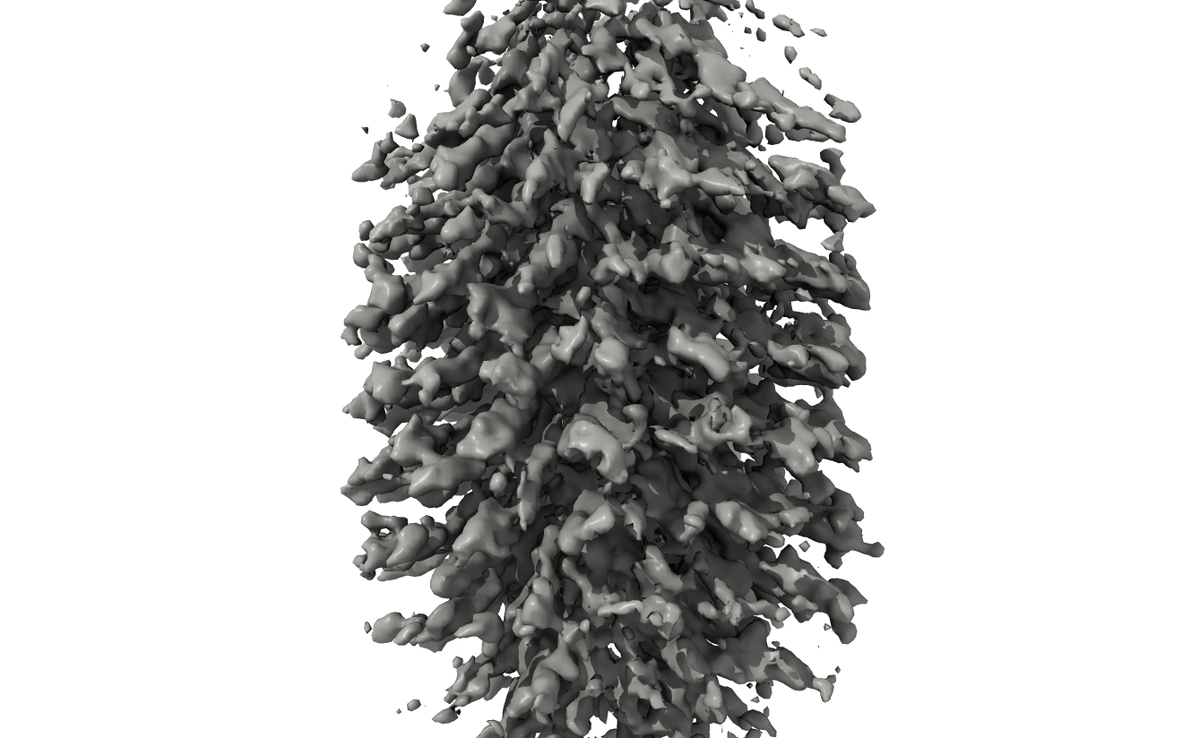
The authors validated on three EMPIAR datasets, feeding SHREC only the axial symmetry and rough tube radius. On Tobacco Mosaic Virus (EMPIAR-10022), refinement converged to a twist of -22.036 degrees and rise of 1.412 A, versus published values of 22.03 degrees and 1.408 A. The final map hit 3.66 A resolution by half-map FSC (0.143 cutoff), compared to the published 3.35 A EMD-2842 map.
On the VipA/VipB type VI secretion sheath (EMPIAR-10019, a C_6-symmetric assembly), the recovered parameters were 29.41 degrees twist and 21.78 A rise (published: 29.4 degrees, 21.78 A), producing a 3.66 A reconstruction. On the MakA toxin from Vibrio cholerae (EMPIAR-10869, a C_1 helix), SHREC recovered a twist of -48.594 degrees and rise of 5.829 A (published: 48.590 degrees, 5.841 A), though final resolution was a more modest 8.23 A, well short of the 3.65 A published map.
Where it shines and where it doesn't
The real breakthrough is not resolution (SHREC-reconstructed maps are slightly worse than the published ones) but robustness of the starting model. In the two challenging datasets (EMPIAR-10019 and EMPIAR-10022), the referenced work by He and Scheres had to be given the correct rise and twist to reconstruct at all. SHREC removes that constraint, which matters most for new specimens where the symmetry genuinely isn't known.
The limitations are worth calling out honestly:
- Spectral embedding assumes distances between images reflect true structural differences, which breaks down at very low SNR. The Wiener denoising helps but doesn't eliminate the issue.
- The method still leaves an inherent chirality ambiguity, so reconstructions can come out mirrored (as happened for the TMV and MakA maps).
- Discrete helices only approximately satisfy the continuous-helix assumption; the deviation is bounded by half the rise times the axial gradient of the structure, so specimens with very large rise or sharp features along the axis will drift further from the ideal 1D manifold.
- Downstream steps still rely on external tools (HI3D, ImageJ) or manual measurement to extract rise and twist from the initial volume, though the authors flag automating this as future work.
The paper does not appear to release a public code repository at this time, which will limit adoption until the authors or others reimplement the pipeline. For labs working on flexible or short filaments, novel assemblies where symmetry cannot be guessed from a power spectrum, or cases where existing IHRSR-based workflows keep converging to the wrong answer, this manifold-based approach offers a principled alternative worth watching.