
Shenzhen University's ZeroSense Exposes DeepSeek-OCR's 50-Point Accuracy Illusion
A new benchmark strips semantic priors from OCR evaluation, revealing that DeepSeek-OCR's real text preservation is far worse than reported.
 Pro
Takeaways
- ZeroSense benchmark isolates true visual-text compression quality from LLM semantic guessing, exposing inflated OCR scores.
- The paper proposes decomposing OCR performance into semantic priors, raw recognition, and true compression fidelity.
- DeepSeek-OCR at 17.5x compression on Fox drops from 81.3% reported accuracy to 27.4% real text preservation.
- Pipeline uses Qwen2.5-7B to insert tokens with posterior probability below 10^-6 while preserving document layout.
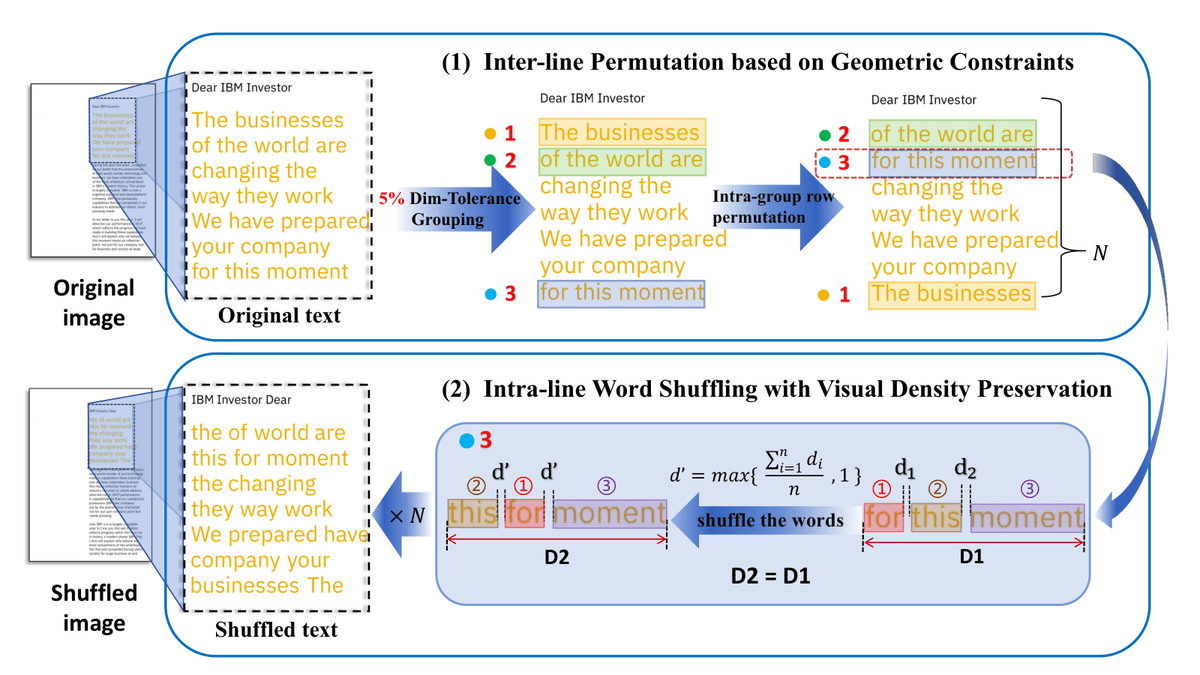
- Word-shuffling perturbations only cause an 18.6% precision drop, insufficient to eliminate residual linguistic priors.
- Code is open source for reproducing the benchmark and framework.
Visual-text compression sounds like magic: render a wall of text into a document image, feed a handful of vision tokens to an LLM, and reconstruct thousands of words. DeepSeek-OCR famously claimed roughly 97% accuracy at 10x compression and around 60% even at 20x. A new paper argues those numbers are inflated, and it introduces a benchmark that measures what compression actually preserves rather than what a smart language model can guess back.
The paper is called ZeroSense: How Vision matters in Long Context Compression, from a team at Shenzhen University of Advanced Technology. Code is public on GitHub.
The hidden cheat in every OCR benchmark
Visual-text compression (VTC) works by rendering long text into an image and encoding it with a vision tokenizer, so one visual token stands in for many text tokens. DeepSeek-OCR reduces the token count by 7 to 20x compared to traditional text tokens, and follow-ups like Glyph and VTC-R1 push similar ideas.
The problem is how these systems are graded. Benchmarks like Fox and OmniDocBench are built from real documents where sentences follow natural language. The paper describes OCR as the natural testbed because it establishes a compression-decompression mapping between visual and textual representations, but that same setup lets the decoder LLM silently paper over compression damage. If a blurry visual token yields something illegible, the language model just guesses the most probable word from context and the metric still counts it as a win.

Decoupling what the eyes see from what the model guesses
The authors formalize end-to-end OCR performance as a sum of two contributions: F_prior, the probability the model can infer a token from surrounding context, plus OCR_raw times K_quality, the model's raw character-recognition ability multiplied by how much text the compression strategy actually preserved. Standard benchmarks conflate all three. The goal is to isolate K_quality, the term that actually reflects compression fidelity.
To do that, they need documents that look real but carry no semantic signal a language model can lean on. That is the ZeroSense benchmark.
Building a semantic vacuum
The pipeline reverse-engineers layouts from existing OCR datasets and substitutes the words with tokens that a language model would essentially never predict. There are three stages:
- Layout extraction: A bottom-up algorithm using vertical projection and neighborhood aggregation recovers paragraph-level bounding boxes when only word-level annotations exist.
- Typography solving: A geometry-constrained inverse solver picks the largest font size where the rendered text fits the original bounding box, with a language-specific buffer coefficient for Latin vs logographic scripts.
- Semantic scrubbing: A causal LM (Qwen2.5-7B) is forced to sample only tokens whose posterior probability under the current context falls below a threshold. If the pool is empty, the threshold is dynamically relaxed.
The authors report that the inserted tokens have prediction probabilities between 10^-6 and 10^-7 under a standard language model, with none exceeding 10^-5. That is as close to a true semantic vacuum as anyone has published.

What DeepSeek-OCR actually preserves
Run DeepSeek-OCR through the decoupled framework and the story changes sharply. On the Fox dataset at 17.5x compression, the standard end-to-end evaluation reports roughly 81% accuracy, but the isolated K_quality drops to 27.4%. The gap of over 50 percentage points is the size of the semantic-priors crutch the model was leaning on.
Breaking down where predictions come from at 17.5x compression on Fox:
- Semantic priors (F_prior): 67% of the correct tokens are essentially guessed from surrounding context.
- Raw visual OCR (OCR_raw): declines from 76.1% at 7.5x to 46% at 17.5x compression.
- True compression fidelity (K_quality): collapses from 93.9% at 7.5x to 27.4% at 17.5x.
Omni tells a different story because its samples cluster at extreme text densities, meaning many pages are either trivially readable or completely unreadable regardless of language priors. The decoupled metric there actually beats the end-to-end number at low compression (97.1% vs 89.2% at 7.5x), because Omni's harder samples drag the raw OCR accuracy down.
The team also tested a simpler perturbation approach: shuffling word order in DDI-100 images while preserving layout. Even at 17.5x compression the precision drop from shuffling was only 18.6%, confirming that shuffling leaves too much local linguistic structure intact to serve as a proper semantic-free test.
Why this matters for long-context work
Optical compression is one of the more promising routes for extending context windows without paying quadratic attention costs, and systems like Glyph are being built on the assumption that VTC preserves most of the source text. If a compression strategy is really discarding 70% of the underlying characters at 17.5x, applications that need faithful retrieval, exact quoting, or auditability cannot rely on it, no matter how good the downstream QA scores look. Applications where the downstream task is genuinely semantic-heavy (summarization, RAG-style QA on natural prose) may still benefit, because the LLM's priors are doing real work rather than hiding a bug.
The takeaway is that any future VTC paper that wants to claim a compression ratio should probably report both the end-to-end score and the ZeroSense-style K_quality. One measures how good the whole stack is at guessing text. The other measures how good the compression actually is.