
Shenzhen Researchers Use Diffusion AI to Simulate Brain Surgery Signals
A new framework upgrades cheap scalp EEG toward the fidelity of implanted electrodes by combining MRI-derived cortical geometry, a pretrained EEG foundation model, and a diffusion generator.
 Pro
Takeaways
- New framework upgrades scalp EEG to approximate intracranial EEG fidelity using MRI-derived cortical geometry and a pretrained model.
- Combines LaBraM features, neural mass and field equations, and Laplace-Beltrami cortical modes as diffusion conditioning.
- Synthesized iEEG hits 0.51 PSD similarity and 0.52 phase consistency against real intracranial recordings.
- Average 5.2% F1 gain across 12 BCI datasets, up to 8.6% on DEAP emotion classification.
- Ablations show pretrained encoder matters most; geometric constraint drives spectral fidelity; N=20 modes optimal.
- No public code yet, but pipeline uses standard tools; paper on arXiv.
Brain computer interfaces sit on an awkward tradeoff. Scalp EEG is cheap, portable and safe, but the skull smears and attenuates the signal. Intracranial EEG (iEEG) records directly from cortex with excellent fidelity, but it requires surgery, which rules it out for almost everyone. A team from the Shenzhen Institutes of Advanced Technology proposes a way to narrow that gap without touching the hardware: a generative model that takes ordinary scalp EEG and synthesizes signals that behave much more like intracranial recordings.
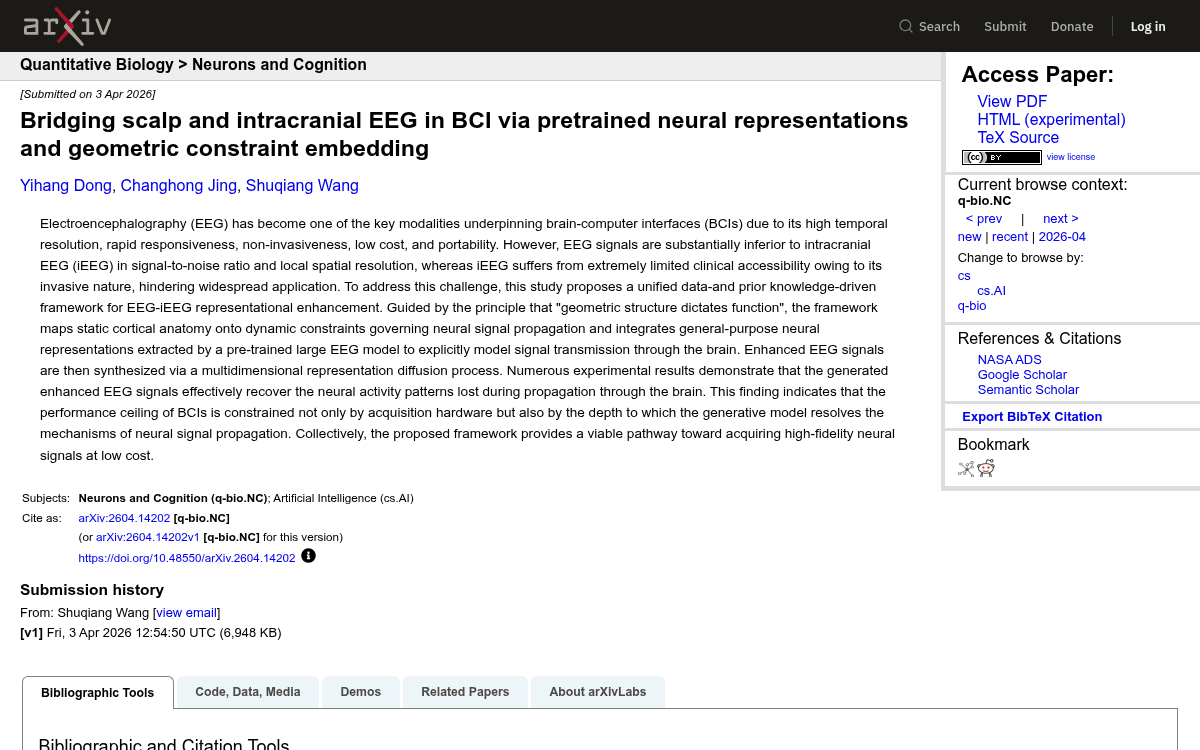
The paper frames this as a signal reconstruction problem rather than a source localization problem. The authors propose a unified data and prior knowledge driven framework for EEG-iEEG representational enhancement, guided by the principle that geometric structure dictates function, that maps static cortical anatomy onto dynamic constraints governing neural signal propagation and integrates general-purpose representations from a pretrained large EEG model, then synthesizes enhanced EEG via a multidimensional representation diffusion process. In plain terms: the shape of your cortex constrains how electrical activity spreads, so bake that geometry into a generative model and let it fill in what the skull washed out.
Why scalp EEG hits a ceiling
The physical problem is volume conduction. Currents from cortical neurons pass through cerebrospinal fluid, skull and scalp before reaching an electrode, and bone in particular acts as a strong spatial low-pass filter, killing high-frequency structure and blurring local activity. Prior attempts to bridge this gap have either used end-to-end deep nets that directly regress EEG onto iEEG, or reconstructed virtual iEEG from magnetoencephalography using linear beamformers. Both approaches leave money on the table: the first ignores physics, and the second requires a magnetically shielded room and hardware most labs will never own.
Three signals, one diffusion model
The pipeline fuses three complementary streams before generation. A Pretrained EEG Representation Encoder