
Shenyang's MMGT Turns a Photo and Audio Into Realistic Gesture Videos
A new two-stage diffusion framework generates upper-body speech videos from just audio and one image, no hand-pose priors required.
 Pro
Takeaways
- MMGT generates co-speech gesture videos from only audio and one image, no hand-pose priors.
- Two stages: SMGA predicts pose plus motion masks, then diffusion synthesizes video.
- MM-HAA replaces Hallo's static mask with dynamic per-region motion masks for face, lips, hands.
- Beats EDGE+Hallo and DiffGest+MimicMotion on FGD, FVD, and SyncNet lip-sync metrics on PATS.
- Generalizes to unseen TED speakers and to French and Afrikaans audio without paired video.
- Code, training scripts, and weights released on GitHub; accepted at IEEE TCSVT 2026.
Generating a video of someone talking with realistic hand gestures from just an audio clip and a single photo sounds simple, but it has been one of the more stubborn problems in audio-driven video synthesis. The face is tightly locked to the audio, but hands wander, gesture rhythms differ per speaker, and full upper-body motion has a much larger range than head-only talking videos. A new paper from the Shenyang Institute of Automation, MMGT, takes a run at this with a two-stage design that predicts its own motion masks instead of relying on external hand-pose or body-movement inputs.
The trap of extra priors
Most recent gesture-video systems fall into one of two camps. Audio-only diffusion models like MM-Diffusion can drive the whole frame from sound but tend to produce significant deformations and distortions in critical regions such as the face and gestures. The stronger competitors, EchoMimicV2 and CyberHost, hit better quality but only because they lean on extra conditioning that is inconvenient to obtain at inference time. EchoMimicV2 and CyberHost require additional inputs such as hand pose sequences or body movement modules, and CyberHost's input body movements maps are built from ground videos, which can only capture large-scale body movements.
That is the practical wall MMGT is trying to break through: keep the quality, drop the priors. The team wants a system that needs only audio plus one reference image at inference, but still stays sharp around the lips, face, and hands.

Motion masks predicted from audio
The core idea is to synthesize the missing priors instead of asking the user for them. MMGT runs in two stages, described in the paper:
- SMGA (Spatial Mask-Guided Audio2Pose Generation) takes the audio and an initial pose extracted from the reference image and produces both a full pose video and per-region motion masks for face, lips, and hands.
- Diffusion video generator with MM-HAA (Motion Masked Hierarchical Audio Attention) uses those pose videos, motion masks, and the raw audio to synthesize the final upper-body video.
SMGA is built on a DiT backbone and splits the pose into face and body branches. Each branch runs its own self-attention over the pose sequence and cross-attention against wav2vec/WavLM audio features, then a FiLM block (feature-wise linear modulation, which applies learned per-channel scale and shift) injects audio and timestep conditioning before a merge module fuses the two streams. Loss terms cover reconstruction, velocity, and acceleration so that motion is temporally smooth rather than jittery.
The motion masks themselves are generated by a simple algorithm: for each frame, the predicted keypoints for face, hands, and limbs are turned into bounding boxes drawn as binary masks. It is superior to SAM2.1 in terms of stability of mask generation and is better suited to our framework because overlapping keypoints naturally produce overlapping boxes rather than gaps.

What MM-HAA actually changes
In Stage II, MMGT starts from an Animate-Anyone-style Denoising UNet with ReferenceNet, and swaps in a new attention module inspired by Hallo. The twist is that Hallo's Hierarchical Audio Attention is innovatively replaced with a dynamic motion mask derived from the pose sequence instead of a static global mask. Three masks are used in parallel, one for face-plus-hands, one for lips, and one for the background, each with its own convolutional adapter. The audio cross-attention output is multiplied by each mask, so audio features are pushed toward the regions that are actually moving in that frame.
Numbers on PATS
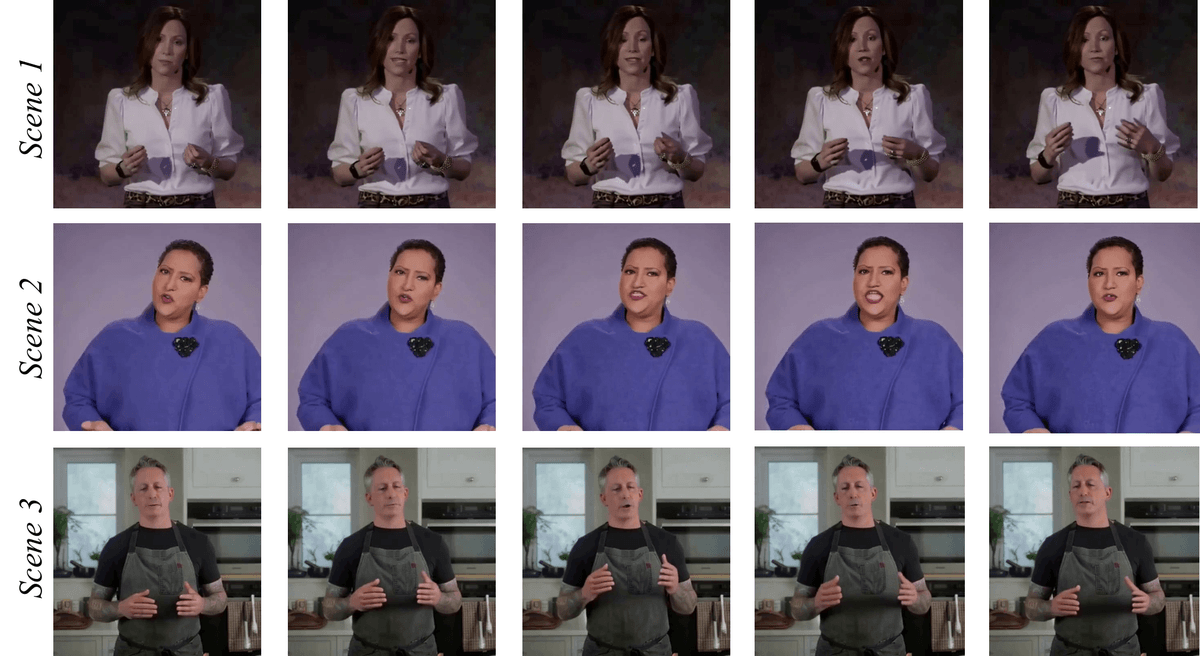
The team trains on four speakers (Jon, Kubinec, Oliver, Seth) from the PATS dataset, producing about 58k training clips and 2k test clips at 512x512. Against three two-stage baselines (EDGE + Animate-Anyone, EDGE + Hallo, DiffGest + MimicMotion) and MM-Diffusion, MMGT posts the best Frechet Gesture Distance (6.02), the lowest video FVD (230.89), the best SyncNet lip-sync scores (Syn-C 10.16, Syn-D 4.51), and top facial FID of 3.43. It also generalizes to unseen speakers on TED-72h and to French and Afrikaans audio without paired training video.
Ablations back up the design choices. Removing the two-branch face/body structure roughly doubles facial FVD, and swapping the dynamic motion mask for a still mask pushes facial FVD from 99 to 267, confirming that the region masking is what stabilizes textures around the mouth and hands.
Where it still breaks
MMGT is not solving the whole gesture-video problem. The authors flag that it still has shortcomings when handling fine physical interactions such as hand-to-face contact or hand-to-object manipulation, and they attribute it to sparse training data for contact events plus a lack of explicit contact constraints in the architecture. Inference is also capped at 3.2-second clips in the current release, with long-video support promised later.
Getting your hands on it
The paper has been accepted to IEEE TCSVT 2026, and the authors have released code, training scripts, and pretrained weights. The GitHub repo ships two inference scripts, one for end-to-end audio-to-video and one for pose-driven generation if you already have pose and mask videos from another source. Pretrained checkpoints are on Hugging Face, and the training pipeline is split into an audio-to-pose stage and two diffusion training stages. The setup calls for Python 3.10 and CUDA 12.4, and training was run on eight NVIDIA A6000 GPUs with inference on a single A6000.