
Shanghai Normal University Beats Complex Models With Simple Audio-Visual Emotion Recognition
A Shanghai Normal University paper details a DINOv2 plus Wav2Vec 2.0 pipeline for frame-level facial expression recognition on Aff-Wild2, with temporal smoothing on top.
 Pro
Takeaways
- Shanghai Normal University paper details a two-stage audio-visual model for the 10th ABAW EXPR challenge on Aff-Wild2.
- Stage I adapts DINOv2 ViT-L/14 on AffectNet and RAF-DB with PadAug and a training-only MoE classifier head.
- Stage II fuses multi-scale DINOv2 features with Wav2Vec 2.0 audio via a lightweight gated fusion module (2.37M params).
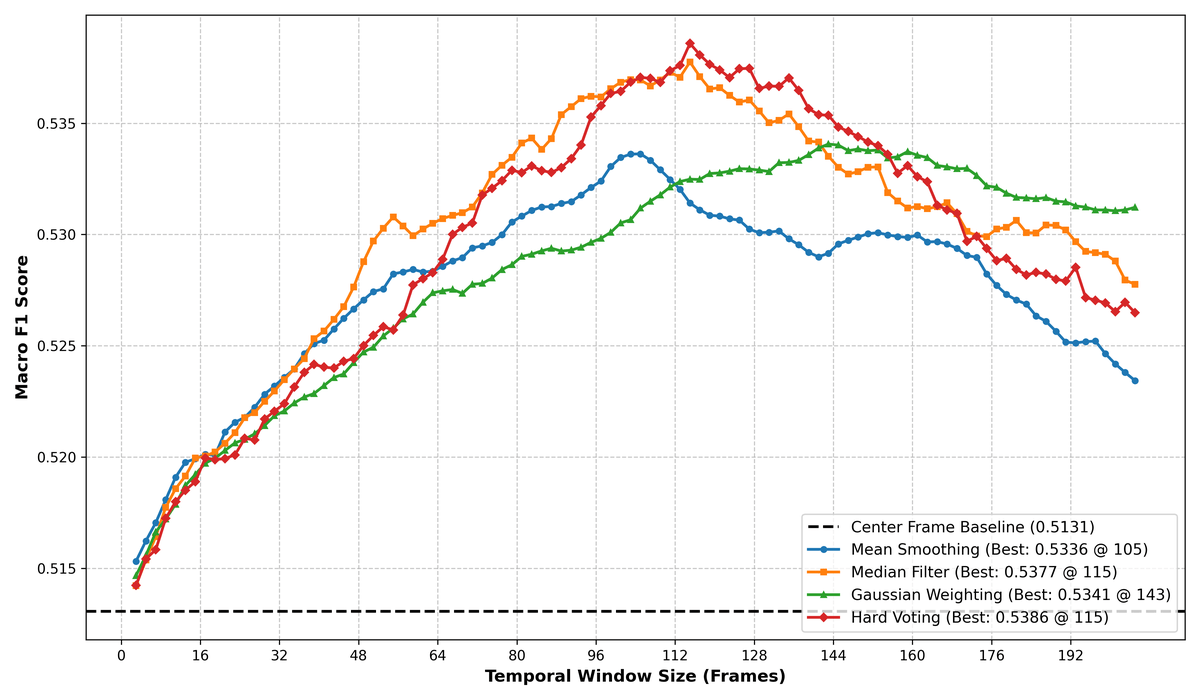
- Inference-time median smoothing over 101-frame windows stabilizes predictions and adds roughly 2 F1 points.
- Reported scores: 0.5368 Macro-F1 on validation, 0.5122 under 5-fold CV, 0.391 on the official test server.
- Full method description in the arXiv preprint; no public code or weights released.
A new arXiv preprint from Shanghai Normal University walks through a two-stage audio-visual system built for the expression recognition (EXPR) track of the 10th ABAW workshop and competition. The paper, A Two-Stage Dual-Modality Model for Facial Emotional Expression Recognition by Jiajun Sun and Zhe Gao, is less about a single flashy idea and more about how carefully stacking pretrained encoders, augmentation tricks, and post-hoc temporal filtering pushes frame-level emotion recognition on messy, in-the-wild video.
The task no one has cleanly solved
The EXPR challenge asks a model to label every frame of an unconstrained video as one of eight expressions: neutral, anger, disgust, fear, happiness, sadness, surprise, or other. This task is challenging due to inaccurate face localization, large pose and scale variations, motion blur, temporal instability, and other confounding factors across adjacent frames. The benchmark is Aff-Wild2, and per the challenge rules, teams can use any pretrained model that has not been trained on Aff-Wild2 itself, plus other public expression datasets.
The wider ABAW event, colocated with CVPR, covers six tracks this year, spanning valence-arousal estimation, expression recognition, action unit detection, fine-grained violence detection, emotional mimicry intensity estimation, and ambivalence/hesitancy recognition. The EXPR track is the discrete-emotion classifier that sits alongside all of that.
Stage I: adapting DINOv2 to faces
The visual backbone is DINOv2 ViT-L/14, initialized from the official self-supervised checkpoint. The authors freeze the patch embedding and the first eight transformer blocks and fine-tune the rest on two image-only expression corpora, AffectNet and RAF-DB. Two components ride along only during training:
- PadAug: an augmentation that pastes black padding bars along image boundaries to mimic the artifacts that appear when a face crop overflows a video frame. It fires with probability 0.6, and total padded area is capped at 20% of the image.
- Training-only Mixture-of-Experts head: a router feeds the CLS token to four residual-MLP experts built from SwiGLU blocks. The expert outputs are combined by soft routing weights, and after Stage I the whole MoE head is discarded, so inference cost stays flat.

Stage II: adding audio and smoothing time
For each labeled frame, the pipeline re-crops the detected face at three scales (0.9, 1.2, 1.5) using InsightFace's buffalo_l detector, runs each crop through the adapted DINOv2, and averages the three 1024-d features. In parallel, a Wav2Vec 2.0 large-lv60k encoder processes a 0.5 second audio window centered on that frame, and the acoustic features are mean-pooled to align with the video frame rate.
The two modality vectors are then combined with a lightweight gated fusion head: both are projected into a 512-d space, a sigmoid gate is predicted from their concatenation, and the fused vector is an element-wise interpolation. In effect, each of the 512 dimensions can pull more from the visual or the audio branch depending on which is more reliable for that frame. The head only adds about 2.37M parameters on top of encoders that together weigh in near 620M.
The final trick is inference-time temporal smoothing. Per-frame logits are passed through a class-wise median filter with a 101-frame window before argmax. The authors sweep window sizes and smoothing methods (mean, median, Gaussian, hard voting) and land on median filtering as the best-behaving option.
What the numbers say
On Aff-Wild2's official validation set, the visual-only branch reaches a Macro-F1 of 0.4344. Turning on the gated audio-visual fusion moves it to 0.5131, and median temporal smoothing pushes it further to 0.5368, with 0.5122 plus or minus 0.0277 under 5-fold cross-validation. On the official challenge server the system scores 0.391 Macro-F1. Ablations show cross-modal attention was competitive but roughly 2.7x heavier in parameters than gated fusion, which is why the authors kept the lighter option.
Why it's interesting, and where it stops
The bigger takeaway is not any single module but the recipe: strong self-supervised visual features, cheap gated fusion with a speech model, and post-hoc median smoothing beats more elaborate temporal transformers on this benchmark. That is useful if you are building a real emotion-recognition pipeline where inference budget matters, since the fusion head is tiny and the smoothing step is just a median filter over logits.
Caveats worth noting before you copy the design:
- Aff-Wild2 is long-tail and noisy, and the paper leans on class-weighted cross-entropy plus mixup rather than any deeper fix for imbalance.
- The audio branch is worth only 0.29 F1 on its own, so the model is essentially a strong vision model with acoustic backup for ambiguous frames.
- Temporal smoothing over 101 frames assumes expressions do not flicker fast, which is fine for most Aff-Wild2 clips but could hurt on datasets with rapid emotional transitions.
- No code or weights are linked in the paper, so anyone wanting to reproduce it will need to rebuild the Stage I adaptation pipeline from the appendix hyperparameters.
For teams working on affective computing or any downstream video task where per-frame labels need to be temporally coherent, the more transferable ideas here are PadAug, the training-only MoE head that gets thrown away at inference, and treating median filtering as a first-class design decision rather than an afterthought.