
Shanghai Jiao Tong's SoulX-Duplug Turns Any Voice AI Into a Real-Time Listener
Researchers from Shanghai Jiao Tong University's X-LANCE Lab propose a plug-in module that gives half-duplex voice models real-time interruption handling with 240ms latency.
 Pro
Takeaways
- Shanghai Jiao Tong University's X-LANCE Lab proposes SoulX-Duplug, a plug-in module adding full-duplex to any half-duplex voice model.
- Unifies VAD, streaming ASR, and turn detection into one streaming architecture using five discrete dialogue state tokens.
- Built on GLM-4-Voice tokenizer plus Qwen3-0.6B backbone with LoRA fine-tuning and three-stage training.
- Measured latency of 250ms in deployment, versus 343ms for FlexDuo and 500ms for VAD baselines.
- Cascaded system beats Moshi, Freeze-Omni, and Gemini Live on overall bilingual turn-management scores.
- Code, model, and bilingual SoulX-Duplug-Eval benchmark released under Apache 2.0.
Voice assistants that can listen and speak at the same time, the way humans do in real conversations, remain surprisingly hard to build. A team from Shanghai Jiao Tong University's X-LANCE Lab, working with collaborators at Soul AI Lab, Shanghai Innovation Institute, and Northwestern Polytechnical University, has released a paper proposing SoulX-Duplug, a small streaming module that bolts onto any half-duplex speech model and turns it into a full-duplex one. The code and evaluation set are released under Apache 2.0.
Rather than retraining a giant end-to-end voice model on scarce full-duplex data, the approach keeps your existing half-duplex stack and hands turn-taking off to a lightweight controller that decides, chunk by chunk, whether the user is still talking, pausing, backchanneling, or done.
Why full-duplex is still a mess
Existing pipelines typically decompose the problem into cascaded VAD, ASR, and turn detection modules run sequentially, while SoulX-Duplug models them within a single streaming architecture and incorporates semantic supervision through a streaming ASR objective during training. The paper argues this cascade has two structural weaknesses.
- Traditional voice activity detection listens only to acoustic energy, so it cannot tell whether a pause means the user is thinking or actually finished speaking.
- Non-streaming ASR and turn-detection stages introduce latency that grows with utterance length, which kills responsiveness on longer turns.
End-to-end full-duplex models like Moshi or Freeze-Omni take a different route but entangle turn-taking policy with language modeling. That coupling makes them hard to control, expensive to scale, and dependent on precisely-aligned dual-channel training data that barely exists in public form.

The five-state trick
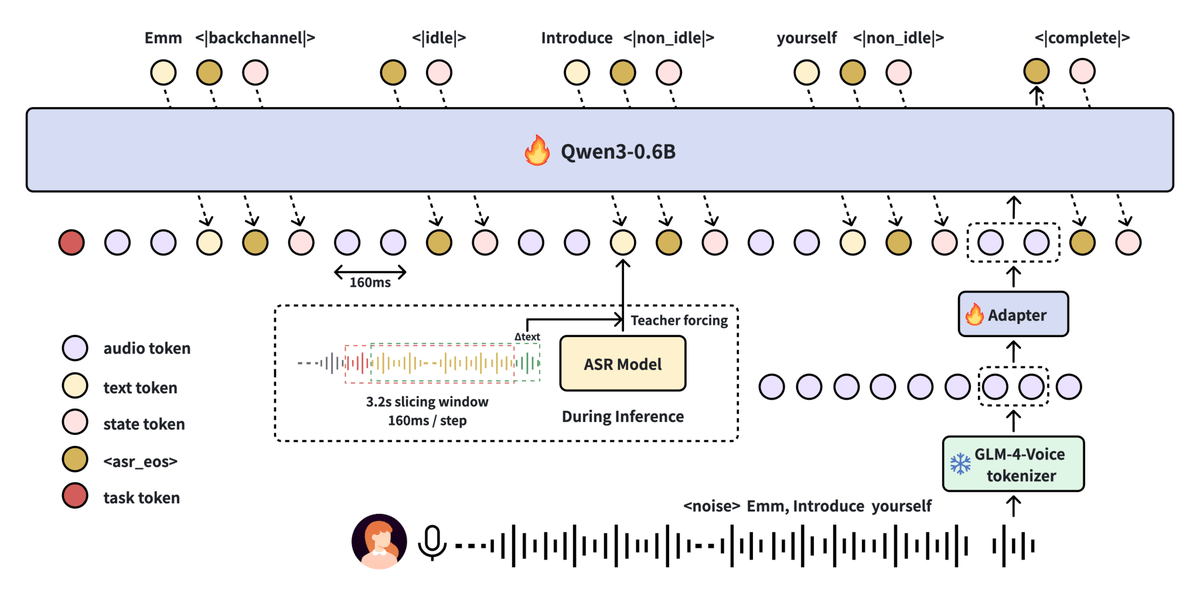
SoulX-Duplug reframes duplex control as a streaming classification problem over five discrete state tokens emitted every 160 milliseconds:
<|user_idle|>- silence or noise in this chunk.<|user_nonidle|>- meaningful speech is happening.<|user_backchannel|>- short acknowledgments like "uh-huh" that should not trigger a full response.<|user_complete|>- utterance is semantically finished, assistant may take the turn.<|user_incomplete|>- user paused mid-thought, assistant should wait.
The clever part is the interleaved sequence layout. For each 160ms chunk the model sees two audio tokens, then predicts the streaming ASR text for that chunk, then predicts the state token. Because the state prediction is conditioned on the freshly-transcribed text, the module effectively becomes a semantic VAD rather than an acoustic one, able to distinguish "I need to think about" (incomplete) from "I need coffee" (complete) even when both end in silence.
How it is put together
The backbone is deliberately small. The team pairs the GLM-4-Voice tokenizer as a frozen speech encoder with Qwen3-0.6B as the LLM, applying LoRA fine-tuning during the state-prediction stage rather than full retraining. Training runs in three stages: non-streaming ASR pretraining on roughly 47,000 hours of Mandarin and 31,000 hours of English, streaming ASR adaptation with chunk-based reorganization of the data, and finally state-prediction fine-tuning on the Fisher corpus plus an in-house Mandarin dataset built in the same format.

At inference time there is a nice pragmatic hack. Instead of trusting the small LLM's own streaming ASR output, the system uses a lightweight external ASR model, Sense Voice Small for English or Paraformer for Chinese, to provide teacher-forced text guidance. The ablation shows this matters: removing external ASR guidance at inference drops average accuracy from 84.33% to 73.50% on the Chinese Easy Turn testset.
Latency where it counts
With 160ms chunks and a single look-ahead step, the theoretical average latency works out to 240ms. Measured on a real deployment pipeline the module lands at roughly 250ms, versus 343ms reported for FlexDuo and 500ms for the VAD baseline used in that paper's comparison.
| Module | Streaming | ASR | Latency |
|---|---|---|---|
| SoulX-Duplug | Yes | Yes | ~250 ms |
| FlexDuo (7B) | Yes | No | 343 ms |
| Phoenix-VAD | Yes | No | - |
| Acoustic VAD (baseline) | Yes | No | 500 ms |
On the paper's Bilingual Full-Duplex-Bench, a cascaded system built with SoulX-Duplug as the controller, Qwen2.5-7B-Instruct as the language brain, and IndexTTS-1.5 for speech synthesis gets the top overall turn-management score in both languages. It hits a 0.933 turn-taking rate in English while keeping the pause-handling takeover rate at 0.352, meaning it interrupts users far less often than Moshi (0.983) or dGSLM (0.935) while still responding promptly when the user is actually done.
What is and isn't practical here
The design's real appeal is deployment flexibility. Because turn-taking is decoupled from response generation, you can swap the underlying half-duplex model, whether that is a 7B chat model today or something larger tomorrow, without retraining the duplex controller. All the scaling work happens on standard half-duplex data, which is orders of magnitude more available than aligned dual-stream conversations.
The limitations are honest and worth noting:
- Streaming ASR at 160ms chunks is unstable, especially in English where words routinely straddle chunk boundaries. The authors note transient recognition errors are unavoidable under strict low-latency constraints.
- SoulX-Duplug's own ASR is about 3% behind a 7B non-streaming turn-detection pipeline on accuracy, though it compensates by avoiding the several-hundred-millisecond VAD segmentation delay that non-streaming systems incur in practice.
- Reliable operation depends on the external teacher-forcing ASR, so the system inherits whatever weaknesses Sense Voice Small or Paraformer bring on unusual accents or noisy audio.
Alongside the model, the team released SoulX-Duplug-Eval, a bilingual benchmark that extends the Easy Turn testset with English samples and adds a Chinese counterpart to Full-Duplex-Bench covering turn-taking, pause handling, user backchannel, and interruption scenarios. Given how many recent full-duplex papers evaluate on self-constructed data, a shared bilingual test set may end up being the most durable contribution here.