
Shanghai Jiao Tong's PRIMO R1 Beats 72B Models at Tracking Robot Task Progress
PRIMO R1 turns a 7B video model into an active critic that scores robotic task progress, beating GPT-4o and OpenAI o1 on failure detection.
 Pro
Takeaways
- PRIMO R1 is a 7B video MLLM framework that estimates robotic task progress via explicit Chain-of-Thought reasoning trained with GRPO.
- Achieves 82.90 average MRA and 15.52 MAE across four environments, beating Qwen2.5-VL-72B by 9.10 MRA points.
- Hits 67.0 percent on the RoboFail zero-shot failure detection benchmark, surpassing GPT-4o (63.0) and OpenAI o1 (61.0).
- Anchors video input between explicit initial and current state images, halving MAE on long-horizon BEHAVIOR tasks.
- SFT alone regresses on out-of-domain tasks; GRPO after SFT recovers generalization and boosts cross-environment accuracy to 72.32.
- Runs at 0.62s average latency with 359-token chains, more efficient than Cosmos-Reasoning 7B while more accurate. Paper here.
Watching a robot fold a shirt and knowing whether it is 30 percent or 90 percent done sounds trivial for a human, but it has been surprisingly hard for vision-language models. A new framework called PRIMO R1 tackles this by reframing progress estimation as an explicit reasoning problem, and the numbers suggest the approach scales down parameters while scaling up accuracy.
The paper, from researchers at Shanghai Jiao Tong University and collaborators, argues that current video multimodal LLMs behave like passive narrators. They excel at describing what is happening but struggle with the rigorous quantitative reasoning required to judge how well the task is proceeding, and most prior approaches treat progress estimation as a standard regression or classification problem via supervised finetuning. The result is a brittle system that often assigns high progress scores to failed attempts simply because the motion looks correct.
Why progress estimation is the real bottleneck
Long-horizon robot manipulation needs reward signals dense enough to guide learning. Sparse binary rewards (did it succeed, yes or no) are easy to write but inefficient. Dense rewards traditionally require hand-engineering or privileged access to simulator state, neither of which survives contact with the real world. A general-purpose video model that could output a reliable progress percentage from raw pixels would unlock scalable reward modeling for imitation and reinforcement learning.
The catch is that existing specialized progress models like VLAC, Robo-Dopamine, and ProgressLM often depend on reference demonstrations, and general MLLMs hallucinate near completion. Baseline models exhibit pronounced error spikes during the final execution stage (80 to 100 percent). This is exactly the region where a downstream policy needs the most trustworthy signal.

From observer to critic
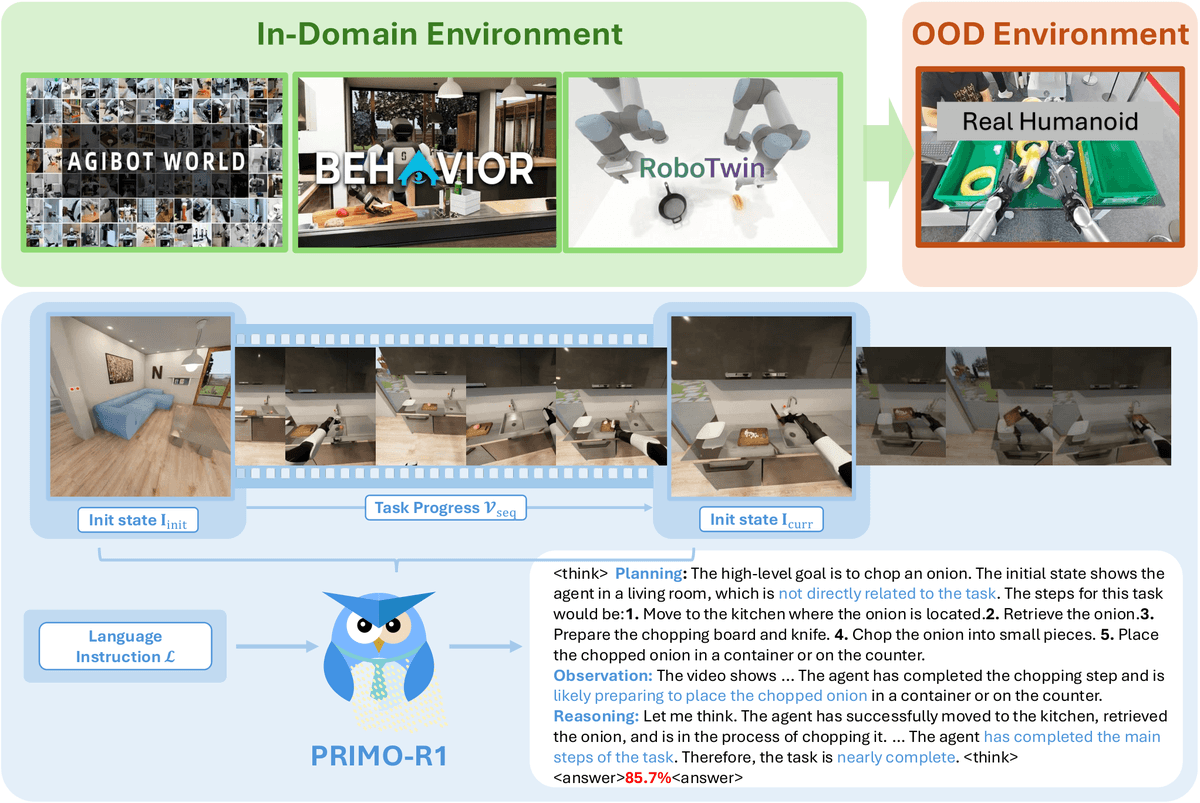
PRIMO R1 (Process Reasoning Induced MOnitoring) is a 7B framework built on Qwen2.5-VL-7B-Instruct. Two design decisions do the heavy lifting:
- Structured temporal input. Rather than feeding the model a raw video clip, the input is explicitly anchored between an initial state image
I_init, the video sequenceV_seq, and a current state imageI_curr. This gives the model concrete visual boundary conditions to compare against. - Outcome-based reinforcement learning. Instead of supervising the reasoning trace token by token, the model is trained with Group Relative Policy Optimization (GRPO) to produce Chain-of-Thought whose final numeric answer maximizes a reward. The reasoning is a latent variable the model must self-organize.
GRPO leverages the group statistics of sampled outputs to estimate the baseline instead of training a separate value network, which is particularly advantageous for Video MLLMs where the memory overhead of maintaining a value network alongside the policy model is prohibitive. For each input, the policy samples a group of G outputs, and each output's reward is normalized against the group mean and standard deviation to compute its advantage.
The reward that makes reasoning emerge
Progress is continuous, so a binary reward would be useless. The team uses a bounded linear decay:
r_acc = max(0, 1 - |y_hat - y_gt| / R_max)with R_max = 100. Exact prediction gives 1.0, and the reward decays linearly to 0 as error hits 100. A separate format reward enforces the required <think> and <answer> tags. Together they push the model to write out planning, observation, and reasoning steps because that is empirically the most reliable way to hit the numeric target.
The prompt template forces a three-part reasoning structure: a planning module that decomposes the goal into canonical steps, an observation module that describes visual state changes, and a reasoning module that aligns observations with the plan to compute a completion ratio.
The numbers
PRIMO R1 was evaluated on four environments: AgiBot (real teleoperation), BEHAVIOR-1k and RoboTwin (simulation), and a real humanoid platform (Kuavo) used only for out-of-domain evaluation. PRIMO R1 achieves the highest average Mean Relative Accuracy of 82.90 and the lowest average MAE of 15.52, consistently outperforming all evaluated open-source baselines. Despite using only a 7B backbone, it surpasses Qwen2.5-VL-72B by 9.10 MRA points.
Against specialized reasoning MLLMs, the error roughly halves. Against specialized reasoning and video MLLMs such as Video R1 7B and Robobrain 7B, PRIMO reduces the average MAE from approximately 27 to 29 down to 15.52, nearly halving the estimation error.
The more interesting result is transfer. On the RoboFail benchmark, which tests failure detection under complex physical constraints and was never seen during training:
- PRIMO R1: 67.0 percent
- Gemini 2.0 Flash: 67.0 percent
- Cosmos-Reason1-56B: 66.2 percent
- GPT-4o: 63.0 percent
- OpenAI o1: 61.0 percent
- Qwen2.5-VL-7B (base): 57.6 percent
The authors make a specific structural claim about this: optimizing a policy model for continuous progress reasoning explicitly constructs the temporal context representations necessary for failure verification. In other words, the ability to spot execution errors falls out of learning to track how far along a task is.
SFT memorizes, RL generalizes
An ablation on training stages is worth flagging. Supervised Fine-Tuning improves overall performance to 79.35 MRA but primarily overfits to the semantic features of the training distribution, consistent with the observation that SFT tends to memorize training formats rather than acquire transferable reasoning. On the tough real humanoid cross-environment split, SFT alone reaches only 67.30. RL alone from the base model fails to bootstrap a good output format. The full pipeline (SFT then GRPO) lifts cross-environment accuracy to 72.32.
The same pattern appears on RoboFail: applying SFT alone causes a regression to 51.0 percent, which the authors attribute to format overfitting rather than a data limitation, because next-token prediction weights all tokens equally. Adding GRPO recovers and then exceeds the base model.
What is and is not new
Several ideas here already exist individually. The R1-style outcome reward for reasoning traces comes from DeepSeek-R1. Boundary-state image anchoring appears in prior video planning work. Progress estimation as a task is an active area with VLAC, ProgressLM, and Robo-Dopamine as recent entries. What PRIMO R1 shows is that combining these pieces, plus a linear-decay accuracy reward that fits continuous targets, produces a specialist that beats much larger closed models on the exact axis that matters for robotics: robust progress judgment that transfers zero-shot to failure detection.
The efficiency picture is also favorable. PRIMO R1 has an average inference latency of 0.62 seconds and a reasoning chain of 359 tokens, remaining competitive with fast baselines like Video R1 7B while delivering an average MRA of 82.90. For comparison, Cosmos-Reasoning 7B averages 1109 tokens and 1.30 seconds per query for lower accuracy.
Where it falls short
PRIMO R1 does not top every column. On the real humanoid split, ProgressLM's dedicated real-world input configuration wins on MRA (84.24 versus 72.32) and MAE. The authors argue their unified protocol is the more honest comparison, but it does mean that if you have reference demonstrations and are willing to tune per-environment, specialized reference-based models can still edge ahead in that regime.
The framework also depends on having both an initial and current state image. If you only get the video sequence with no clean boundary frames, ablations show a jump from an MAE of roughly 22 to 34 on BEHAVIOR-length tasks. It is a critic, not a magician.
Availability
The project website is listed in the paper as 10-oasis-01.github.io/primo-r1-website. The PDF and supplementary appendices include full prompts, hyperparameters (SFT at learning rate 1e-6, GRPO with beta 0.04, 8 rollouts per prompt), and the PRIMO Dataset and Bench composition (116k SFT samples, 182k RL samples, drawn from AgiBot, BEHAVIOR-1k, and RoboTwin). Training was done on 8 A100 80GB GPUs with 16-frame inputs at 128 by 28 by 28 pixel resolution. At the time of writing the paper lists a project site but does not confirm a public model or code release.
For anyone building reward models or evaluators for manipulation policies, the takeaway is concrete: forcing a 7B video model to think in structured planning-observation-reasoning steps, trained against a graded numeric reward, is enough to close and in some cases invert the gap to 72B and closed-source frontier models on process supervision tasks. That is a useful piece of scaffolding for anyone trying to bootstrap dense rewards from raw video.