
Shanghai Jiao Tong's MU-Mis Erases AI Training Data 27x Faster Without Retraining
MU-Mis erases training data influence without needing the rest of the dataset, matching state-of-the-art methods that do
 Pro
Takeaways
- MU-Mis is the first remaining-data-free machine unlearning method to match state-of-the-art methods that require the full retained training set.
- The core insight: a trained model becomes measurably more sensitive to its training samples' inputs, and suppressing that sensitivity gap erases their contribution.
- The loss function requires only the forget set and the pre-trained model, no retained data, no OOD data, no training history.
- On Tiny ImageNet with ViT, MU-Mis is 27x faster than SalUn (3 min vs. 81 min) while matching it on accuracy and privacy metrics.
- Sequential unlearning experiments expose critical failure modes in existing methods (knowledge recovery, utility collapse); MU-Mis maintains the lowest KL divergence from the retrained model across all iterations.
- Code is open-source at github.com/poppopbean0903/MU-Mis; main limitation is the harder random-subset unlearning scenario where data-dependent methods still lead.
Every time a user invokes their GDPR "right to be forgotten," an AI company faces an uncomfortable reality: the only truly clean way to remove someone's data from a model is to retrain from scratch. That can cost millions of dollars and weeks of compute. Machine unlearning (MU) was supposed to be the shortcut, but most existing methods come with a hidden tax: they need access to the rest of the training data just to keep the model from falling apart after forgetting. Researchers from Shanghai Jiao Tong University now propose a method that breaks that dependency entirely.
Why forgetting is so hard
The Right to be Forgotten is a core principle of the EU's GDPR, allowing individuals to request that their personal data be deleted from deployed machine learning models. While forgetting can be naively achieved by retraining on the remaining dataset, it is computationally expensive, and several machine unlearning methods have been proposed as efficient alternatives.
Most existing MU methods circumvent the difficulty of estimating sample contribution through other heuristics. A common strategy is to introduce confusion, such as random relabeling or knowledge distillation from a useless teacher. The problem is that these confusion-based tricks break the model's knowledge of the data it was supposed to keep. To fix that collateral damage, they need to fine-tune on the retained training data, which may not be available due to privacy silos, contractual deletion, or sheer scale.
The deeper issue is conceptual: none of these methods actually answer the question of what a training sample contributed to the model in the first place. Without knowing what to remove, they end up removing too much, or not enough.
Sensitivity as a fingerprint of contribution
The key insight in this paper is elegant. When a sample participates in training, gradient descent nudges the model's parameters to fit it better. That nudge leaves a trace: a sample's contribution during training manifests in the learned model's increased sensitivity to it. In other words, if you slightly perturb a training image at inference time, a well-trained model's output will shift noticeably. For a sample the model never saw, the output barely moves.

The team formalizes this with a theoretical derivation through gradient descent dynamics. They show that the derivative of the training algorithm with respect to a training sample can be approximated by the model's input sensitivity, i.e., how much the output changes when the input changes. This is computable from the pre-trained model alone, no training history required.
But they go further. They find that the sensitivity signal is not uniform across the model's output logits (the raw scores for each class). After training, the gap between target and irrelevant class sensitivities enlarges, providing a clearer signal of the sample's contribution. A training sample amplifies sensitivity specifically for its own correct class, while leaving sensitivity to other classes relatively flat. That asymmetry is the fingerprint of contribution.

The MU-Mis algorithm
MU-Mis (Machine Unlearning by Minimizing Input Sensitivity) operationalizes this insight into a single loss function. For each sample to be forgotten, it minimizes the gap between the sensitivity of the target-class logit and a randomly sampled irrelevant-class logit:
# Conceptual MU-Mis loss for a single forget sample x
# f_c: target class logit, f_c_prime: random irrelevant class logit
# grad_x: gradient of logit w.r.t. input x
loss = ||grad_x(f_c(x, w))||_F^2 - ||grad_x(f_c_prime(x, w))||_F^2
# Minimize this over the forget set D_f
# No remaining data D_r needed at any point
Minimizing this loss does two things simultaneously: it rolls back the target-class sensitivity (undoing the sample's contribution) and restores sensitivity to irrelevant classes (which naturally recovers model utility on the remaining data). The algorithm runs in model.eval() mode with batch norm layers frozen, and uses a principled stopping criterion: optimization halts when the irrelevant-class sensitivity returns to near its pre-unlearning level, signaling that the withdrawal is complete.
A key reason this works without touching the remaining data comes down to gradient geometry. The input-sensitivity gradients of different training samples are nearly orthogonal to each other across classes. This means suppressing one sample's contribution does not accidentally suppress another's, which is exactly the failure mode of methods that use cross-entropy loss gradients directly.
Benchmarks: matching methods that cheat
The team evaluated MU-Mis across three unlearning scenarios:
- Full-class removal: forget all samples of one class (e.g., erase all "rocket" images from CIFAR-100)
- Sub-class removal: forget a sub-category within a superclass (e.g., erase "orchid" from the "flower" superclass)
- Random subset removal: forget an arbitrary 10% of training samples regardless of class
Datasets spanned CIFAR-10, CIFAR-100, CIFAR-20, Tiny ImageNet, PinsFaceRecognition, and SVHN. Models tested included ResNet-18 and ViT. Baselines included 8 remaining-data-dependent methods (Bad Teacher, SCRUB, SalUn, SSD, DUCK, FT, MUNBa, LoTus) and 4 remaining-data-free methods (Random Labeling, Negative Gradient, JiT, SCAR).
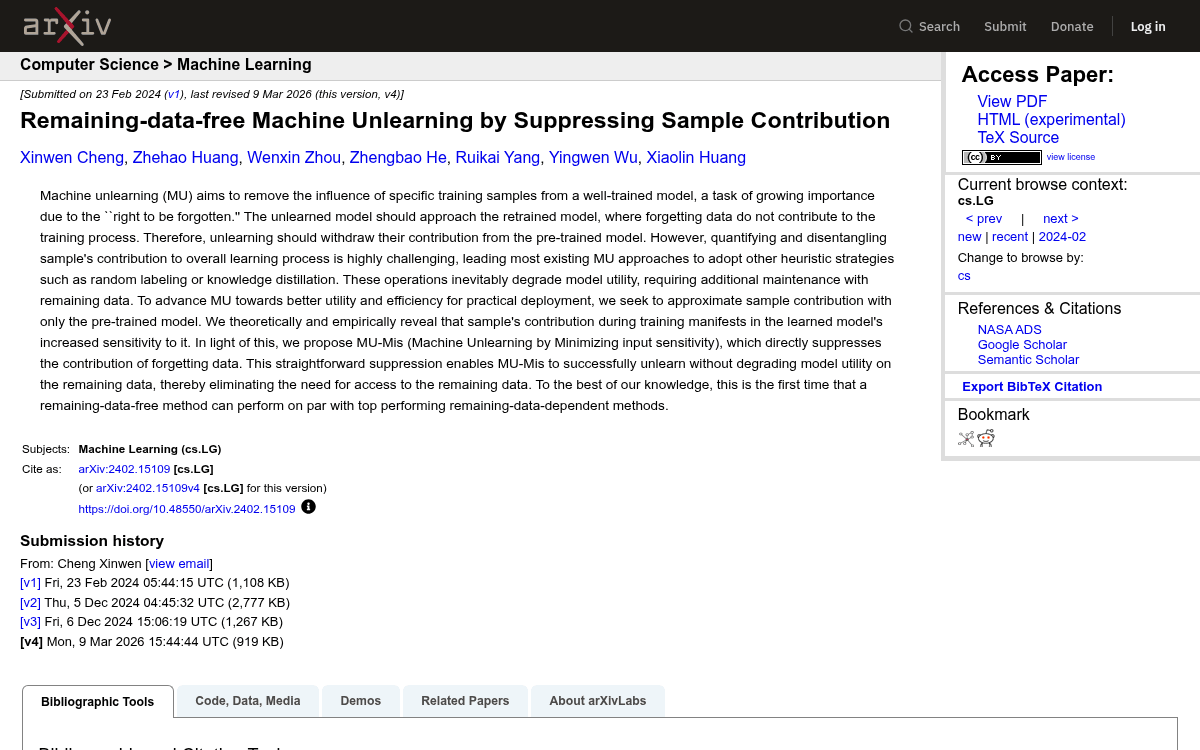
MU-Mis successfully unlearns without degrading model utility on the remaining data, thereby eliminating the need for access to the remaining data. To the best of the authors' knowledge, this is the first time that a remaining-data-free method can perform on par with top-performing remaining-data-dependent methods.
On full-class CIFAR-100, MU-Mis achieves an average accuracy gap of just 0.07 from the retrained model, beating every baseline including all remaining-data-dependent methods. On Tiny ImageNet with ViT, it completes unlearning in 3 minutes versus SalUn's 81 minutes, a 27x speedup, while matching it on model utility and privacy metrics.
Where it struggles
The random subset setting is the hardest case, and MU-Mis shows its limits there. When the forget set is a random 10% of training samples, the forgotten and retained data are highly entangled in feature space. MU-Mis outperforms all other remaining-data-free methods in this scenario, but falls short of the best remaining-data-dependent methods like RUM, which explicitly partitions the forget set by memorization level and applies tailored strategies per group.
The authors also note that highly memorized samples (rare, long-tail examples the model has overfit) are harder to unlearn cleanly. The sensitivity gap for these samples is actually smaller than for low-memorization samples, making the signal noisier. This is an acknowledged limitation and an open direction for future work.
Sequential unlearning: where existing methods break
One of the more revealing experiments is sequential unlearning, where five separate unlearning requests arrive one after another. This stress-tests whether a method's forgetting mechanism is principled or fragile. The paper identifies three failure modes in existing methods:
- Performance recovery: Bad Teacher and SalUn show the forgotten class accuracy creeping back up after subsequent requests, meaning the knowledge was never truly removed
- Knowledge residue: Fine-tuning via catastrophic forgetting fails on sub-class tasks because the forgotten and remaining data are too similar
- Utility breakdown: SSD's remaining accuracy collapses to 76.3% after five sequential requests, versus 84.6% for MU-Mis and 84.8% for the retrained model
MU-Mis maintains the lowest KL divergence from the retrained model throughout all sequential unlearning iterations, for both full-class and sub-class tasks. Because it targets the actual contribution of each sample rather than applying a heuristic perturbation, the forgetting operations do not interfere with each other.

What this unlocks in practice
The practical implications go beyond benchmark numbers. Most real-world deployments cannot easily produce a clean copy of the retained training data on demand. Data may be distributed across storage silos, subject to contractual deletion, or simply too large to reload for repeated maintenance cycles. Companies encounter great challenges in complying with RTBF regulations, particularly when asked to erase specific training data from their well-trained predictive models.
MU-Mis is particularly relevant for:
- Face recognition systems that need to remove specific individuals on request
- Content moderation models trained on data that later becomes legally problematic
- Medical AI where patient data deletion requests must be honored without retraining expensive models
- Any production system where the original training set is no longer accessible or is too large to iterate over
The code is available at github.com/poppopbean0903/MU-Mis. The method works with standard PyTorch and requires only the pre-trained model weights and the samples to be forgotten, making it straightforward to drop into an existing ML pipeline.
The real breakthrough here is not just the performance numbers. It is the shift in framing: instead of asking "how do we confuse the model about the forgotten data," MU-Mis asks "what did this data actually contribute, and how do we undo exactly that." That principled foundation is what makes the method stable under sequential requests and efficient enough to run in minutes rather than hours.