
Shanghai Jiao Tong's HistRISE Gives Robot Arms Long-Term Memory Without Extra Cameras
A new object-centric point tracking method gives robot policies memory of past observations, letting them count actions, remember locations, and handle long-horizon tasks.
 Pro
Takeaways
- New method gives robot manipulation policies memory by tracking points on task-relevant objects instead of stacking raw video frames.
- Pipeline uses SAM2 segmentation, point tracking, and a cross-attention track encoder to build compact per-object history tokens.
- Plugs into ACT, Diffusion Policy, and RISE without changing their architectures, producing HistACT, HistDP, and HistRISE.
- 3D point trackers beat 2D trackers thanks to depth handling and robustness to occlusion in manipulation scenes.
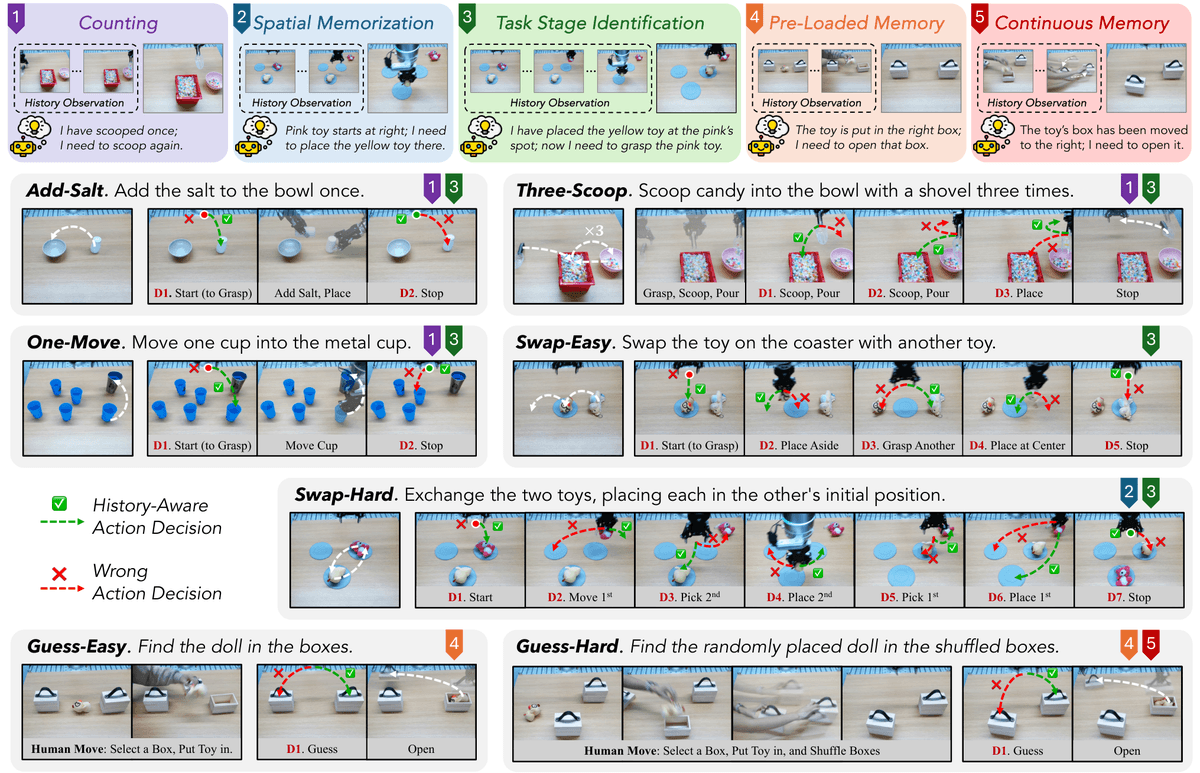
- Evaluated on seven real tasks covering counting, spatial memory, task stages, pre-loaded memory, and continuous memory.
- Accepted at ICRA 2026 with paper and project site including videos and code.
Most robot manipulation policies suffer from a strange kind of amnesia. They look at the current camera frame, decide what to do next, and forget everything that came before. That works fine for pick-and-place, but it breaks the moment a task requires memory, like scooping salt three times, remembering where a cup was before it got hidden, or knowing which stage of a recipe you are in.
A team from Shanghai Jiao Tong University, Noematrix, and Flexiv Robotics has a fix. Their paper, History-Aware Visuomotor Policy Learning via Point Tracking, accepted at ICRA 2026, compresses an entire task history into a small set of tracked points on task-relevant objects. Code is available under CC BY-NC-SA 4.0.
The Markov trap
Many manipulation tasks require memory beyond the current observation, yet most visuomotor policies rely on the Markov assumption and stumble on repeated states or long-horizon dependencies. The Markov assumption here means the policy treats each moment as independent, choosing actions from the current frame alone. Existing methods try to extend observation horizons but remain insufficient for diverse memory requirements.
The naive fix is to feed the policy a stack of recent frames. That works up to a point, but stacks of raw images are heavy, redundant, and still miss information from before the window started. If a task takes 60 seconds and you keep the last 2 seconds of frames, everything else is gone.
Points, not pixels
The core idea abstracts the past into something small and structured. Rather than storing raw video, the system tracks a handful of points on each task-relevant object and keeps their trajectories. Those trajectories are compact, retain only motion that matters, and can span the entire episode.

The pipeline runs in four stages. SAM2 detects and segments all task-related objects. From each object, a set of points is sampled and tracked over time with an off-the-shelf point tracker. A track encoder then compresses these tracks into compact tokens by embedding each patch with an MLP and applying cross-attention with temporal encodings. Finally, the track tokens from all points of an object are aggregated into a history-aware object token. Together with the original observation tokens and other tokens, they feed into the transformer backbone of the visuomotor policy, which outputs history-aware robot actions.
Because the representation is just a set of object tokens, it slots into existing policies without changing their architecture. The authors bolt it onto three popular backbones, producing history-aware variants: HistACT (from ACT), HistDP (from Diffusion Policy), and HistRISE (from RISE).
2D vs 3D tracking, and the async trick
One of the more useful findings for practitioners is that the choice of tracker matters a lot. 2D trackers suffer from depth ambiguities and tracking discontinuities, producing low-quality traces. 3D trackers maintain accurate spatial relationships and handle occlusions effectively, yielding substantially better policy performance and making them the better fit for robotic manipulation.
Tracking every point at every frame is expensive, so the authors also introduce an asynchronous tracking scheme. Combined with train-time augmentation, it improves efficiency while preserving policy performance. In all experiments and the accompanying videos, HistRISE runs asynchronous tracking, while HistACT and HistDP run synchronous tracking. The upshot: the tracker can run at a slower cadence than the policy without hurting decisions.
What they tested
The team built seven real-world manipulation tasks specifically designed to stress memory: Add-Salt, One-Move, Three-Scoop, Swap-Easy, Swap-Hard, Guess-Easy, and Guess-Hard. Together they probe five distinct memory demands:
- Counting: knowing how many times an action has been performed (three scoops of salt).
- Spatial memorization: recalling where an object was placed earlier.
- Task stage identification: distinguishing visually similar states at different points in the task.
- Pre-loaded memory: information given before the task starts, like a hidden target.
- Continuous memory: keeping context across a long horizon rather than a single lookback.
Baselines include LongDP (Diffusion Policy with a longer observation window) and TraceDP (a visual-trace history baseline). The object-centric point track history representation integrates cleanly into various visuomotor policies, enables history-aware decision-making, and shows strong results across all five evaluation aspects.

Why this matters
The headline result is a working memory module for imitation learning that is architecture-agnostic and cheap. The deeper contribution is a design principle: rather than feeding a policy more pixels, feed it fewer but more meaningful tokens, anchored to the objects that actually matter.
The approach fits tasks involving counting, sequential recipes, hidden goals, or reorientation after occlusion. It is less compelling for pure reactive tasks where the current frame already contains everything the policy needs, and it inherits the failure modes of its upstream components. If SAM2 misses an object or the point tracker loses lock during heavy occlusion, the history token degrades. The reliance on 3D tracking also means depth sensing or multi-view rigs are effectively required for the best results, rather than a single RGB camera.
For anyone building imitation-learning stacks on top of ACT, Diffusion Policy, or RISE, the appeal is that you can graft this on without redesigning your policy. The HistRISE repository ships the track encoder, the diffusion head adapted from Diffusion Policy, and the transformer module adapted from ACT, so the integration path is fairly direct.