
Shanghai Jiao Tong's FineRMoE Beats 184B Models With Just 27B Parameters
A new Mixture-of-Experts design pushes fine-grained specialization into the output dimension, cutting prefill latency 281x while beating dense baselines across ten benchmarks.
 Pro
Takeaways
- FineRMoE extends fine-grained MoE from the intermediate dimension to the output dimension, breaking a known scaling ceiling.
- A bi-level sparse forward path (sum then concat) is driven by a single unified router mechanism.
- A generalized upcycling method converts a dense FFN into finer-grained experts, subsuming replicate and split recipes.
- On Qwen2.5-7B with 50B tokens, FineRMoE averages 70.04 across ten benchmarks versus 68.91 dense and 69.92 for C32A2.
- Reported 6x parameter efficiency, 281x lower TTFT (178.3ms vs 50245.9ms) and 136x higher decoding throughput than C32A2.
- Code and weights are public on GitHub and Hugging Face.
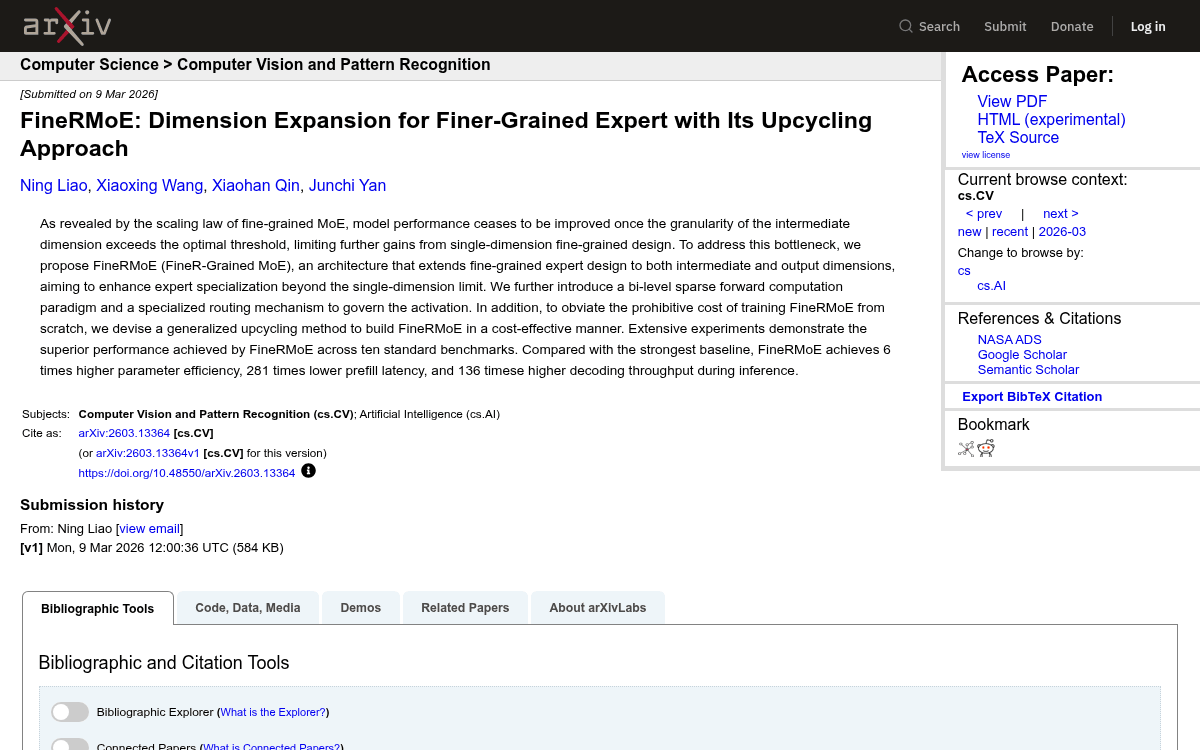
Fine-grained Mixture-of-Experts has become the default recipe for modern LLMs, but it hits a wall. Once you slice experts thin enough along the FFN intermediate dimension, performance stops improving and starts falling. A team from Shanghai Jiao Tong University argues the fix is to slice along a second axis entirely, and their FineRMoE architecture shows the idea works, delivering both better benchmark scores and dramatically faster inference than every baseline it was tested against.
Why single-axis fine-graining runs out of room
Fine-grained MoE shrinks each expert's intermediate (FFN hidden) dimension so more experts can be packed in with lower redundancy and sharper specialization. Empirical studies on the scaling law of fine-grained MoE demonstrate that, within a rational scope, higher expert granularity contributes to better performance; nevertheless, model performance tends to deteriorate when expert granularity goes beyond its optimal point. Beyond that point, extra granularity is wasted parameters.
The authors' observation is borrowed from multi-head attention: shrinking the output dimension of QKV projections is what pushes different heads toward different features. Applying the same logic to experts should force them into independent output subspaces, cutting redundancy in a way that intermediate-dimension slicing cannot.
A two-dimensional expert grid
FineRMoE generalizes fine-grained design beyond the intermediate dimension to the output dimension. Four hyper-parameters control the geometry: intermediate granularity and expansion rate, plus output granularity and expansion rate. Together they determine how many small experts exist and how their outputs stitch back together into the model's hidden size.

Because output-dimension slicing breaks the usual assumption that every expert emits a full-width vector, a straight weighted sum no longer works. FineRMoE introduces a bi-level sparse forward computation with two layers:
- Sparse sum layer: experts are grouped, and within each group a small number of active experts are weighted-summed into a dimension-reduced vector.
- Sparse concatenation layer: for each output slot, one candidate vector is picked from several competing groups and the winners are concatenated to restore the full hidden dimension.
The forward path is essentially reduce-then-restore, and the sparsity happens twice: which experts fire inside a group, and which group's output makes it into the final concatenation.
One router doing two jobs
With sparsity at two levels, the obvious design is two routers. The authors argue that leads to conflicting activations: an expert that a sum-layer router loves might belong to a group that the concatenation-layer router discards, leaving the final output dominated by low-scored experts. Their solution is a single router whose scores are reshaped and masked to drive both decisions consistently. An ablation on Qwen2.5-1.5B confirms the choice, with the single-router variant scoring an average of 56.21 versus 54.96 for the two-router version across ten benchmarks.

Upcycling instead of training from scratch
MoEs are famously expensive to train from random init, and existing upcycling tricks (duplicating an FFN, or slicing it along the intermediate axis) do not know how to produce experts that are narrower on both axes. The paper contributes a generalized upcycling method that partitions a pre-trained FFN's up, gate, and down projections along whichever axes the four hyper-parameters demand. Setting three of them to 1 recovers the classic replicate-FFN and split-FFN upcycling recipes as special cases, so the same machinery covers conventional MoEs too. The shared expert is initialized by simply copying the original FFN weights.
What the numbers look like
FineRMoE was built on top of Qwen2.5 at 0.5B, 1.5B, and 7B, with the configuration G_I=32, R_I=1, G_O=2, R_O=2 giving 128 total experts and 2 activated per token, then continued-trained on 50B tokens. Across MMLU, BBH, HellaSwag, WinoGrande, ARC-C/E, AGIEval, MBPP, GSM8K, and GPQA, it wins the average at every scale.
Some highlights from the 7B tier:
- FineRMoE hits an average of 70.04 with 26.65B total / 7.94B active parameters.
- The C32A2 baseline (32 duplicated FFNs, 2 active) reaches 69.92 but requires 184.42B total parameters.
- The dense pre-trained Qwen2.5-7B baseline sits at 68.91.
- S16A4, an FFN-splitting baseline with no shared expert, collapses to 35.77 average, reproducing the paper's argument that shared experts are essential once experts get this thin.
The parameter-efficiency claim in the abstract comes from the C32A2 comparison: roughly the same benchmark quality at about one-sixth of the total parameters.
The inference story is where it gets loud
On the same 7B configuration, running the same prompt, the paper reports a TTFT of 178.3 ms versus 50245.9 ms for C32A2, a 281x speedup, and a throughput of 27.3 tokens/s versus 0.2 tokens/s, 136x higher. C32A2's problem is straightforward: 184B parameters, most of them cold on any given token, still have to be shuffled around during prefill. FineRMoE gets to competitive quality with a much smaller memory footprint, so the whole pipeline runs faster.
What is available and what to watch out for
The authors have released both code on GitHub and weights on Hugging Face for the Qwen2.5-based variants. Some caveats worth flagging before adopting it:
- All experiments upcycle from Qwen2.5. Whether the two-dimensional design transfers cleanly to other base models is untested.
- Training was only 50B tokens of continued pre-training. On a well-tuned 7B dense model that is enough to slightly regress raw MMLU (73.08 vs 74.28 for the pre-trained baseline) even though the average across ten benchmarks improves.
- The Drop-Upcycling baseline was clearly starved of tokens compared to its original 500B-token training recipe, so the head-to-head is a token-budget comparison as much as a method comparison.
- The architecture only touches FFN blocks. Attention remains standard multi-head.
The takeaway for anyone doing MoE work: the fine-grained scaling ceiling is not actually a ceiling if you are willing to slice a second axis, and the same upcycling code that builds this thing also subsumes the classic replicate-and-split recipes. That is a useful drop-in when the alternative is training a 180B-parameter MoE from scratch to match a 7B dense model.