
Shanghai Jiao Tong's EvoTok Fixes the Core Flaw Crippling Multimodal AI Models
Researchers from Shanghai Jiao Tong University, USTC, and Microsoft propose EvoTok, a tokenizer that unifies image understanding and generation via residual latent evolution.
 Pro
Takeaways
- Shanghai Jiao Tong, USTC, and Microsoft researchers propose EvoTok, a unified image tokenizer for understanding and generation.
- Uses residual vector quantization where early depths encode pixels and deep depths accumulate into SigLIP2-aligned semantics.
- Achieves 0.43 rFID on ImageNet-1K at 256x256 while training on just 13M images.
- Best score on 7 of 9 vision-language benchmarks among discrete unified methods, including AI2D 76.2 and MME 1895.1.
- Scores 0.75 on GenEval and 0.87 on GenAI-Bench Basic, with strong compositional generation.
- Code released at github.com/VisionXLab/EvoTok, trained on 16 GPUs.
A team led by Shanghai Jiao Tong University, together with collaborators at the University of Science and Technology of China and Microsoft, has released EvoTok, a unified image tokenizer that tries to fix one of the most stubborn problems in multimodal modeling: how to turn an image into tokens that are equally useful for understanding what is in it and for regenerating it pixel by pixel.
The reason unified vision-language models have historically been awkward is that understanding and generation want opposite things from a tokenizer. Understanding tasks want compressed, abstract semantic vectors that align with language. Generation wants dense, low-level detail so a decoder can reconstruct textures and edges. Existing designs typically pick one of two bad tradeoffs, and EvoTok proposes a third path.
The two dead ends everyone keeps hitting
Prior unified tokenizers fall into two camps. The first, used by models like ViLA-U and UniTok, forces both objectives onto the same features. This gives you consistency between the two tasks but creates optimization conflict, because contrastive semantic alignment and pixel reconstruction pull the shared representation in incompatible directions.
The second camp, including TokenFlow and DualToken, decouples the two by using separate encoders, separate codebooks, or splitting features across encoder depths. That removes the interference but severs the intrinsic link between visual structure and semantics, leaving the two branches isolated in feature space.

Tokens that evolve from pixels into meaning
EvoTok's core idea is to represent an image as a trajectory rather than a fixed vector. A shared encoder produces an initial feature, then cascaded residual vector quantization (RQ) breaks it into a sequence of residual tokens across L stages. Each stage quantizes the residual left over from the previous stage using its own codebook of 32,768 entries.
The crucial design choice is what the paper calls pixel-to-semantic progression. Early residual stages are optimized for pixel-level reconstruction. Later stages, formed by cumulatively summing all residuals up to that depth, are aligned with features from SigLIP2 and used as the semantic representation. Concretely, the first 4 depths (L_pix=4) form the pixel feature and the full 16 depths (L_sem=16) form the semantic feature.
Training uses a combined objective:
- A pixel loss with reconstruction, perceptual, and adversarial terms applied to the shallow-depth feature
- A cosine-similarity semantic loss between the deep-depth feature and the SigLIP2 target
- A standard VQ loss on each residual codebook
Because both features live on the same residual trajectory in a single latent space, the two tasks stay linked, but because they read from different depths, they do not compete for the same parameters.

How it gets plugged into an LLM
For understanding, the semantic feature at each spatial location is decoded, projected through an MLP, and fed into Qwen-2.5-7B-Instruct together with text tokens in a standard LLaVA-style setup with autoregressive language modeling loss.
For generation, the LLM predicts the pixel residual codes. Following the pattern used by ViLA-U and UniTok, a depth RQ-Transformer head autoregressively emits the L_pix codes for each spatial position, one classifier per codebook level. The predicted codes are summed into the pixel feature and passed through the pixel decoder to render the image. Classifier-free guidance with scale 7.5 is applied at inference.
Results that punch above the training weight
EvoTok is trained on roughly 13M images (CC12M plus ImageNet-1K for the tokenizer, with LLaVA-OneVision, LLaVA-NeXT, Cambrian-10M, and HoneyBee for supervised fine-tuning). That is orders of magnitude smaller than the billion-scale corpora such as COYO-700M or DataComp-1B used by rivals.
Despite that, the numbers are strong:
- Reconstruction: 0.43 rFID on ImageNet-1K at 256x256, better than TokenFlow-L (0.63), DualToken (0.52), and VILA-U (1.80). Only UniTok (0.33) does better, and it uses 1.28B image-text pairs.
- Understanding: best result on 7 of 9 benchmarks among discrete unified methods, including SEEDBench (71.8), AI2D (76.2), MMMU (45.9), RealWorldQA (62.0), and MME (1895.1, versus 1660.4 for the next best discrete unified model).
- Generation: 0.75 overall on GenEval and 0.87 on GenAI-Bench Basic, with especially large gains on compositional tasks like Position (0.69) and Color Attribution (0.62).
What actually happens inside the trajectory
The ablations are where the paper earns its central claim. When the authors flip the direction (semantic-to-pixel, with 16 shallow semantic depths and 4 deep pixel depths), reconstruction improves slightly but understanding and generation both drop. When they entangle features at equal depth, everything gets worse. Only the pixel-to-semantic order produces balanced gains, suggesting that semantics need to be built by accumulating detail rather than the other way around.
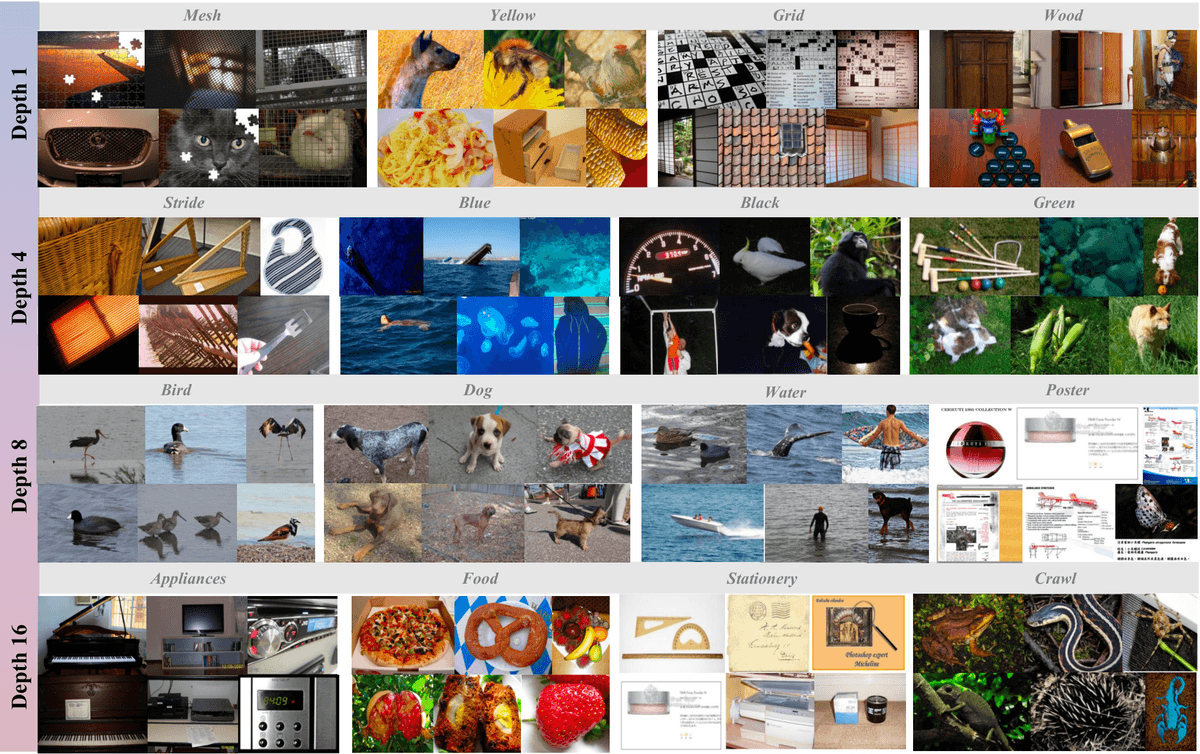
t-SNE visualizations and K-means clustering at different depths make this concrete. At depth 1 to 4, clusters group images by low-level cues like mesh textures, grid patterns, and dominant colors. By depth 8, clusters reflect coarse object categories (bird, dog, water). By depth 16, they capture abstract taxonomies such as appliances, stationery, and reptiles despite variation in pose and background.

Availability and practical takeaways
Code is available on GitHub under the VisionXLab organization. Training used 16 GPUs for 500k tokenizer steps at batch size 256, which is within reach of a serious academic lab rather than only a frontier compute cluster.
The limitations are worth flagging. Everything is demonstrated at 256x256, which is small compared to modern generation systems working at 1024 and above. On MM-Vet and MME-Perception the model comes in second rather than first among discrete unified methods, and pure diffusion specialists like DALL-E 3 still have edges on some GenEval categories. The residual depth (L=16, each with a 32k codebook) also means more tokens per image than a single-codebook tokenizer, which affects sequence length inside the LLM.
Where the work matters most is as evidence that the choice between entangled and decoupled representations was a false dichotomy. Structuring tokens as a residual trajectory that starts at pixels and evolves into semantics gives you both a clean handoff for generation and a clean handoff for understanding without either one dragging on the other, and it does so with a training budget small enough that other groups can plausibly reproduce and iterate on it.