
Shanghai Jiao Tong's CEI-3D Slashes 3D Object Editing From Hours to 16 Seconds
A new framework combines implicit surfaces with editable handler points, cutting 3D object editing from over an hour to 16 seconds while lifting realism.
 Pro
Takeaways
- CEI-3D reconstructs objects as an SDF surface plus differentiable handler points for local edits.
- Physical properties are disentangled into lighting, metalness, roughness, and diffuse albedo via PBR.
- Cross-view propagation with SAM spreads a single scribble to a full 3D part.
- Average edit time drops to 16 seconds, roughly 315x faster than NeuMesh's 1.4 hours.
- FID improves by up to 30% on shiny objects; PSNR on non-edited regions reaches 33.65 dB.
- Code and pipeline released at github.com/shiyue001/CEI-3D.
Editing a 3D object reconstructed from photos is still one of the messiest problems in computer vision. You get a sharp NeRF or SDF model, try to change a color or push out a curve, and the whole thing either smears the edit across the entire object or renders it as a flat sticker floating on top of the surface. A new paper from Shanghai Jiao Tong University proposes CEI-3D, a reconstruction pipeline built from the start around editability, and the numbers are hard to ignore.
Why current 3D editors keep breaking
Implicit 3D representations like NeRF and SDF networks produce photo-realistic rendering, but they inherently lack flexibility for editing because a continuous neural function does not support localized modifications. Change one region and the network's weights leak that change everywhere else. EditNeRF tries to fix this by adding a modulation network trained on category data, but the scribble color spills over the whole object. NeuMesh attaches geometry and texture codes to mesh vertices, but its results show coarse edge patterns and inaccurate colors from the limited resolution of its mesh, and it takes over 30 hours to train and 1.7 hours per edit.
The authors identify three separate failure modes: no local control, no separation between lighting and material (so edited colors look pasted on), and no spatial awareness (so users have to scribble the same part from many angles).
The core idea: handler points on an implicit surface
CEI-3D keeps an SDF network for global geometry but samples a set of explicit handler points directly on the zero-level surface using a differentiable formulation. Unlike implicit-based editing methods that inevitably sample points from free space or inside the object, the handler points are sampled directly on the surface, ensuring greater editing accuracy. Edits are made by adjusting the attributes of these local points, and the change then propagates back through the implicit surface to keep views consistent.

Three modules make up the framework:
- EIR (Explicit-Implicit Reconstruction): fits an 8-layer MLP for the SDF, then uses implicit differentiation to place handler points on the surface as functions of the network parameters.
- PPD (Physical Properties Disentangling): instead of predicting RGB, it factors color into lighting (spherical Gaussians), metalness, roughness, and a diffuse albedo. A dual-diffuse-albedo network sends edited and non-edited surface points through separate branches, so an edit cannot bleed into untouched regions.
- SAE (Spatial-Aware Editing): uses a cross-view propagation strategy that runs Segment Anything on one view, back-projects the mask onto handler points, then projects those points into neighboring views as positive and negative prompts for the next SAM call. One scribble labels an entire 3D part.
The physics matters
The reason edits stop looking like decals is the PBR decomposition. Diffuse albedo describes the base color of the object since it does not contain lighting information, and modifying the diffuse albedo instead of the RGB value makes the user's scribbles realistic. A scribble on a shiny mouse ends up reflecting the room lights correctly because those lights live in a separate parameter set that was never touched.
Numbers on four datasets
The team benchmarks against EditNeRF, NeuMesh, Seal3D, and GaussianEditor on the PhySG synthetic, NeRF synthetic, DTU real-world, and PhotoShape datasets. Editing quality is measured with FID between pre- and post-edit image sets, and non-edited regions are scored with PSNR/SSIM/LPIPS.
| Dataset | NeuMesh FID | CEI-3D FID | NeuMesh edit time | CEI-3D edit time |
|---|---|---|---|---|
| Phy. Syn. | 178 | 124 | 1.2 h | 14 s |
| NeRF Syn. | 130 | 121 | 1.3 h | 18 s |
| DTU | 198 | 175 | 1.6 h | 20 s |
| PhotoShape | 131 | 102 | 1.1 h | 12 s |
On the shiny-object Phy. Syn. dataset CEI-3D reaches PSNR 33.65 dB on non-edited regions, 3.37 dB above NeuMesh. Average editing time is 16 seconds, about 315 times faster than NeuMesh and roughly twice as fast as Seal3D at 32 seconds. A user study with 45 participants gave CEI-3D mean scores of 8.36 for accuracy and 8.73 for realism, above every baseline.

What you can actually do with it
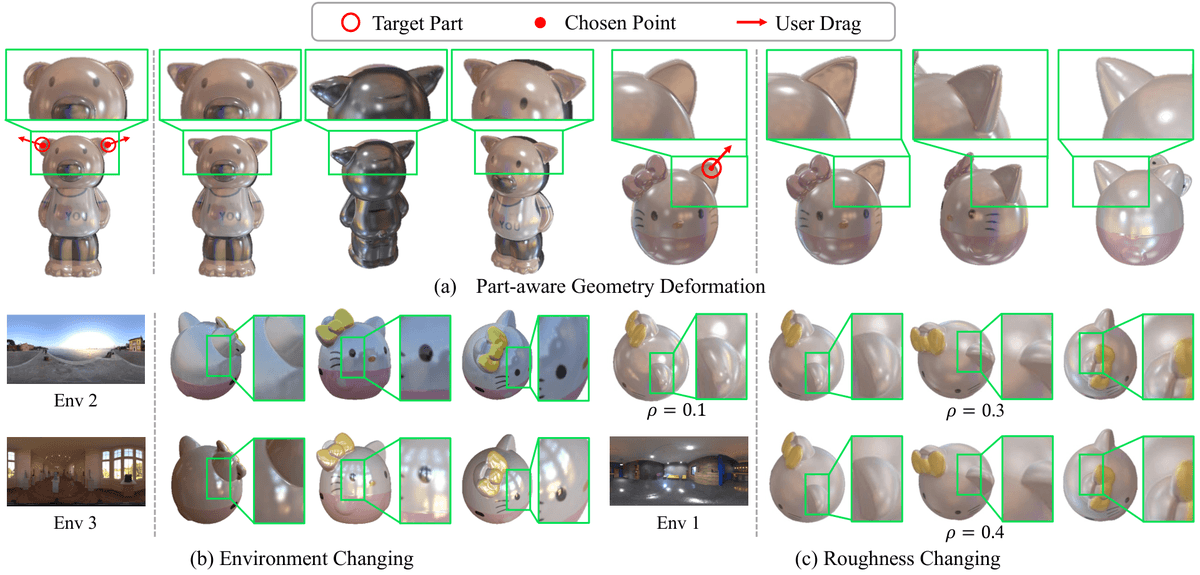
Beyond flat texture painting, the disentangled attributes open up several editing modes from the same reconstruction:
- Pattern and color scribbles that respect existing lighting and reflections.
- Part-aware geometry deformation via as-rigid-as-possible handler-point displacement.
- Relighting by swapping the environment map parameters.
- Roughness changes that convert a glossy surface into a matte one without repainting.
- Part removal using the SAM-driven segmentation labels.
Limits and availability
The framework still requires per-object training (200,000 iterations on a single RTX 2080 Ti) before any editing can happen, and the paper focuses on object-centric captures rather than full unbounded scenes. Editing is also driven by handler points sampled from training-view rays, so extremely occluded regions may need extra viewpoints during capture. The authors plan to extend the framework to dynamic scenes and videos for AR/VR content creation, digital twins, and interactive design.
Code is available on the project's GitHub repository, and all four evaluation datasets are public. For anyone building 3D content tools where users expect Photoshop-level responsiveness on real objects, cutting the edit loop from an hour to under 20 seconds is the kind of change that makes the workflow usable at all.