
Shanghai Jiao Tong's AI Navigates Deep Lung Surgery Without Any Tracking Hardware
A vision-only AI framework navigates a robotic bronchoscope through deep lung airways without electromagnetic tracking, matching expert bronchoscopist accuracy in live animal tests
 Pro
Takeaways
- Sensor-free bronchoscopy: A new AI framework navigates a robotic bronchoscope to deep lung targets using only the endoscopic camera and preoperative CT, with no EM tracking hardware.
- Expert-level accuracy in vivo: In a live porcine model, the system hit all 7/7 targets with a mean endpoint deviation of 4.90 mm from a senior expert -- within the range of human inter-operator variability.
- Hierarchical agents: A fast reactive agent handles continuous steering; a slow strategic agent (backed by Gemini Flash) intervenes only at ambiguous branch points; a diffusion-based world model breaks ties by simulating future visual states.
- 80%+ success to generation 8: Across 59 trajectories in ex vivo porcine lungs, the system maintained over 80% success rate navigating to the 8th bronchial generation.
- 6 ms inference: The reactive agent runs in 6 ms per step; procedure time is dominated by a deliberate 3-second safety pause per command, not compute.
- Code pending: Data and code will be released after publication; the paper is available on arXiv.
Getting a bronchoscope to the right spot deep inside the lung is one of the harder navigation problems in medicine. The airways branch like a tree, every branch looks nearly identical, and the scope's camera only shows a tiny circle of tissue a few millimeters ahead. Today, robotic bronchoscopy systems solve this by bolting on electromagnetic (EM) tracking hardware that constantly triangulates the scope's position against a preoperative CT scan. It works, but the hardware is expensive, adds workflow complexity, and is notoriously vulnerable to CT-to-body divergence -- the gap that opens up between the preoperative map and the actual anatomy once the patient is breathing on the table and the lung has deformed.
A team from Shanghai Jiao Tong University and Shanghai Chest Hospital has now demonstrated that you can throw away the EM tracker entirely. Their system, described in a new preprint on arXiv, navigates a flexible robotic bronchoscope to deep segmental targets using nothing but the live endoscopic camera and a preoperative CT scan -- no external sensors during the procedure itself. In a live porcine model, the autonomous agent reached all seven planned targets with endpoint accuracy comparable to a senior bronchoscopist with over a decade of experience.
Why EM tracking is a problem worth solving around
Robotic bronchoscopy has taken off at high-volume centers because it extends reach into peripheral lung lesions that are otherwise inaccessible without surgery. Robotic-assisted bronchoscopy provides superior precision, enhanced visualization, and increased maneuverability relative to conventional methods, with demonstrated advantages in navigating difficult-to-reach lung lesions. But the dominant navigation approach -- EM tracking -- carries real baggage.
- Registration drift: EM platforms depend on registration between preoperative imaging and intraoperative anatomy, and in bronchoscopy this registration is vulnerable to respiratory motion, tissue deformation, and instrument interaction, which can produce clinically important CT-to-body divergence.
- Interference: Electromagnetic sensing is also susceptible to interference from metallic instruments.
- Hardware cost and complexity: These platforms introduce additional hardware, workflow complexity, and cost.
Pure vision-based navigation sidesteps all of these issues in principle -- the endoscope already has a camera, so no extra hardware is needed. The hard part is making vision alone reliable enough to navigate a 10-plus branch deep tree without getting lost.
Reframing navigation as a visual matching problem
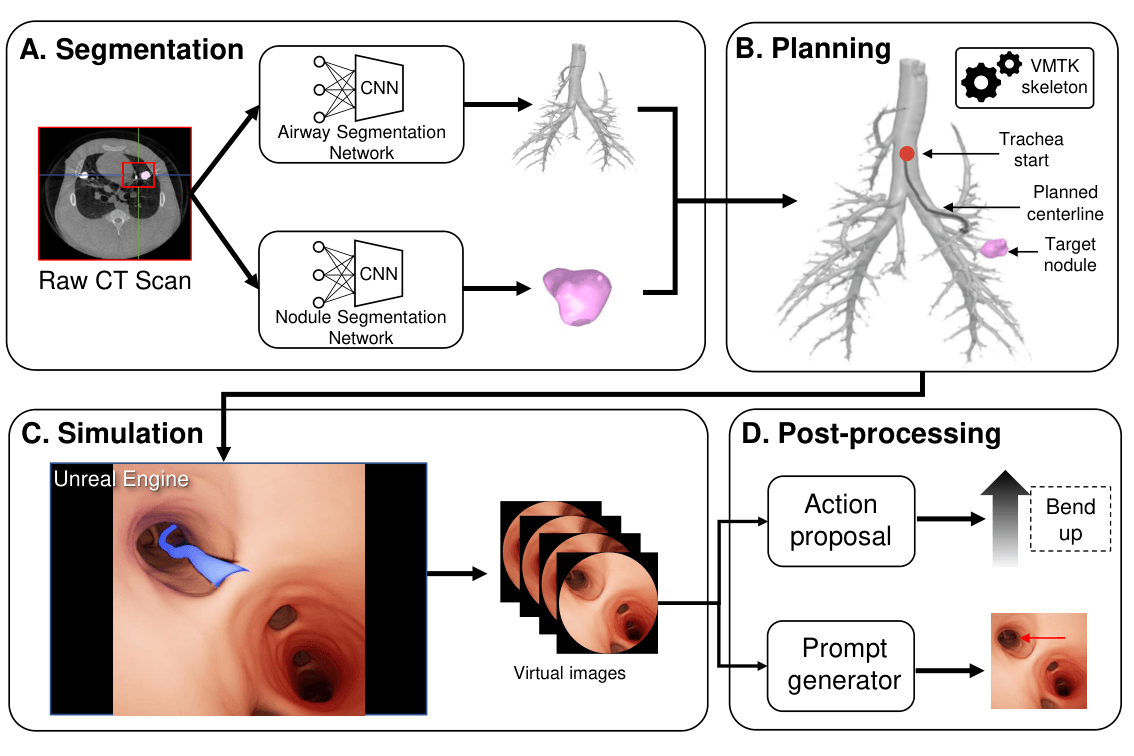
The core insight of the paper is a reframing: instead of trying to estimate the scope's 3D pose in the airway (a hard geometric problem), the system treats navigation as sequential visual alignment. Before the procedure, the CT is segmented, a path to the target lesion is planned, and a sequence of virtual bronchoscopic images is rendered along that path -- essentially a visual storyboard of what the camera should see at each waypoint. Intraoperatively, the robot's job is simply to make the live camera view match the next image in the storyboard, then advance to the next one, all the way to the target.

This is handled by a hierarchical multi-agent system with two agents operating at different time scales, plus a world-model critic that breaks ties:
- Short-term Reactive Agent: Provides continuous, high-frequency command execution for the vast majority of the intraoperative procedure, adapting instantaneously to real-time endoluminal dynamics. It uses an EfficientNet-B0 backbone to encode both the live frame and the virtual target into 512-dimensional embeddings, which are fed into a decoder-only Transformer. The output is one of seven discrete commands: forward, backward, four bending directions, or a subgoal-switch signal.
- Long-term Strategic Agent: Sparsely invoked -- triggered only at critical anatomical decision points, such as bronchial bifurcations, or by specific procedural anomalies. It combines two guidance sources: a geometric prior derived from the preoperative centerline (majority-voted over the last 10 frames), and a large multimodal model (Gemini Flash) that receives annotated virtual images with directional arrows and outputs a 5-step action sequence.
- World Model Critic: When the two agents disagree, a diffusion-based latent video model predicts what the camera will see a few frames ahead under each candidate action. The action whose predicted future view most closely matches the target virtual image -- measured by LPIPS (Learned Perceptual Image Patch Similarity, a perceptual distance metric) -- wins.

The consensus mechanism is worth understanding in detail. If the action proposed by the long-term agent falls within the top-K predicted logits of the short-term reactive agent, a consensus is established and the action is executed immediately. If not, the resolution depends on the source: preoperative guidance is simply dropped, but LLM guidance triggers the world model to simulate outcomes and pick the best one. This asymmetry is intentional -- the geometric prior is a conservative failsafe, while the LLM is trusted enough to warrant deeper arbitration.
Training the reactive agent
The short-term agent is trained by imitation learning on expert demonstrations. The full training corpus combined three domains: 12,218 phantom instances, 5,414 ex vivo porcine instances, and 16,206 in vivo porcine instances. A key data-scaling trick was CycleGAN-based style transfer: experts performed randomized exploratory maneuvers in the phantom, and the resulting real post-action images were translated into the virtual domain using CycleGAN. This expanded the phantom dataset from 2,865 manually annotated cases to 12,218 total instances and substantially improved cross-domain generalization, as confirmed by ablation studies.
What the benchmarks show
The system was evaluated across three progressively realistic settings, each more demanding than the last.
High-fidelity phantom: The system reached all 17 planned segmental targets, matching expert coverage. It achieved a mean generation depth of 5.53 ± 1.55, significantly outperforming GNM (4.24 ± 1.60) and ViNT (3.65 ± 1.62) baselines. The autonomous system required more time than expert teleoperation (450.7 ± 69.5 s versus 273.5 ± 77.5 s) but required significantly fewer control actions (275.8 ± 31.9 versus 346.8 ± 45.9). The time gap is almost entirely explained by a deliberate 3-second safety pause enforced after each command -- model inference itself takes only 6 ms.
Ex vivo porcine lungs: Across 59 distinct navigation trajectories in three ex vivo porcine lungs spanning different airway morphologies, the system maintained a success rate exceeding 80% for targets located up to the eighth bronchial generation, confirming reliable deep-lung access.
Live porcine model: This is the headline result. The autonomous system achieved a 100% success rate (7/7 targets). The mean endpoint deviation from the senior expert was 4.90 ± 2.64 mm, which was of similar magnitude to the difference observed between the senior and junior bronchoscopists (3.92 ± 2.42 mm). Visual alignment consistency (SSIM) across the seven trajectories yielded an average of 0.7701 ± 0.0564 for the autonomous system relative to the senior expert, similar to the inter-operator value between senior and junior bronchoscopists (0.7847 ± 0.0401).

In the nodule-targeting tasks specifically, the autonomous system reached distances to the target comparable to, and in some cases smaller than, those achieved by manual navigation. In all four test cases, the agent achieved minimum distances to the nodule ranging from 6.77 mm to 20.55 mm, outperforming or matching manual navigation particularly in complex trajectories.
Where it still falls short
The paper is candid about the limitations:
- Speed: The autonomous system required a mean duration of 417.1 ± 74.9 s, significantly longer than the senior bronchoscopist (176.7 ± 52.5 s) but comparable to the junior doctor (334.3 ± 34.7 s). The 3-second safety window per step is the main culprit, not the AI.
- Severe occlusion: Navigation failed primarily when persistent artifacts (e.g., mucus) adhered directly to the camera lens, permanently obstructing the visual field, or when bubbles completely occluded the target lumen, rendering the anatomical destination invisible.
- Scope of autonomy: The current system only handles navigation. Biopsy sampling and tool-tissue interaction require a different skill set not yet addressed.
The real breakthrough
The deeper significance here is architectural, not just clinical. Prior bronchoscopic autonomy work either depended on hand-crafted geometric heuristics or only demonstrated short-horizon control -- navigating one or two branches at a time. While recent works demonstrate efficacy in executing discrete surgical sub-tasks, they lack the capacity to support comprehensive, end-to-end procedural autonomy. This system navigates the full path from trachea to peripheral segment in a single continuous run, handling bifurcations, mucus, motion blur, and tissue deformation along the way.
The hierarchical agent design -- fast reactive control for routine maneuvers, slow strategic reasoning only at ambiguous branch points, and a world model to simulate futures when the two disagree -- is a blueprint that could generalize well beyond bronchoscopy to colonoscopy, ureteroscopy, and other endoluminal procedures. The translational implication is that autonomous navigation may be achievable in standard bronchoscopic workflows: preoperative CT for planning and endoscopic imaging for intraoperative navigation, reducing dependence on specialized tracking hardware while preserving the ability to reach peripheral targets.
Code and data are not yet publicly available -- the authors note they will be released after publication. The system runs on dual NVIDIA RTX 4090 GPUs, with the reactive agent on one and the world model on the other, invoked only on demand.