
Shanghai AI Lab's IDC Rewrites Wrong Answers to Make AI Reason 3.27% Better
New research shows that carefully crafting wrong answers, not stripping them out, is the key to training reasoning models with multiple-choice data.
 Pro
Takeaways
- Shanghai AI Lab and Fudan propose Iterative Distractor Curation (IDC) to fix reward hacking in MCQ-based RLVR training.
- Distractor quality matters more than option count: 2-way questions with strong distractors beat 10-way with weak ones.
- Mismatched option counts between training and testing degrade RLVR performance across model sizes.
- IDC iteratively replaces weak wrong answers using an empirical strength score computed from model sampling.
- Gains: +3.23% on Qwen2-7B and +3.27% on Llama-3.1-8B averaged across five medical benchmarks.
- Self-generated distractors match stronger external models; pipeline adds under 10% overhead to RLVR training.
A common workaround in reasoning research has been to strip multiple-choice questions of their options and turn them into open-ended prompts before feeding them to reinforcement learning. A new paper from Shanghai AI Laboratory and Fudan University argues that this throws away one of the most valuable signals in the data: the carefully crafted wrong answers. Their alternative, called Iterative Distractor Curation (IDC), keeps the multiple-choice format but rewrites the distractors to be genuinely difficult, and it consistently beats the strip-and-convert baselines.
The reward hacking problem with multiple choice
Reinforcement Learning with Verifiable Rewards (RLVR) is the technique behind recent reasoning models: sample outputs, check them against a ground truth, and update the policy. It works well when correctness is unambiguous, like math or code. Multiple-choice questions look like an easy extension because you can just compare the selected letter to the answer key, but models can shortcut reasoning via random guessing or simple elimination, producing correct answers for the wrong reasons.
The paper formalizes this as a spurious reward: the probability that a model picks the right option even though its reasoning was flawed. Two factors drive it, namely the raw number of options (which sets the guessing floor) and the strength of the distractors (how easily flawed reasoning can rule them out). Prior systems like Kimi k1.5 and Seed-Thinking-v1.5 sidestepped the problem by converting MCQs to open-ended formats, but that discards the expert-designed wrong answers that could have served as hard negatives.
Two counterintuitive findings
Before proposing a fix, the authors ran a systematic study on MMLU-Pro, training Llama-3.1-8B and Qwen2-7B with GRPO across 2-way, 4-way, 6-way, 8-way, and 10-way variants of the same questions. Two things fell out:
- Option counts need to match between training and testing. Increasing options reduces the random guess rate (25% for 4-way vs. 10% for 10-way), but the effect on RLVR training is limited. Inconsistency in option counts between training and test sets degrades RLVR performance. The model overfits to the number of choices it saw during training.
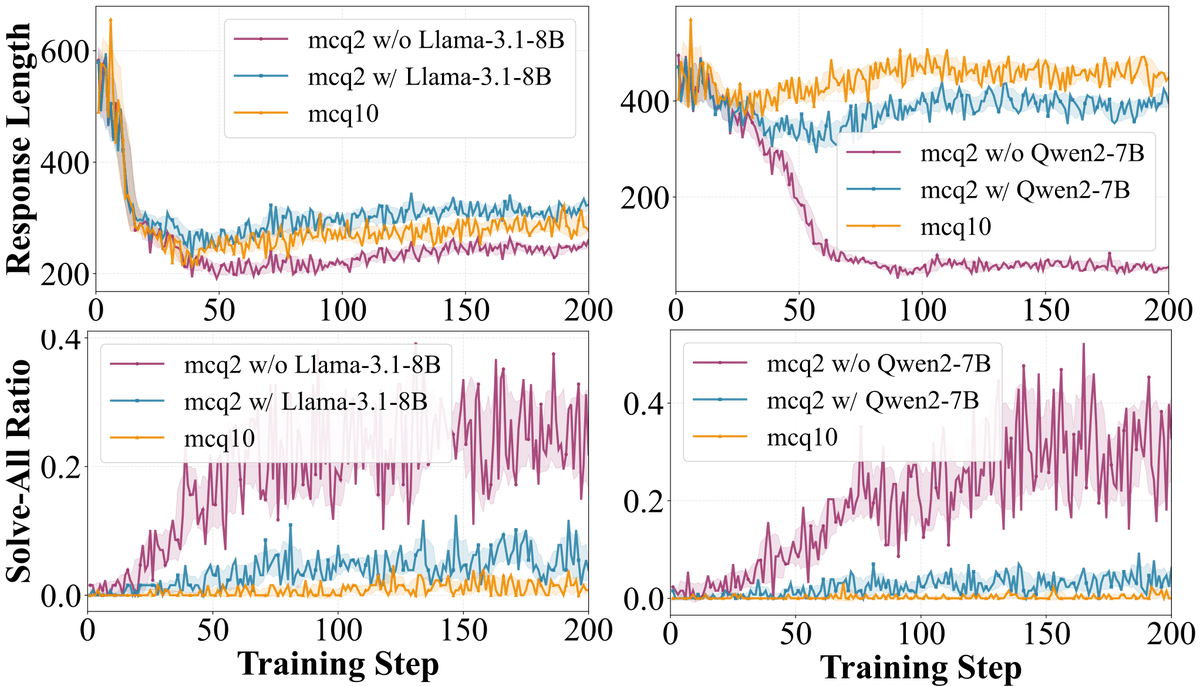
- Distractor quality dominates distractor quantity. Even in 2-way questions (with a 50% chance of guessing correctly), high-quality distractors can make RLVR training effective. Conversely, a 10-way question with weak distractors is easy to game.

The training dynamics are revealing. When strong distractors are removed, models quickly learn to skip reasoning: response length drops and the fraction of questions solved on every sampled attempt shoots up. With strong distractors present, both metrics stay in a healthy range that indicates the model is actually working through the problem.
How Iterative Distractor Curation works
IDC treats distractor design as an optimization problem over the option set, keeping the stem and the correct answer fixed. For each distractor, it computes an empirical strength score by sampling K trajectories from a reference model and measuring how often that distractor gets picked among the wrong answers. Higher score means the distractor is a better trap.
The algorithm then iterates through two phases:
- Filling phase. When effective distractors (with strength greater than zero) are below the target count, generate new candidates and add them if they demonstrate non-zero empirical strength.
- Replacement phase. Once the pool is full, identify the weakest distractor and swap it out for a newly generated candidate only if the new one scores higher. Repeat.
A semantic equivalence check runs on every candidate to catch cases where the generator accidentally produces something that means the same thing as the correct answer (Vitamin B1 vs. Thiamine, for example). The authors settle on T=7 iterations as the sweet spot between quality gains and compute.
The results
On five medical benchmarks (MedQA, SuperGPQA Clinical, MMLU-Pro Health, MedXpertQA, PubMedQA), IDC beats standard RLVR on original MCQs plus three conversion-to-open-ended baselines. On Qwen2-7B and Llama-3.1-8B, IDC consistently improves average accuracy: from 39.39% to 42.62% (+3.23%) and from 48.63% to 51.90% (+3.27%), respectively. The biggest single jump is MedXpertQA on Llama, which climbs from 14.29% at baseline to 19.31% with IDC.
Two practical findings from the ablations stand out. First, the target model itself works as well as or better than larger external generators (GPT-OSS-120B, DeepSeek-V3.1, Llama-3.1-70B) for producing distractors. That is because self-generated distractors sit closer to the model's own decision boundary, giving more targeted training signal. Second, the whole IDC pipeline takes under 10% of total training time. On 8 H200 GPUs with a 10k-sample MedQA setup, distractor generation is 15 to 20 minutes per round and strength evaluation is under 5 minutes per round, versus 18 to 20 hours for the actual RLVR training.
Where it helps and where it does not
IDC is targeted at any RLVR setup where MCQs are the natural data format, which currently includes medicine, law, and other knowledge-heavy domains where expert-designed answer choices already exist. A follow-up experiment on the law subset of MMLU-Pro with Qwen2.5-14B-Instruct saw a 2.73% gain over standard RLVR, so the technique is not medicine-specific.
The main limitation is format transfer. On PubMedQA, which is natively a short-answer task, Llama-3.1-8B trained with IDC underperforms the direct-conversion baseline. Llama is more sensitive to format mismatch than Qwen, and if the downstream task is not multiple choice, training on MCQ-shaped data leaves gains on the table. The authors also note that predicting whether a given model can synthesize effective distractors is still an open question.
The paper does not release a public code repository at the abstract, but the algorithm and all prompts (distractor generation, strength evaluation, semantic equivalence checking, filtering, and conversion baselines) are provided in full in the appendices, which is enough to reproduce the pipeline against any open model.