
Shanghai AI Lab's FutureVLA Beats pi_0 by 26.7% Without Changing Inference
A new pretraining recipe splits robot video into separate visual and motor streams, delivering 21.7% real-world gains for vision-language-action policies.
 Pro
Takeaways
- FutureVLA introduces Joint Visuomotor Gating that splits video tokens into visual and motor streams before re-coupling them.
- Two-stage training: pretrain on 15.6M frames from Open X-Embodiment and LIBERO, then align downstream VLA via latent MSE.
- Delivers 11.4% SimplerEnv gain, 21.7% real-world gain, and beats pi_0 by 26.7% on Franka tasks.
- Compatible with both OpenVLA-OFT regression heads and GR00T-style flow matching, no inference changes.
- Embedding drift under visual noise drops from 0.3047 (LAPA) to 0.0054, indicating true motor intent capture.
- Limitation: contact-rich control still needs tactile or force-torque signals beyond vision alone.
Robotic policies that map camera pixels and language straight to actions have a blind spot: they are reactive. They see the current frame, hear the instruction, and predict a motor command without ever asking what happens next. A new paper from Shanghai AI Lab and collaborators, called FutureVLA, proposes a way to bake predictive foresight into vision-language-action (VLA) models by cleanly separating what the robot sees from what it plans to do, then re-fusing them through a gated attention mechanism.
The headline numbers are unusually large for a training-recipe paper: an 11.4% absolute gain on the SimplerEnv simulation benchmark and a 21.7% gain on real-world Franka manipulation tasks compared to the same architectures trained without the new pretraining stage. FutureVLA-GT also surpasses Physical Intelligence's flagship pi_0 baseline by 26.7% on the real robot.
Why current future-guided VLAs get stuck
There are two dominant camps for adding foresight to VLAs. Explicit methods generate full future frames or subgoal images, then condition action generation on those pixels. Implicit methods, such as LAPA and Villa-X, avoid pixel-level rendering by learning latent action tokens between two sparsely sampled frames using inverse and forward dynamics models.
Both share a subtle flaw. Because their supervision ultimately boils down to reconstructing visual observations, the learned embeddings drift toward describing appearance rather than motion. Change the background lighting or add camera noise, and the latent action shifts even if the robot's motor intent is identical. Sparse frame pairs also break temporal continuity, which does not match the multi-step action chunks that modern VLAs execute at inference.

Two streams, one gate
FutureVLA reframes the problem as joint visuomotor predictive modeling: an internal representation should encode static environmental geometry and continuous motor dynamics as distinct but coupled objects. The architecture achieves this in a pretraining stage that never touches the downstream VLA.
The pipeline works like this:
- Temporal tokenization. A 17-frame RGB clip at 224x224 is passed through a frozen 3D-VAE borrowed from the WAN video generation model. The 3D-VAE requires inputs in a 4N+1 shape, and its output is a compact 1960x48 token grid that already compresses inter-frame redundancy.
- Token split. The tokens go through two Transformer layers, then are evenly split into 980 visual tokens and 980 motor tokens with different supervision signals.
- Visual stream. Visual tokens are refined by a three-layer Transformer and supervised to reconstruct only the latent embedding of the first frame. This is deliberate: reconstructing the last frame would force these tokens to memorize future appearance and re-introduce visual dominance.
- Motor stream with Joint Visuomotor Gating. Motor tokens self-attend, then cross-attend to the visual features using the visual stream as keys and values. A learnable scalar
rpassed through a sigmoid controls how much of that cross-attended context is injected back into the motor tokens. This loop runs three times. - Action head. The final motor embeddings drive either an OpenVLA-OFT style residual MLP with MAE loss or a GR00T-style conditional flow-matching head predicting a 16-step action chunk.

Transferring the priors without touching inference
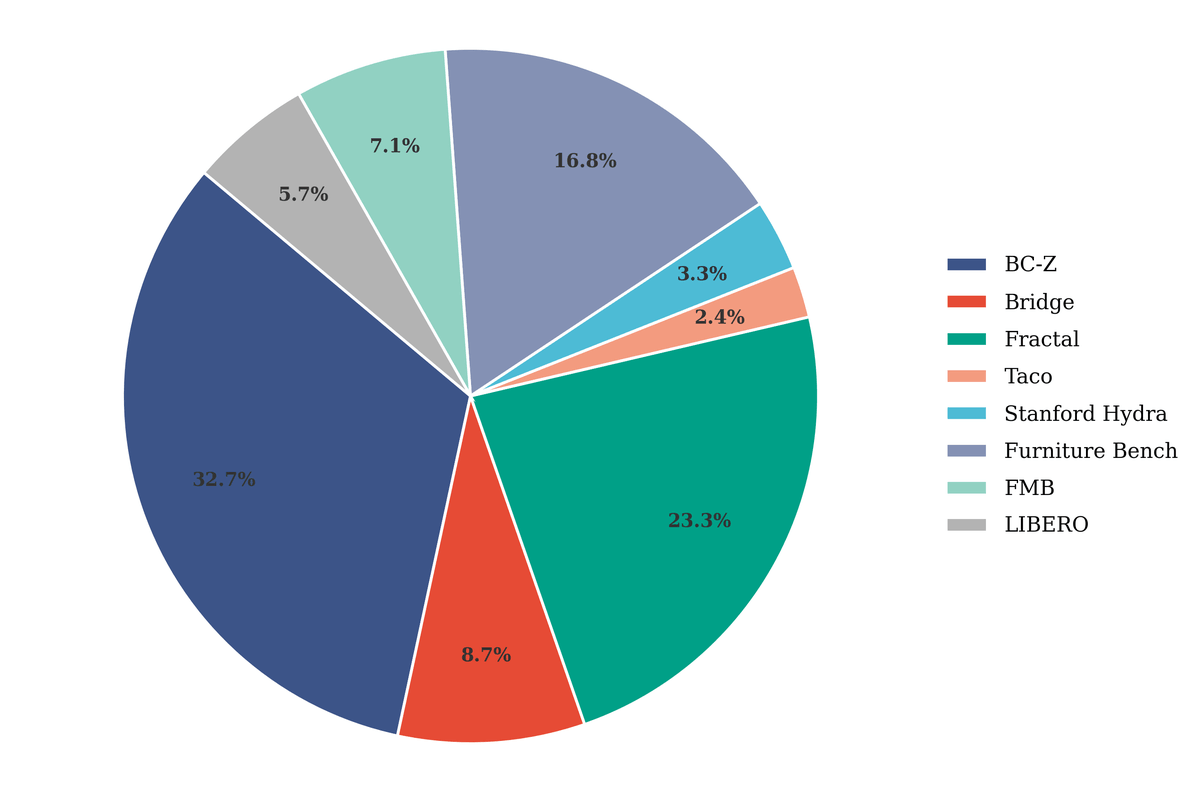
Pretraining runs on a mix of the Open X-Embodiment collection and LIBERO totaling 15.6 million frames, on 16 A100 GPUs for roughly three days. The interesting part is what happens next. Rather than shipping this new backbone as the policy, FutureVLA uses it as a teacher.
In the post-training stage, the pretrained model is frozen and fed the future video clip to produce the joint visuomotor embedding M_f. The downstream VLA, built on a Qwen3-VL-4B-Instruct backbone, only sees the current observation and the language instruction. A lightweight Transformer adapter maps its intermediate features to match M_f under an MSE alignment loss, with a cosine-decayed weight so the guidance fades as the policy learns to act.
The upshot: inference architecture is unchanged. No future frames are needed at deployment. Any VLA with intermediate token representations can be aligned to this future-aware prior.
What the numbers say
On SimplerEnv with the Google robot, FutureVLA-GT reports a 44.9% absolute average gain over GR00T-N1.5 in the Visual Matching setting, and FutureVLA-OT beats OpenVLA-OFT by 30.1%. The Put in Drawer long-horizon task jumps from 7.4% (GR00T-N1.5) to 85.2% (FutureVLA-GT). On the WidowX robot suite, FutureVLA-GT averages 71.9%, versus 61.9% for GR00T-N1.5 and 40.8% for Villa-X.
On LIBERO, FutureVLA-GT reaches 98.3% averaged across Object, Spatial, Goal, and Long suites. The largest ablation gain comes from the gate itself: without any decoupling, adding multi-frame temporal tokens actually hurts the baseline slightly. Adding a decoupled visual reconstruction target adds 7.2%. Turning on the cross-attention gate adds another 6.3%, for a total of 65.6% to 71.9% on WidowX.
Frame-count ablations show a clean trend: performance rises from 66% at 2 sampled frames to 72% at 17 frames, though per-step training time climbs from 2.2s to 3.3s. Extending to 21 frames actually hurts, because it exceeds the fixed 16-step action chunk and introduces temporally misaligned context.
Real robot: contact-rich tasks benefit most
The Franka Research 3 experiments cover burger assembly, rose insertion, bean scooping, and whiteboard erasing, trained on 300 total trajectories at 5 Hz. FutureVLA-GT hits 70% average success versus 33.3% without the joint visuomotor priors. Whiteboard erasing, which demands sustained force regulation, jumps 40 percentage points.

Robustness: the real payoff
The most compelling evidence that FutureVLA is capturing motor intent rather than visual residuals comes from perturbation tests. Under color jitter and Gaussian noise, the embedding drift (MSE between clean and noisy embeddings) is 0.3047 for LAPA-style, 0.0188 for Villa-X-style, and 0.0054 for FutureVLA. On the LIBERO-Plus robustness benchmark, FutureVLA-GT scores 79.7% overall versus 43.9% for UniVLA and 25.0% for WorldVLA under camera, robot, language, lighting, background, sensor noise, and layout perturbations.
When it fits your stack, and when it does not
FutureVLA is worth attention if:
- You are already training a VLA with a flow-matching action head or a regression MLP head, and want a drop-in pretraining phase that does not touch inference-time architecture.
- Your target tasks are long-horizon or visually noisy, where reactive policies degrade.
- You have access to Open X-Embodiment-scale video data, or can transfer from the released pretrained weights (the authors point to a project website but code availability was not confirmed at the time of writing).
The paper is honest about its ceiling. Contact-rich tasks like whiteboard erasing still leave headroom because visual priors alone cannot capture force dynamics. The authors flag tactile and force-torque integration as the next step, which suggests future iterations may fuse a third modality stream through the same gating mechanism.
The broader takeaway is architectural. If your future-guided VLA is losing capacity to visual reconstruction, decoupling the streams and re-coupling them through an asymmetric, gated query may be a cheaper win than adding another billion parameters.