
Shanghai AI Lab's FinToolBench Exposes How AI Agents Fail Financial Tasks
FinToolBench pairs 760 live financial APIs with 295 real queries, exposing how today's best LLMs fail compliance checks even when they execute tools correctly
 Pro
Takeaways
- First runnable financial agent benchmark: FinToolBench pairs 760 real, executable financial APIs with 295 tool-required queries.
- Beyond pass/fail: Introduces three compliance metrics (TMR, IMR, DMR) measuring timeliness, intent escalation, and domain mismatch at the individual API call level.
- Alarming intent mismatch rates: Every tested model (Qwen3-8B, GPT-4o, Doubao-Seed-1.6, GLM-4.7-Flash) shows >50% intent mismatch rate on tool-using traces.
- Precision vs. recall trade-off exposed: GPT-4o achieves the highest per-call accuracy (CER 0.62) but the lowest overall coverage (TIR 0.23), often refusing to call tools at all.
- FATR baseline included: A lightweight finance-aware agent that injects compliance tags into tool cards and runs a ReAct loop, improving compliance alignment without retraining.
- Open-sourced: Tool manifest, question set, and evaluation code available at github.com/Double-wk/FinToolBench.
Asking an LLM agent to look up a stock price sounds simple. But in a real financial workflow, a wrong tool call can be more dangerous than a wrong answer. It can look perfectly grounded while silently pulling stale data, escalating a read-only query into a transactional action, or fetching equity metrics for a cryptocurrency question. Until now, no benchmark existed to catch those failures at scale. FinToolBench is the first attempt to fix that.
Researchers from Shanghai AI Lab, Tencent, Xiamen University, and several other institutions have released FinToolBench, a runnable benchmark that pairs 760 real, executable financial APIs with 295 carefully constructed queries. Unlike prior financial benchmarks that test knowledge recall or document-level QA, every question in FinToolBench requires a live tool call to answer correctly.
Why existing benchmarks fall short
The financial sector, characterized by high stakes, strict compliance, and rapid data volatility, remains critically underserved. Existing financial evaluations predominantly focus on static textual analysis or document-based QA, ignoring the complex reality of tool execution. Conversely, general tool benchmarks lack the domain-specific rigor required for finance, often relying on toy environments or a negligible number of financial APIs.
The paper identifies three specific failure modes that existing metrics are blind to:
- Timeliness mismatch: A question asking for "current" exchange rates is fundamentally unanswered if the agent retrieves a daily snapshot, even if the API call is syntactically perfect.
- Intent escalation: An agent must strictly differentiate between informational queries and transactional actions, never escalating to execution without explicit authorization.
- Domain hallucination: Using equity market tools for a cryptocurrency inquiry is a hallucination of domain, even if the tool executes without errors.

Building the benchmark: 5,470 candidates, 760 survivors
FinToolBench is an execution-grounded benchmark designed to evaluate financial tool use under real execution. Its design emphasizes two principles: every run produces an auditable tool trace, and evaluation separates capability from compliance.
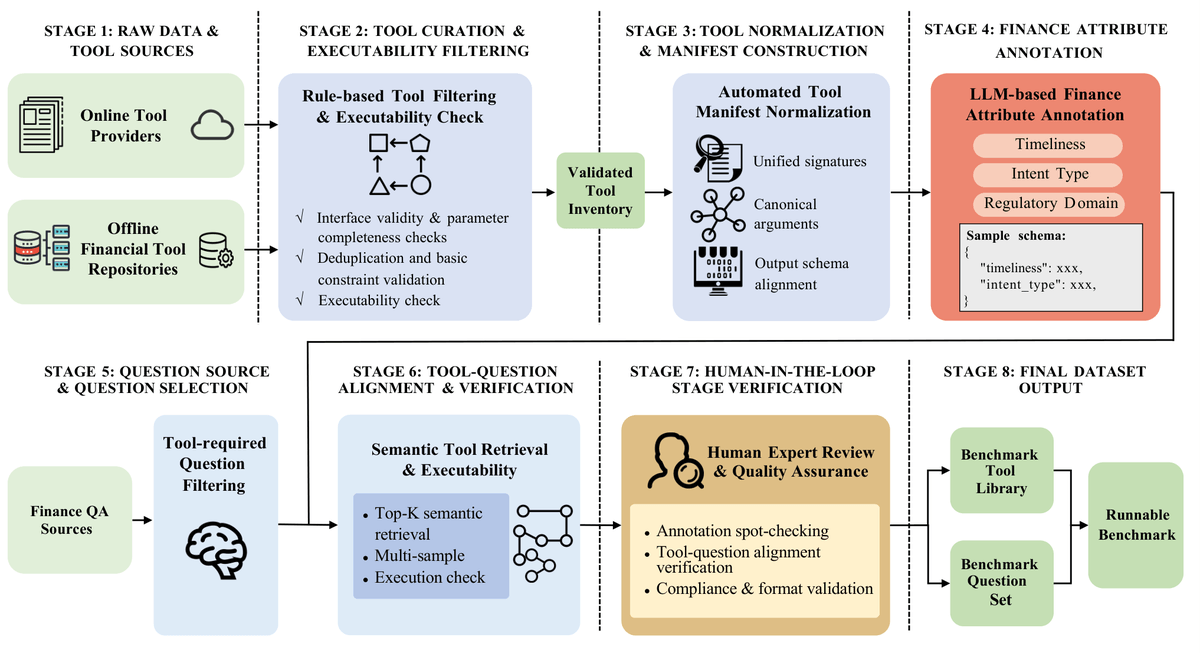
The tool inventory was assembled through an eight-stage pipeline. The team started from two complementary sources: RapidAPI (a marketplace of third-party APIs) and AkShare (an open-source Python library for financial data). We start from 5,470 candidate interfaces (4,507 RapidAPI endpoints and 963 AkShare interfaces). After filtering RapidAPI endpoints and selecting AkShare interfaces, the final tool library contains 760 tools. Tools were only kept if they passed executability checks, had valid parameter definitions, and could be invoked under free-tier access without credit card binding.
Each of the 760 tools was then annotated with three finance-specific attributes using an LLM labeling pipeline with three-vote majority agreement:
- Timeliness (realtime, daily, as_filed, periodic, or static)
- Intent type (informational, advisory, or transactional)
- Regulatory domain (a subset of equity, bond, fund, forex, derivatives, macro, crypto, ESG, and others)
The 295 questions were sourced from FinanceBench and OpenFinData, then filtered to keep only those that genuinely require a tool call. Questions answerable from static memory were systematically excluded. The final set contains 166 single-tool questions and 129 multi-tool questions.
FATR: the finance-aware baseline
Alongside the benchmark, the team introduces FATR (Finance-Aware Tool Routing), a lightweight baseline agent that demonstrates how to use the benchmark's finance attributes in practice. FATR addresses the specific challenges of the financial domain by retrieving a small candidate set, injecting finance attributes into tool cards, and stabilizing execution with caching, retries, and output compression.
The FATR pipeline works in three stages:
- Retrieve: Embed the user query and retrieve the top-20 most relevant tools using BGE-M3 dense embeddings.
- Infer constraints: The LLM planner reads the question and explicitly infers the required timeliness, allowed intent type, and regulatory domain.
- ReAct loop: The planner proposes tool calls, observes outputs, and iterates, capped at 5 steps per question. Every call is logged to a structured trace for auditing.

What the numbers reveal
Qwen3-8B exhibits the highest tool invocation rate (TIR = 0.8712) and achieves the highest soft accuracy (Soft Score = 0.4234). However, its comparatively low CER (0.3385) implies that while it is eager to use tools, it frequently suffers from argument instantiation errors or execution failures.
The results expose a sharp trade-off between aggression and precision:
| Model | TIR (invokes tools) | TESR (execution success) | CER (success given invocation) | Soft Score | IMR (intent mismatch, lower=better) |
|---|---|---|---|---|---|
| Doubao-Seed-1.6 | 0.65 | 0.33 | 0.50 | 0.40 | 0.66 |
| Qwen3-8B | 0.87 | 0.29 | 0.34 | 0.42 | 0.69 |
| GLM-4.7-Flash | 0.44 | 0.21 | 0.48 | 0.28 | 0.72 |
| GPT-4o | 0.23 | 0.14 | 0.62 | 0.23 | 0.50 |
GPT-4o adopts an extremely conservative strategy with the lowest invocation rate (TIR = 0.2267), leading to the lowest overall coverage (TESR = 0.1400). Yet, when it does choose to invoke tools, it is highly precise, achieving the highest CER (0.6176) and CSS (0.6700), along with the lowest intent and domain mismatch rates. In other words, GPT-4o often refuses to use tools at all, which is its own kind of failure on a benchmark where tool use is mandatory.
The intent mismatch rate (IMR) is the most alarming number across the board. Every model tested shows an IMR above 0.50, meaning more than half of all tool-using traces contain at least one call that violates the intent constraint. This is the kind of failure that could cause a read-only financial assistant to accidentally trigger a transactional action.
Does injecting finance tags actually help?
The team ran an ablation comparing full FATR (with finance tags in tool cards) against a version that strips those tags out. The results are nuanced. Adding finance tags slightly reduces how often the agent invokes tools, because the planner becomes more selective and avoids marginal calls. But when it does invoke tools, the execution success rate and compliance alignment both improve. Overall, injection primarily improves tool choice and compliance alignment rather than executor stability.
The case studies in the paper are particularly instructive. In one example, attribute injection helped an agent recover from an early API failure by searching for alternative tools, whereas the baseline simply produced no answer. In another, injection reduced a four-step trace to a single correct tool call. But in a third case, injection redirected the agent toward a proxy metric (gross margin instead of historical COGS), producing a cleaner trace that was still numerically wrong. Finance attributes can guide routing, but they cannot manufacture data that the available APIs do not expose.
What it is and is not good for
FinToolBench is most useful as a standardized testbed for anyone building or evaluating LLM agents that interact with financial APIs. The benchmark is especially relevant for:
- Teams building copilots for financial analysts that need to pull live market data
- Researchers studying tool-selection and argument-construction failures in agentic systems
- Compliance-focused deployments where intent escalation (informational vs. transactional) is a hard constraint
- Anyone comparing LLM backends for financial agent tasks beyond simple QA
The benchmark has real limitations too. All 760 tools are free-tier, which excludes the proprietary real-time feeds that production financial systems depend on. The 295 questions, while carefully curated, represent a narrow slice of the full complexity of financial workflows. And the compliance metrics are computed by an LLM judge (GPT-5.1), which introduces its own variance. The paper mitigates this with three-repeat judging, but it is not a substitute for human audit at scale.
What is now possible
FinToolBench presents the first real-world benchmark for evaluating financial tool learning agents, featuring 760 executable tools and comprehensive evaluation criteria beyond simple execution success. Before this work, there was no standard way to measure whether an LLM agent was using the right kind of tool for a financial query, only whether it used a tool at all. The compliance mismatch rates (TMR, IMR, DMR) are new primitives that let researchers diagnose failures at the call level rather than just the answer level.
The runnable tool library of 760 free-tier financial tools (RapidAPI + AkShare), normalized into a unified schema, is available on GitHub along with the question set and evaluation scripts. The full paper includes prompt templates, the FATR algorithm pseudocode, and a reproduction checklist so results can be compared fairly across studies. The benchmark is released under a CC BY-NC-SA 4.0 license.