
Shandong University's RSONet Picks the Sharper Camera Before Fusing RGB and Thermal
A two-stage network learns which modality to trust first, then fuses features accordingly, cutting mean absolute error to 0.020 on VT5000.
 Pro
Takeaways
- RSONet addresses inconsistent salient regions between RGB and thermal images with a two-stage architecture.
- A region guidance stage runs three parallel branches to select which modality contains more reliable object information.
- Selective Optimization, Dense Detail Enhancement, and Mutual Interaction Semantic modules handle fusion, detail recovery, and localization.
- Achieves 0.020 MAE on VT5000, outperforming 27 prior methods including Samba and SAMSOD.
- Ablations show similarity-based modality selection beats fixed fusion strategies like addition, multiplication, or pixel-wise gating.
- Runs at 9.4 FPS with 88M parameters; no public code repository released with the paper.
Fusing RGB with thermal imagery sounds like a free win for salient object detection: when the visible-light view fails in the dark, heat signatures fill in the gaps, and vice versa. In practice, that intuition breaks down often enough to hurt. A team from Shandong University, Hangzhou Dianzi University, Huzhou University, and Lingnan University has published a paper introducing RSONet, a two-stage network that first decides which modality actually contains the object before letting the two streams talk to each other.
When two eyes disagree
RGB-T salient object detection (SOD) aims to segment the most visually important region in a scene at the pixel level, using paired color and thermal images. The pitch for adding thermal is that it survives dark environments and cluttered backgrounds where RGB alone struggles. But three benchmark datasets dominate this space: VT821, VT1000 and VT5000, which have 821, 1000, and 5000 aligned image pairs, respectively, and across all of them a recurring failure mode shows up. The salient object can be crisp in one modality and nearly indistinguishable from background in the other.

The authors argue that most existing methods sweep this asymmetry under the rug. Popular fusion strategies use addition, multiplication, concatenation, or attention, and they all implicitly assume the two modalities carry roughly equal-quality information. When one view is noisy, that assumption injects garbage into the fused representation and drags segmentation quality down.
Pick the winner, then fuse
RSONet splits the work into a region guidance stage and a saliency generation stage. In the first stage, three parallel encoder-decoder branches process the RGB image, the thermal image, and the pixel-wise sum of the two. Each branch uses a Swin Transformer backbone plus two custom modules:
- Context Interaction (CI): applies convolutions with different kernel sizes (1, 3, 5, 7) matched to feature level. Low-resolution high-level features get small kernels, high-resolution low-level features get the full ladder, so the receptive field never over- or under-shoots the object.
- Spatial-aware Fusion (SF): uses global max pooling and a sigmoid gate to weight features spatially before combining them layer by layer.
Each branch outputs a guidance map. The RGB+thermal branch, having seen both inputs, is treated as a rough oracle. The system computes the average activation of each guidance map, then compares the RGB and thermal maps to the combined one. Whichever is closer is judged to carry the more accurate object information and gets to dominate downstream fusion.

Selective optimization and detail recovery
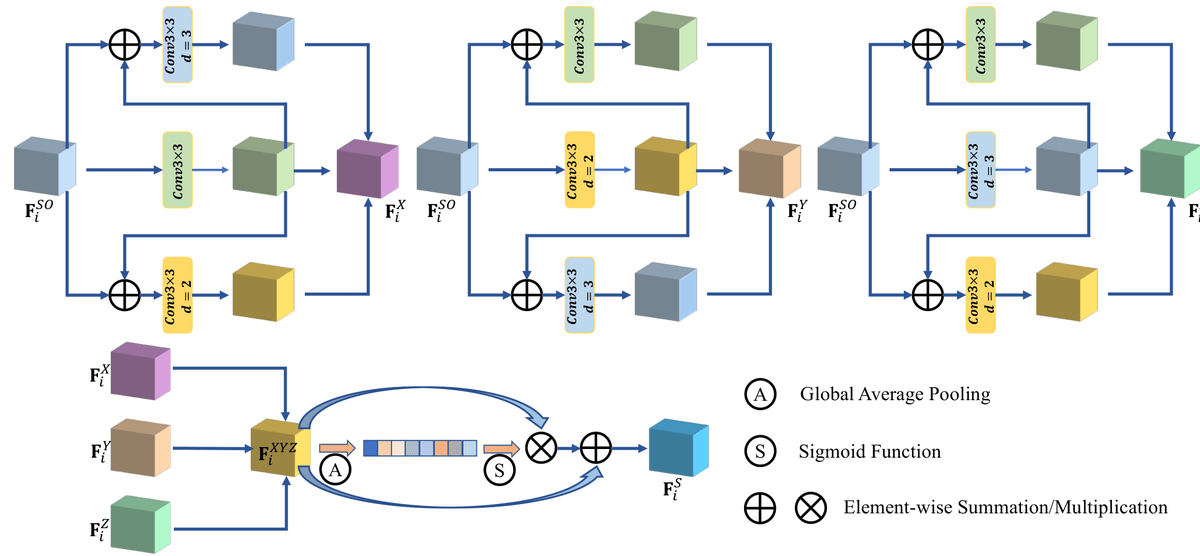
The saliency generation stage picks up the backbone features and pushes them through three more modules. The Selective Optimization (SO) module applies channel attention to both modalities, then uses spatial attention from the winning modality to refine the losing one, so the higher-quality view guides feature enhancement rather than being averaged with noise. The Dense Detail Enhancement (DDE) module handles low-level features with four parallel dilated convolution branches connected densely, each capped with a visual state space (VSS) block, which is a Mamba-style sequence operator that captures long-range spatial relationships without quadratic attention cost. The Mutual Interaction Semantic (MIS) module handles high-level features with three main branches of dilated 3x3 convolutions that cross-fertilize each other to pin down object location.
Training uses a sum of binary cross entropy, boundary IoU, and F-measure losses, applied with deep supervision across five saliency maps. Inputs are resized to 384x384 and optimized with RMSprop at a 1e-4 learning rate on a single RTX 4080.
The numbers
The authors benchmark against 27 prior methods on VT5000, VT1000, and VT821 using four standard metrics: mean absolute error (M), F-measure, S-measure, and E-measure. RSONet posts the best mean absolute error on VT5000 at 0.020, matches or beats leading competitors on structure measure, and holds its own against very recent transformer- and mamba-based systems like Samba (CVPR 2025) and SAMSOD.
| Dataset | MAE | F-measure | S-measure | E-measure |
|---|---|---|---|---|
| VT5000 | 0.020 | 0.910 | 0.926 | 0.963 |
| VT1000 | 0.014 | 0.923 | 0.946 | 0.972 |
| VT821 | 0.021 | 0.883 | 0.921 | 0.946 |
Ablations confirm that the region guidance stage is doing real work. Replacing the SO module with addition, multiplication, concatenation, or pixel-wise soft gating all cause measurable drops, and forcing a fixed direction (always RGB-guides-T or always T-guides-R) is worse than letting the similarity score decide. Swapping the Swin Transformer backbone for ResNet variants tanks performance, and interestingly, plugging in frozen SAM or DINO backbones also degrades results, suggesting large pretrained vision models need dedicated adapters before they help on RGB-T imagery.
The model runs at 9.4 FPS with 88M parameters and 143.8 GFLOPs, which is middle-of-the-pack. That is the price of the two-stage design: three parallel encoder branches for guidance plus the main saliency pipeline. Failure cases documented in the paper include very small or thin objects and scenes where both RGB and thermal inputs are simultaneously low quality, where even the guidance stage cannot pick a winner because there is none.
Where this fits
RSONet is a research contribution, not a productized release. The paper does not link to a public code repository or pretrained weights, so anyone wanting to reproduce it will need to re-implement from the described modules. For teams working on all-day surveillance, autonomous driving in low-light conditions, or industrial defect detection where thermal cameras complement visible ones, the core insight is worth borrowing even without the specific implementation: before you fuse modalities, spend some capacity deciding which one to trust.