
Shandong University's QLLM Replaces Neural Mixers With AI-Written Code, Training 40% Faster
QLLM replaces trained mixing networks in multi-agent RL with LLM-generated code, cutting parameters up to 37 percent while boosting interpretability.
 Pro
Takeaways
- QLLM replaces trained mixing networks in multi-agent RL with LLM-generated code from a new framework.
- A coder-evaluator loop generates and validates Python credit assignment functions with zero learnable parameters.
- Beats QMIX, QPLEX, Qatten, RIIT and others on LBF, GRF, MPE, and SMAC benchmarks.
- Cuts learnable parameters 13 to 37 percent and total training time roughly 40 percent on SMAC.
- Generated code is human-readable, exposing tactical reasoning like ball possession and goal proximity.
- Code available at github.com/MaoMaoLYJ/pymarl-qllm, tested with DeepSeek-R1, DeepSeek-V3, and Mistral-Large.
Credit assignment is one of the oldest headaches in cooperative multi-agent reinforcement learning. When a team of agents shares a single reward signal, how do you figure out which agent actually deserves credit for the win? For years, the answer has been a learned mixing network sitting on top of individual Q-values. A new paper from researchers at Shandong University and the Chinese Academy of Sciences argues that the mixing network itself might be unnecessary, and that a large language model can write a better one in code, without any training at all.
The framework, called QLLM, uses an LLM to generate a Python function that maps global state and individual Q-values to a team Q-value. That function replaces the usual hypernetwork-driven mixer in algorithms like QMIX. The generated code is fixed during training, contains zero learnable parameters, and is human-readable. Across four standard benchmarks, it beats the neural mixers it replaces.
Why the mixing network became a bottleneck
Under the centralized training with decentralized execution paradigm, value decomposition methods learn one Q-value per agent and combine them into a global Q-value. VDN models the global value function as a linear summation of individual value functions, which is fast but too simplistic for complex coordination. QMIX improves upon VDN by using a monotonic mixing network to non-linearly combine individual value functions, allowing for more expressive representations, but the monotonicity assumption may restrict flexibility in highly complex environments. Later methods like QPLEX and QTRAN relax that constraint but pay for it in compute and complexity.
The deeper problem is that all of these mixers are black boxes. The mixing network often suffers from limited interpretability and slow convergence during training. You cannot inspect it to understand why agent 2 got more credit than agent 3 on a given step. And when the global state balloons into hundreds of dimensions, the hypernetwork that generates the mixer's weights has to optimize an enormous parameter space just to figure out reasonable weightings.
Swapping the neural mixer for generated code
QLLM's core idea is to keep the standard value decomposition structure but replace the learned mixer with what the authors call a Training-Free Credit Assignment Function (TFCAF). Formally, the global Q-value becomes a weighted sum of individual Q-values plus a bias, where both the weights and the bias are nonlinear functions of the global state that the LLM writes as Python code.

The theoretical justification comes from a Taylor expansion of the joint value function around an optimal joint action. The paper shows that near optimality, the second-order cross terms between agent Q-values collapse into a state-dependent linear form, so the sum-of-weighted-Q-values-plus-bias template is a sound approximation for any mixer that respects the Individual-Global-Max principle. That principle just says the joint action that maximizes the team Q must be the combination of each agent's individually best action.
A coder that writes, an evaluator that judges
Getting an LLM to reliably generate a credit assignment function is not a one-shot problem. Hallucinated tensor shapes, division by zero, and vague reasoning are all failure modes. QLLM addresses this with a two-role setup where the same underlying model plays both a coder and an evaluator.
The pipeline works in three steps:
- Initial generation. The coder LLM receives a role prompt describing its job and a task prompt describing the environment's state layout, then produces K candidate TFCAFs.
- Error detection. Each candidate is compiled and executed on sample states. If it throws an error, the compiler message is fed back to the coder for a corrected version.
- Evaluation. The evaluator LLM inspects the surviving candidates and picks the one whose logic best matches the task, feeding its choice back to the coder for another round. This repeats T times.
The prompts do most of the heavy lifting. Task prompts spell out exactly what each dimension of the state vector means. For Google Research Football, that includes ball position, possession flags, and player coordinates. For StarCraft, it includes ally health, shield, cooldown, and last actions. The role prompts stay fixed across tasks, which is what lets the framework generalize without prompt tuning per environment.
What the generated code actually looks like
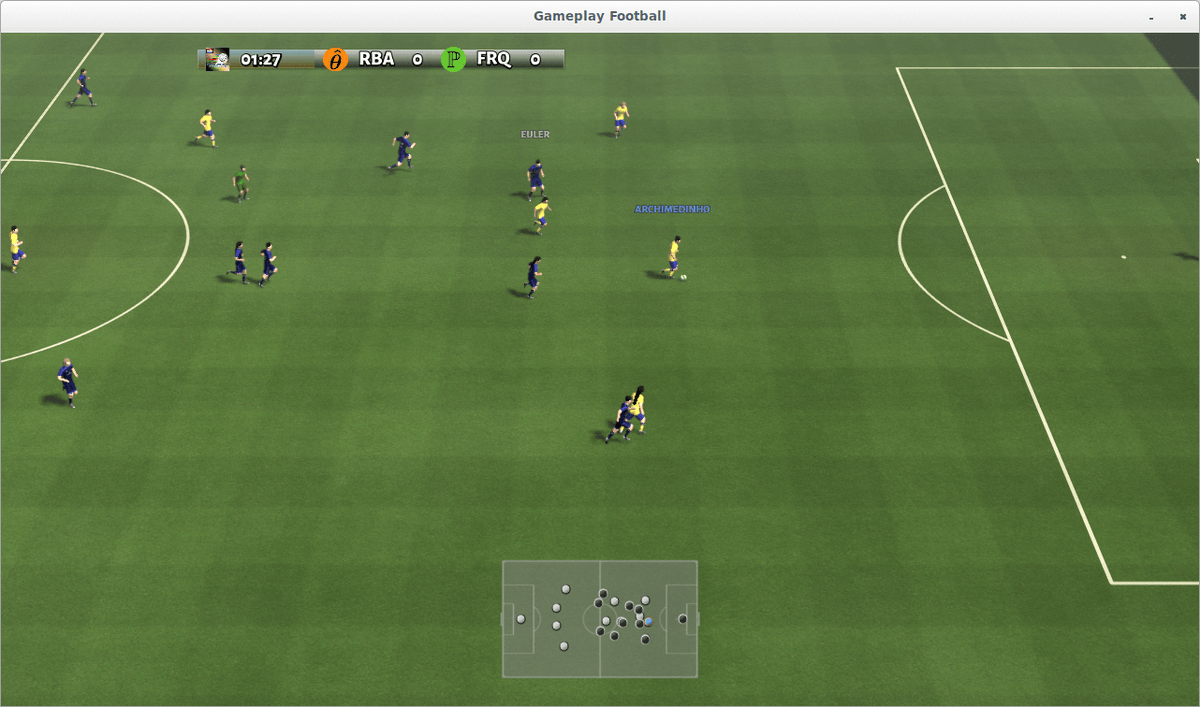
The interpretability story is the most striking part. For a 3-vs-1 football scenario, the generated TFCAF computes four physically meaningful weight components: a bonus for ball carriers in scoring zones, a base weight for general possession, a support weight for offensive positioning, and a defense weight rewarding proximity to the ball when the opponent has possession. These are then combined through a softmax to produce agent weights.

You can literally read the code and understand the tactical rationale. That is a very different experience from probing a hypernetwork's outputs.
Benchmark results
The team evaluated QLLM on four MARL environments: Level-Based Foraging for sparse rewards, Google Research Football for realistic cooperation, Multi-Agent Particle Environments for high-dimensional states, and the StarCraft Multi-Agent Challenge for micromanagement. Baselines include QMIX, QPLEX, Qatten, RIIT, COMA, Weighted QMIX, and MASER, with DeepSeek-R1 serving as the primary LLM.
Two results stand out. First, on the hard SMAC maps 3s_vs_5z and 2c_vs_64zg, QLLM converges noticeably faster than neural mixers, which typically thrash for a long time before finding a decent policy. Second, when the number of agents in the MPE simple-spread task is pushed to 15 and 25, baselines degrade sharply while QLLM holds up. The generated logic is invariant to state dimensionality in a way that gradient-optimized hypernetworks are not.
The parameter and time savings are also substantial:
| Metric | QLLM vs baselines |
|---|---|
| Learnable parameter reduction | 13 to 37 percent across environments |
| Training time per step on SMAC | 161 ms down to 104 ms (35 percent faster) |
| Total 2M-step training duration | 9.05 hours down to 5.38 hours (40 percent faster) |
| One TFCAF generation cycle (K=3) | About 15 minutes |
Where it works and where it does not
An ablation showed that in relatively simple environments like MPE simple-tag, a single-shot generation with K=1 and T=1 is enough. The evaluator only becomes essential in complex settings like SMAC, where iterative refinement filters out subtle logical errors that would otherwise sink performance. The framework was also tested with DeepSeek-V3 and Mistral-Large in addition to DeepSeek-R1, and all three outperformed QMIX, with reasoning-heavier models producing slightly better results.
The obvious limitation is dependence on prompt quality. QLLM assumes that the state vector's semantics can be described precisely enough for the LLM to reason about them. For environments where the state is a raw pixel buffer or an opaque embedding, generating meaningful physical weights would be much harder. It also inherits standard LLM constraints on code correctness, which is why the executability check exists in the first place.
Availability
The implementation is available at github.com/MaoMaoLYJ/pymarl-qllm, built on top of the popular pymarl, epymarl, and pymarl2 codebases. For anyone already running QMIX-family algorithms, dropping a TFCAF in place of the mixer is a fairly local change, and the paper reports gains across multiple value decomposition algorithms including RIIT and MASER. It is a rare case where using an LLM at design time, rather than at inference time, is the point.