
SGMatch Cuts 3D Shape-Matching Errors by 42% on Corrupted Meshes
SGMatch fuses vision-model semantics with flow-matching regularization to fix long-standing failures of functional maps under heavy deformation and topological noise.
 Pro
Takeaways
- SGMatch injects DINOv2 semantics into functional maps via local cross-attention restricted to 1-ring mesh neighborhoods.
- A conditional flow matching regularizer trains a shared velocity MLP that penalizes locally inconsistent correspondences implicitly.
- Cuts mean geodesic error 24% on SMAL animals and 42% on TOPKIDS topology-noisy scans versus prior SOTA.
- Marginal gains on near-isometric benchmarks like FAUST and SCAPE where geometry alone already suffices.
- Backbone matters: DINOv2 gives 2.5 error, DINOv1 4.1, CLIP 5.8 on SMAL.
- Limitations include no partial-to-partial matching and dependence on visual foundation model quality for niche domains.
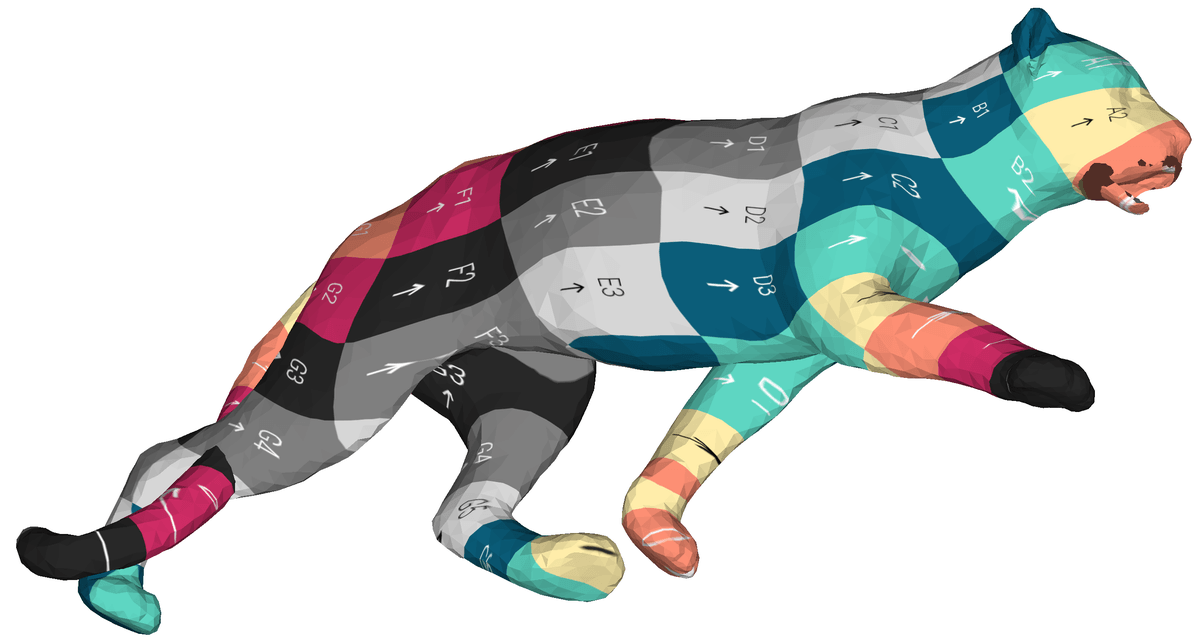
Matching points between two non-rigid 3D shapes, say a horse to a cougar, or a scanned kid whose mesh has fused fingers, has been stuck in the same failure modes for years. A new ECCV 2026 paper called SGMatch tackles those failures directly by injecting DINOv2 semantics into the classical functional maps pipeline and adding a flow-matching regularizer that keeps neighboring vertices moving together. The result is a 24% error reduction on animal matching (SMAL) and a 42% reduction on topology-corrupted meshes (TOPKIDS), while still holding its own on clean human data.
Where functional maps break
The dominant approach to non-rigid shape correspondence is the functional maps framework: instead of directly finding vertex-to-vertex pairings, you estimate a small linear operator between the Laplace Beltrami eigenbases of two shapes, then recover point-wise matches from that spectral operator. This is elegant for near-isometric pairs, like two poses of the same person, but it has two well-documented weaknesses.
First, purely geometric descriptors like Heat Kernel Signature or Wave Kernel Signature cannot tell left arm from right arm on a symmetric mesh, they only see local curvature. Second, when you project a truncated spectral basis back to dense correspondences, neighboring vertices on the source can land on distant regions of the target, producing visible tearing in texture transfer. Prior work like Synchronous Diffusion tried to fix the second issue with diffusion-based smoothness, but the diffusion process is inconsistent for pairs of shapes with severe non-isometries and topological differences, and requires careful tuning of the maximum diffusion time.

Two ideas glued to the functional maps pipeline
SGMatch keeps the classical spectral scaffolding but bolts on two learned modules. The first is a Semantic-Guided Local Cross-Attention (SGLCA) block. The second is a Conditional Flow Matching (CFM) regularizer over vertex features. Both are trained end to end with the standard structural losses (bijectivity, orthogonality, coupling) plus the CFM term.

The semantic pipeline follows the Diff3F recipe: render each mesh from 100 viewpoints at 512x512, push depth-and-normal-guided renders through a frozen DINOv2-ViT-B/14 encoder, back-project the resulting dense features onto the 3D surface using known camera parameters, and average across views. That produces a 768-dimensional semantic vector per vertex, which sits alongside a 256-dimensional geometric descriptor from DiffusionNet.
Why global attention would ruin everything
A naive fusion would concatenate the two and hope for the best, or run full cross-attention across all vertices. SGMatch does neither. In SGLCA, semantic features first pass through a small MLP that produces a channel-wise sigmoid gate, and the geometric features are multiplied by (1 + alpha * gate) so semantics can amplify or attenuate specific geometric channels rather than override them. Then a cross-attention layer computes queries from geometry and keys/values from semantics, but restricted to the 1-ring mesh neighborhood padded to a fixed size of 32.
The ablation is telling: global attention gives 2.6 mean geodesic error on SMAL, local attention gives 2.5, and gating alone (no attention) gives 3.6. Unrestricted semantic mixing pulls in irrelevant long-range responses, which matters because DINOv2 features are class-aware but not localized enough to survive contact with distant body parts.
Flow matching as a smoothness prior
The CFM regularizer is the more novel piece. Rather than penalize spatial roughness directly, SGMatch treats correspondence as feature transport between manifolds. For each source vertex, it defines an endpoint z0 (its heat-diffused feature) and z1 (the feature transported from the target via the soft correspondence matrix), samples a random time t in [0,1] to form a linear interpolate zt, and trains a shared MLP velocity field v_theta(zt, t) to predict the displacement z1 - z0.
The key insight is that this shared, finite-capacity velocity network cannot fit locally inconsistent correspondences, because neighboring vertices with wildly different displacement targets would require high-frequency solutions the MLP simply cannot express. So CFM acts as an implicit smoothness prior, not by adding a Laplacian penalty (which the ablation shows actually hurts, 4.1 vs 2.5 on SMAL), but by making inconsistency expensive to represent. Time conditioning uses sinusoidal embeddings injected via FiLM, and outliers from early-training soft correspondences are handled with a Charbonnier loss plus confidence-weighted importance sampling.
The numbers
SGMatch is evaluated across six benchmarks spanning three regimes. On near-isometric human data it is roughly tied with the previous state of the art, which is expected since geometry alone already suffices there. The real gains show up in the harder settings.
| Benchmark | Regime | Prev SOTA | SGMatch |
|---|---|---|---|
| FAUST | near-isometric | 1.5 | 1.4 |
| SHREC'19 | cross-dataset humans | 3.6 | 3.3 |
| SMAL | animals, non-isometric | 3.3 | 2.5 |
| DT4D-H inter | cross-category humans | 3.5 | 3.4 |
| TOPKIDS | topological noise | 5.0 | 2.9 |
Beyond mean geodesic error, the paper reports map smoothness metrics (conformal distortion, Dirichlet energy, coverage, bijectivity) and shows lower distortion on the challenging datasets. A three-seed statistical run also shows SGMatch has much lower variance than HybridFMap, 0.06 vs 1.02 standard deviation on TOPKIDS, suggesting the semantic anchors stabilize optimization.
When it helps and when it doesn't
The pattern across experiments is consistent, and the authors are candid about it:
- Semantic guidance helps most when geometric descriptors get ambiguous, cross-species animals, cross-category humans, or topologically noisy scans.
- On clean near-isometric pairs, the gains are marginal because rotation-invariant geometric features already resolve the matching.
- SGMatch handles only full-shape correspondence, partial-to-partial matching is not supported.
- Performance depends on the quality of the 2D visual backbone, DINOv2 gives 2.5 on SMAL, DINOv1 gives 4.1, CLIP gives 5.8. Domains where pretrained visual priors are weak would need task-specific encoders.
Practical costs
The model has 2.8M parameters versus 0.5M for HybridFMap, and inference times are comparable, around 7 seconds per pair on SMAL, 11 seconds on TOPKIDS on a single RTX 3090. Semantic feature extraction is a one-time preprocessing step per shape (34 to 109 seconds depending on mesh size) that can be cached across pairwise evaluations. The authors have not yet released code publicly at the time of the arXiv posting, though the paper documents implementation details sufficient for reproduction.