
SFM-FWI Beats Conventional Seismic Imaging With No Pretraining Data
A new physics-driven framework couples flow matching with seismic full-waveform inversion, removing the need for offline pretraining while beating standard baselines.
 Pro
Takeaways
- SFM-FWI trains a flow-matching network online using only wave-equation physics and observed seismic data, no pretraining datasets required. Paper
- Flow matching removes the Gaussian-initialization assumption baked into diffusion-based FWI, letting the current velocity estimate directly seed the transport dynamics.
- On the salt-body benchmark, SFM-FWI hit 0.061 relative L2 error and 0.926 SSIM versus 0.198 and 0.667 for conventional FWI.
- The method emerges an automatic coarse-to-fine schedule, recovering low-wavenumber background before adding high-wavenumber detail.
- Implementation uses a timestep-conditioned U-Net (~46M params) and the differentiable Deepwave solver for adjoint gradients.
- Limitations: 2D constant-density acoustic only, no elastic or 3D tests, no field data validation yet.
Seismic imaging is one of those problems where deep learning has been tantalizing but tricky to actually deploy. A new paper on arXiv from Xinquan Huang and Paris Perdikaris proposes Self-Flow-Matching assisted Full Waveform Inversion (SFM-FWI), a method that plugs a flow-matching network into the inversion loop and trains it online using only the physics of wave propagation and the observed data. No massive pretraining datasets required.
The cycle-skipping headache
Full-waveform inversion (FWI) is the workhorse technique for reconstructing underground velocity models by matching simulated seismograms against recorded ones. It is also famously fragile. FWI is highly nonlinear, prone to cycle skipping, and sensitive to noise, particularly when low frequencies are missing or the initial model is poor, leading to failures under imperfect acquisition. Cycle skipping is what happens when the predicted and observed waveforms are misaligned by more than half a period, causing the optimizer to lock onto the wrong minimum.
The recent fix has been generative priors. Diffusion-regularized FWI biases the solution toward geologically realistic models, but it comes with strings attached. These priors typically require costly offline pretraining and can deteriorate under distribution shift. There is also a conceptual snag: diffusion models expect Gaussian noise as their starting point and a fixed noise schedule, so it is genuinely unclear how to map a real FWI iterate to a specific diffusion timestep.
Flow matching without the pretraining
SFM-FWI sidesteps both problems by using flow matching instead of diffusion. SFM-FWI leverages flow matching to learn a transport field without assuming Gaussian initialization or a predefined noise schedule, so the initial model can be used directly as the starting point of the dynamics. Flow matching learns a continuous vector field that transports samples from any source distribution to a target distribution via an ODE, which means the current velocity estimate itself can be the source. No artificial Gaussian corruption, no noise-level calibration.
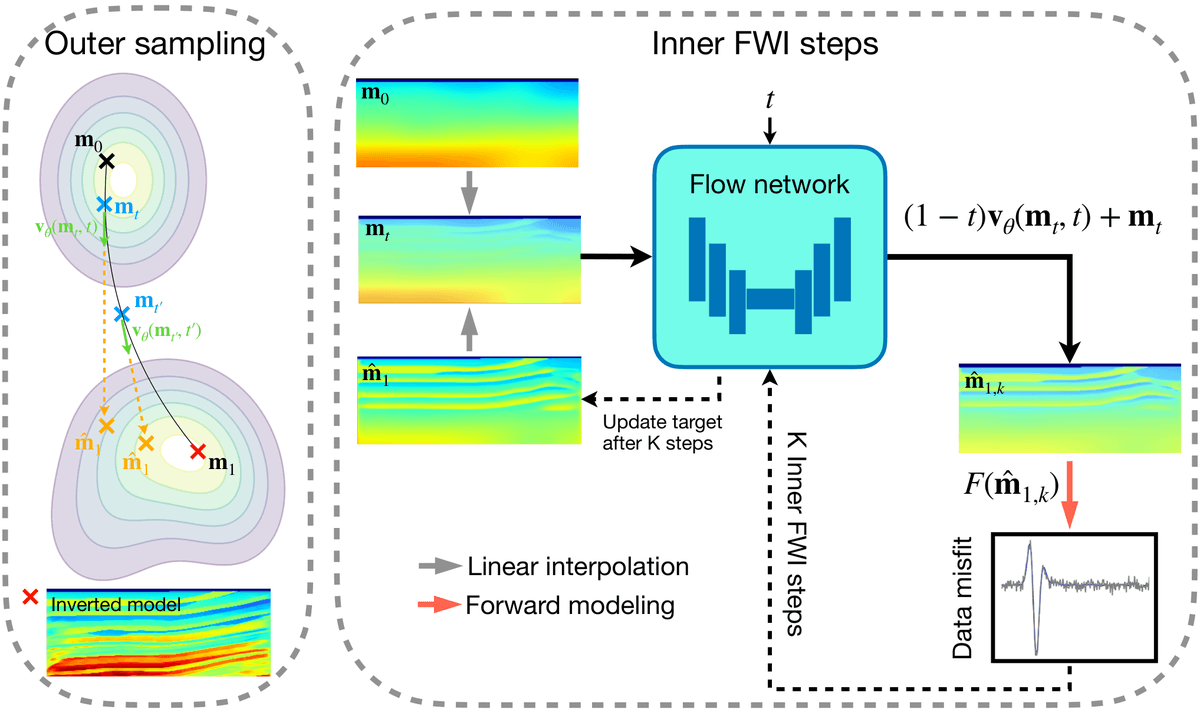
The training loop is where things get interesting. Their approach trains a single flow network online using the governing physics and observed data. At each outer iteration, they build an interpolated model and update the flow by backpropagating the FWI data misfit, providing self-supervision without external training pairs.

How the loop actually runs
Concretely, the algorithm alternates between outer and inner loops:
- Build an intermediate model by linearly interpolating between the initial model and the current best estimate at time
t. - Feed it into a U-Net that predicts a flow field
v_theta(m_t, t). - Construct a proposal
m_hat_1 = m_t + (1-t) * v_theta(m_t, t). - Compute the FWI data misfit between simulated and observed waveforms, backpropagate through the wave equation into the network.
- Update the target estimate and advance
ttoward 1.
The wave-equation gradient comes from Deepwave, a differentiable finite-difference solver that provides adjoint-equivalent gradients through automatic differentiation. The flow network itself is a timestep-conditioned U-Net adapted from OpenAI's guided-diffusion codebase, roughly 35 to 47 million parameters depending on model size.
Results across three standard benchmarks
The authors tested on the Marmousi, SEG/EAGE Overthrust, and BP salt-body models against conventional FWI, TV-regularized FWI, and Deep Image Prior FWI, all with matched compute budgets of 3000 physics steps. The salt body case is the most striking:
| Method | Relative L2 error | SSIM |
|---|---|---|
| Conventional FWI | 0.198 | 0.667 |
| FWI + TV | 0.153 | 0.811 |
| DIP-FWI | 0.474 | 0.531 |
| SFM-FWI | 0.061 | 0.926 |
On Overthrust, SFM-FWI delivers more accurate reconstructions, greater noise robustness, and more stable convergence than standard FWI and pretraining-free regularization methods. The robustness study with poor initial models, 3.5 dB noisy data, and sparse shots (5 shots vs 25) showed the biggest gains under bad initialization, where cycle skipping normally destroys conventional FWI.

Why it works: automatic coarse-to-fine
The interesting analysis in the paper is on why the method behaves so well. By tracking the effective rank of the velocity model across iterations, the authors show SFM-FWI naturally prioritizes low-wavenumber background structures first, then gradually adds finer detail. This mirrors classical multi-scale frequency continuation, but emerges without any handcrafted schedule. They also demonstrate a deblurring-like effect: mean gradient energy of the corrected model rises to 3.03x the corrupted intermediate model by iteration 800, indicating structured interface sharpening rather than noise amplification.
Wall-clock overhead is modest. On the Marmousi sub-region, SFM-FWI takes 23.4 minutes versus 20.9 for vanilla FWI on an H200. The dominant cost remains the wave-equation solves, not the U-Net.
Where it falls short
The limitations are honest and worth flagging. Everything here is 2D constant-density acoustic. There is no elastic or anisotropic physics, no 3D acquisition, no field data with real source signature uncertainty. The comparison against a pretrained diffusion prior is limited to a tiny 64x64 Overthrust patch because the released DiffusionFWI weights only work at that resolution. Extending to full 3D elastic FWI is where this needs to go before it lands in production processing flows.
For anyone working on inverse problems where you have strong physics but limited representative training data, the pattern here is genuinely useful: use flow matching to learn an update operator online, supervised entirely by the forward model residual. It is a clean recipe that could apply well beyond seismic imaging.