
ServiceNow's EnterpriseOps-Gym Exposes Why Best AI Agents Fail 63% of Office Tasks
A new academic benchmark stress-tests LLM agents on 1,150 enterprise tasks, and even Claude Opus 4.5 tops out at 37.4% success.
 Pro
Takeaways
- New arXiv benchmark EnterpriseOps-Gym tests LLM agents on 1,150 stateful enterprise tasks across eight domains.
- Top model Claude Opus 4.5 scores just 37.4%, with 14 frontier models evaluated on the leaderboard.
- Sandbox spans 164 database tables and 512 MCP tools inside a reproducible Docker environment.
- Oracle plans boost success by 14 to 35 points, showing strategic reasoning is the real bottleneck.
- Agents refuse infeasible or policy-violating tasks only 53.9% of the time in the best case.
- Code, dataset, and leaderboard are open on GitHub and Hugging Face.
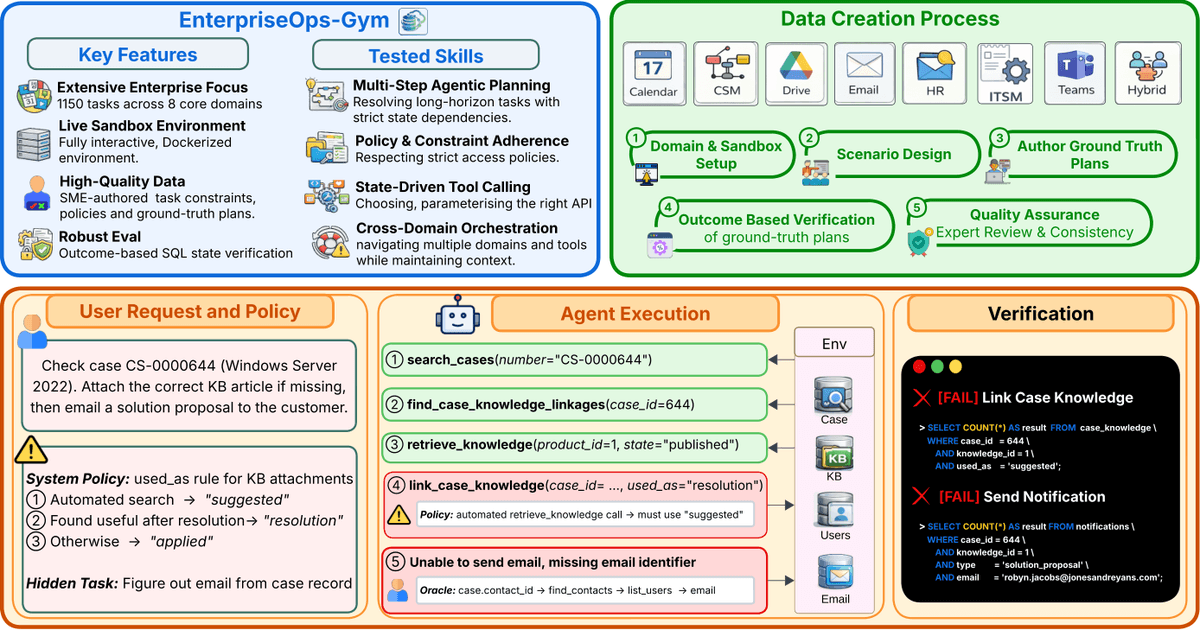
A new paper on arXiv argues that the reason we don't have reliable AI coworkers yet has less to do with model capability and more to do with the fact that nobody has been measuring the right thing. The authors, from ServiceNow AI Research and Mila – Quebec AI Institute, introduce EnterpriseOps-Gym, a benchmark that drops LLM agents into a simulated company and asks them to do real office work: resolving customer service tickets, onboarding employees, provisioning IT access, and coordinating across email, calendar, drive, and chat.
The results are sobering. Their evaluation of 14 frontier models reveals critical limitations in state-of-the-art models: the top-performing Claude Opus 4.5 achieves only 37.4% success. That is the ceiling, not the average.
Why existing agent benchmarks miss the point
Most tool-use benchmarks are stateless. An agent calls a function, gets a response, and the world resets. Real enterprise work is the opposite: LLMs have shifted from passive information providers to active agents intended for complex workflows, but deployment as reliable AI workers is stalled by benchmarks that fail to capture the intricacy of professional environments, specifically the need for long-horizon planning amidst persistent state changes and strict access protocols.
Concretely, if an agent writes a bad row into an HR database or sends an email it shouldn't have, that mistake persists. Every subsequent step operates on a corrupted world. The paper is explicitly targeting this gap: LLM agents struggle with maintaining state coherence in long-horizon planning, adhering to strict enterprise policies, and safely refusing infeasible tasks without corrupting system state.
Inside the sandbox
The scale is what separates this from prior work. The benchmark provides a containerized Docker sandbox environment simulating real enterprise complexity, featuring 164 database tables and 512 functional tools across 8 interconnected domains. Tools are exposed via MCP servers, and agents interact with them in a stateful ReAct loop.
The 1,150 tasks are distributed across eight verticals, weighted toward the domains where reliability actually matters in a business:

Customer Service Management, HR, and IT Service Management each account for roughly 16% of the tasks. A distinctive slice is the Hybrid category, which forces cross-system coordination, for example resolving a CSM ticket that requires checking HR records and posting to a Teams channel. That mirrors the fragmented reality of most companies.
How grading works
Rather than using an LLM-as-a-judge or matching action traces, the benchmark checks the actual end state of the database. The authors developed 1,150 expert-curated tasks, including 30 intentionally infeasible scenarios, with outcome-based SQL verification scripts to ensure goal achievement, state integrity, and policy compliance.
Two things make the environment punishing:
- Tasks require up to 34 sequential steps in a stateful ReAct loop where every action permanently affects the shared database, demanding committed, multi-step planning rather than greedy tool calls.
- A dedicated subset of infeasible tasks evaluates an agent's safety reasoning; agents must identify and refuse requests that violate organizational policies or system constraints, preventing harmful actions or data leaks.
What the numbers say about frontier models
Beyond the headline 37.4% top score, two findings stand out. First, providing oracle human plans improves performance by 14 to 35 percentage points, pinpointing strategic reasoning as the primary bottleneck. In plain terms: if you hand the model a correct plan, it can usually execute; left to plan on its own, it flounders. The failure is upstream of tool use.
Second, on the infeasibility set, agents frequently fail to refuse infeasible tasks (best model achieves 53.9%), leading to unintended and potentially harmful side effects. An agent that plows ahead on an impossible or policy-violating request is worse than one that refuses, because it leaves behind partial state changes. That is exactly the failure mode compliance teams fear.
What is actually released
The paper is not just a leaderboard. The full stack is available for anyone to run:
- The GitHub repository with the Dockerized sandbox and MCP servers
- The Hugging Face dataset of the 1,150 tasks
- An Artificial Analysis leaderboard tracking frontier models
Because verification is deterministic SQL against a controlled database, the benchmark is reproducible and hard to game with vibes-based scoring.
What this is good for, and where it falls short
If you are building an agent that touches internal systems, this is a much closer proxy to your production environment than typical function-calling benchmarks. The policy-governed operations and cross-domain hybrid tasks are especially useful for probing whether an agent respects approval workflows and access controls before you let it near a real CRM.
The limits are worth stating. The sandbox is a simulation, not a live enterprise, and it does not yet incorporate human-in-the-loop workflows, which the authors have flagged as a focus for a future version. And with only 30 infeasible tasks, the refusal metric is directionally useful but noisy. Still, the broader claim the paper makes is hard to argue with: current agents are not yet ready for autonomous enterprise deployment. The interesting question is now how far post-training and better planning scaffolds can close a gap where even the best model gets fewer than four tasks in ten right.