
ServiceNow's DRBench Reveals Top AI Agents Miss 58% of Critical Enterprise Insights
ServiceNow Research releases DRBench, the first benchmark that tests AI agents on real enterprise deep research tasks spanning private files, emails, and the open web
 Pro
Takeaways
- ServiceNow Research releases DRBench, the first benchmark for AI agents on enterprise deep research tasks combining public web and private organizational data.
- 100 tasks across 10 domains (Sales, Cybersecurity, Compliance, etc.) with 1,093 ground-truth insights injected into realistic enterprise files (PDFs, emails, chats, spreadsheets).
- Even the best system (OpenAI Deep Research with GPT-5) only recalls ~42% of critical insights, despite scoring 93% on report quality — agents write polished reports while missing key facts.
- No agent successfully retrieved any external web insights (0% external recall across all models), revealing a fundamental gap in missing-knowledge detection and query formulation.
- Browser-only agents (GPT-4.1) nearly completely fail at 1.11% insight recall, while API-based agents with adaptive planning perform significantly better.
- Fully open-source with a self-hosted Docker environment; code and data available at GitHub and HuggingFace.
Every enterprise analyst knows the pain: the answer to a critical strategic question is buried somewhere across a SharePoint folder, three Slack threads, a compliance PDF, and a regulatory website. Now, ServiceNow Research has built a benchmark to measure whether AI agents can actually do that job. DRBench is the first benchmark designed specifically to evaluate AI agents on complex, open-ended deep research tasks in enterprise settings, combining public web retrieval with private organizational data in a fully reproducible environment.
The gap nobody was measuring
The deep research agent space has exploded. Systems like Gemini Deep Research, Perplexity, and open-source frameworks like smolagents and OpenHands can synthesize impressive web-based reports. But production enterprise use is a different beast. Most deep research agents look compelling on public-web question sets, but production usage hinges on reliably finding the right internal needles, ignoring plausible internal distractors, and citing both public and private sources under enterprise constraints.
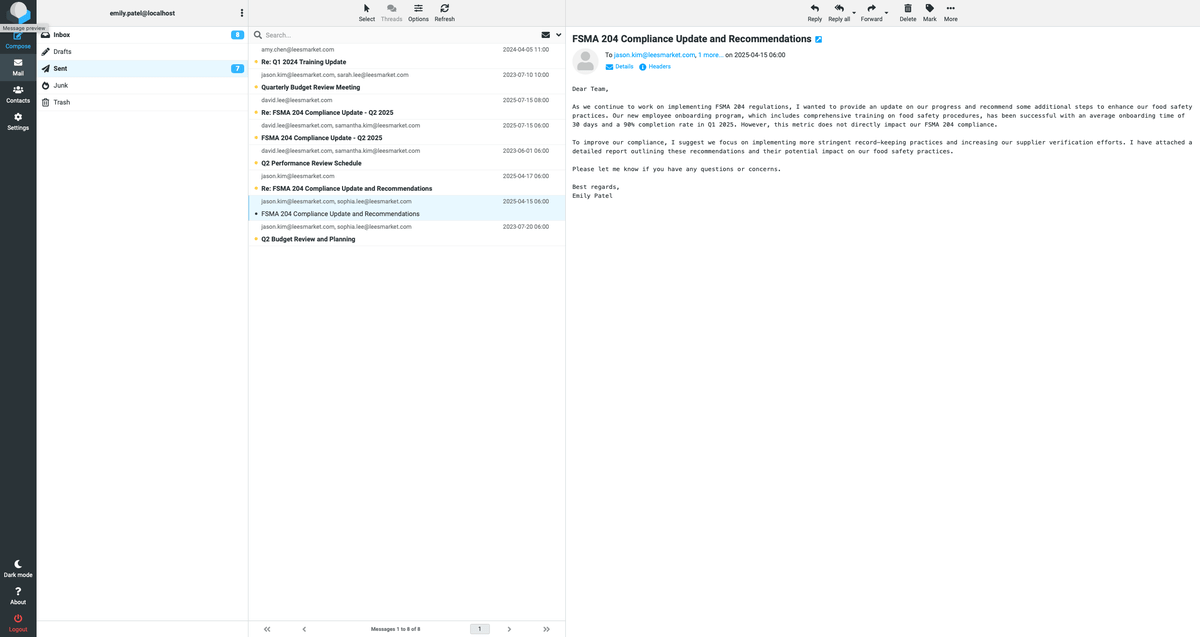
Unlike web-only testbeds, DRBench stages heterogeneous, enterprise-style workflows including files, emails, chat logs, and cloud storage, so agents must retrieve, filter, and attribute insights across multiple applications before writing a coherent research report. Prior benchmarks like DeepResearchGym, GAIA, and Mind2Web 2 all evaluate web-only retrieval or simple fact lookup. None of them ask an agent to cross-reference a regulatory document on the web with an internal spreadsheet buried in a cloud drive.
What the benchmark actually tests
DRBench benchmarks AI agents on enterprise deep research with 100 persona-grounded tasks across diverse domains and 1,093 files, with agents evaluated on insight recall, factuality, and report quality. Tasks span 10 enterprise domains across three synthetic companies: a supermarket chain (Lee's Market), a virtual healthcare provider (MediConn Solutions), and an EV manufacturer (Elexion Automotive).

The questions are deliberately strategic and open-ended, not factual lookups. Examples include:
- "How can Lee's Market leverage FSMA 204 regulations to enhance food safety and customer trust?"
- "What changes should we make to our product roadmap to ensure compliance with this standard?"
- "What is the impact of third-party data breaches on MediConn's virtual healthcare platforms?"
Each task is grounded in realistic user personas and enterprise context, spanning a heterogeneous search space that includes productivity software, cloud file systems, emails, chat conversations, and the open web. Difficulty scales from easy (2 applications, 3 insights) to hard (5 applications, up to 16 insights buried among 33 distractors).
A five-stage factory for realistic tasks
Generating realistic enterprise research tasks at scale is its own hard problem. The team built a five-stage LLM pipeline with human-in-the-loop verification at every step.

- Company and Persona Generation: LLMs produce synthetic company profiles (industry, revenue, market position) and realistic employee personas like a Regulatory Affairs Manager or Market Research Analyst.
- Public Source Collection: The pipeline retrieves candidate URLs from authoritative, time-stable sources (industry reports, journal articles) and extracts structured business insights from them. Human annotators select and validate the final URL per task.
- Question Generation: Given the company, persona, and public insight, an LLM proposes several open-ended candidate research questions. Human annotators select and refine one, ensuring it requires both public and private data to answer fully.
- Internal Insight Generation: LLMs generate company-specific supporting facts (e.g., "Lee's Market reduced food waste by 8% in Q2 2024, saving $1.2M") plus plausible distractor insights that are topically related but irrelevant to the question.
- File Mapping and Generation: Each insight is assigned to a file modality (PDF, DOCX, XLSX, PPTX, email, chat) using a "needle-in-a-haystack" process: create an outline, inject the insight naturally, then fill the rest with realistic but irrelevant content.
The resulting environment runs inside a self-contained Docker container integrating Nextcloud (file sharing), Mattermost (team chat), Roundcube (email), and FileBrowser (local files). Each service exposes both a web UI for browser-based agents and a programmatic API for API-calling agents.
Three ways to score a research report
DRBench evaluates agent outputs on three axes, all operating at the level of atomic insights rather than treating the full report as a single unit. This design allows partial credit and pinpoints exactly where agents fail.
- Insight Recall: Did the agent surface the ground-truth insights injected into the enterprise files? An LLM judge compares each predicted insight against the ground-truth set. To prevent gaming by copying entire documents, only the first k+5 insights are evaluated, where k is the number of ground-truth insights.
- Distractor Avoidance: Did the agent avoid including plausible-but-irrelevant distractor insights? Defined as 1 minus distractor recall.
- Factuality: Are the agent's cited claims actually supported by the cited source? Verified using a retrieval-augmented pipeline that fetches the top-5 chunks from the cited document and asks an LLM judge whether the evidence supports the claim.
- Report Quality: A holistic 1-10 score across six dimensions: depth of analysis, relevance, persona consistency, coherence, absence of contradictions, and completeness.
Human validation confirmed the LLM-as-a-judge setup is reliable: across 264 evaluated insights, there was over 91.3% agreement between human annotators and the LLM judge, with a Cohen's kappa of 0.683 (substantial agreement).
The numbers are humbling
The headline finding is stark. Even the best agents struggle to actually find the critical insights. Here is how major models performed on the full benchmark:
| Model | Insight Recall | Factuality | Distractor Avoidance | Report Quality |
|---|---|---|---|---|
| OpenAI Deep Research (GPT-5) | 41.96% | 83.64% | 96.88% | 93.02% |
| Gemini Deep Research | 40.88% | 81.32% | 96.41% | 91.54% |
| DRBA (GPT-5) | 36.52% | 72.11% | 93.22% | 93.41% |
| Perplexity | 34.21% | 76.08% | 96.12% | 87.41% |
| DRBA (DeepSeek-V3.1) | 22.6% | 68.4% | 94.9% | 84.1% |
| DRBA (GPT-4o) | 16.23% | 61.44% | 95.86% | 89.94% |
| Browser-only agent (GPT-4.1) | 1.11% | 6.67% | -- | 33.07% |
The pattern is consistent: agents are excellent at avoiding distractors (95%+ across the board) and producing well-structured reports (80-93%), but they dramatically underperform on the core task of actually finding the right insights. Even the best system, OpenAI Deep Research, only recalls about 42% of the ground-truth insights. The browser-only agent, which navigates the enterprise apps through a web UI rather than APIs, nearly completely fails with just 1.11% insight recall.
The real bottleneck: web retrieval is broken
One of the most striking findings is that no agent successfully retrieved any external web insights. Every model scored 0.0 on the "External Fact" recall column across all configurations. The failure mode is revealing: when a task requires regulatory information (like FSMA 204 rules) that does not appear in the enterprise files, agents generate broad queries like "grocery store customer trust" instead of targeted searches for the specific regulation. This points to a fundamental gap in missing-knowledge detection. Agents do not know what they do not know, and they do not formulate targeted web queries to fill those gaps.
A second key finding is the planning trade-off. Adaptive Action Planning (AAP), which dynamically generates new search actions based on gaps detected after each iteration, produces the largest gains in insight recall. But combining AAP with structured research plans (CRP or SRP) often hurts factuality, likely because overlapping strategies create redundant or unstable planning behavior. The best overall performance comes from moderate iteration counts (15 steps), not from scaling up to 50 steps, where additional exploration introduces noise.
What this is good for, and what it is not
DRBench is directly useful for teams building or evaluating enterprise AI research agents. The self-hosted Docker environment means you can run your own agent against the benchmark without sending proprietary data anywhere. The open-source codebase and HuggingFace dataset make it straightforward to reproduce results or add new tasks.
That said, the benchmark has deliberate limitations worth knowing:
- Finite domain coverage: Tasks span only three industries (retail, healthcare, EVs) and 10 task domains. Cross-team decision making, longitudinal audits, and incident response are not yet covered.
- Atomic insight evaluation: Scoring operates at the level of discrete facts, not span- or token-level grounding, which limits fine-grained attribution analysis.
- Synthetic data: All enterprise files and personas are synthetically generated, which may not capture the full messiness of real organizational data.
- No novel insight credit: The benchmark cannot reward agents for discovering genuinely useful insights beyond the injected ground truth set.
Why this matters beyond the leaderboard
The deeper contribution here is a methodology, not just a score. DRBench establishes that evaluating enterprise AI agents requires a fundamentally different setup than web-only benchmarks: a live, multi-application environment, persona-grounded tasks, and insight-level scoring that separates recall from report quality. The fact that even GPT-5-powered systems only recall 42% of critical insights, while scoring 93% on report quality, exposes a dangerous illusion: agents can write polished, confident-sounding reports while missing most of the decision-critical information. For anyone deploying these systems in compliance, sales, or cybersecurity workflows, that gap is the whole problem.
The paper and all benchmark code, data, and evaluation scripts are available under a permissive license, with the full environment containerized for reproducible evaluation.