
ServiceNow's DoubleCast Beats Unimodal Forecasters by Actually Reading Text
ServiceNow Research releases CAF-7M, a 7 million window dataset and DoubleCast model that finally makes text-augmented time series forecasting work.
 Pro
Takeaways
- ServiceNow Research released CAF-7M, a 7 million window context-aided forecasting corpus with a verified test set.
- Multimodal time series models have historically failed to beat unimodal ones due to unverified context quality in training data.
- The pipeline uses Llama-3.3-70B to generate scenarios then filters by whether context reduces CRPS on a Direct Prompt forecaster.
- DoubleCast extends Chronos with dual cross-attention over Qwen3-14B text embeddings, only training the new fusion layers.
- DoubleCast beats Chronos on 71% of test windows and generalizes zero-shot to the real-world CGTSF benchmark.
- Dataset on Hugging Face, code on GitHub.
Time series forecasting has a modality problem. For years, researchers have tried to give numerical forecasters access to unstructured text such as incident reports, weather notes, or event descriptions, hoping that context would push accuracy past what a purely numerical model can achieve. The results have been underwhelming. A team from ServiceNow Research, McGill, and Mila argues the fault is not in the architectures but in the training data itself, and they have built a dataset and model to prove it.
Their paper introduces CAF-7M, a corpus of 7 million context-augmented time series windows, alongside DoubleCast, a multimodal architecture built on top of the Chronos foundation model. The results demonstrate that semi-synthetic pre-training transfers effectively to real-world evaluation, and show clear evidence of context utilization.
Why multimodal forecasters keep losing to their unimodal cousins
Context-aided forecasting (CAF) is the task of predicting future numerical values given both a numerical history and some natural language description, like operational notes, expert narratives, or forward-looking factors such as disruptions or policy changes. In theory this should beat any purely numerical forecaster. In practice, recent empirical analyses show that multimodal forecasting models that fuse time series with textual context frequently fail to outperform unimodal baselines.
The authors trace the problem to how existing CAF datasets are built. Most rely on scraping timestamped news articles or reports and pairing them with numerical series, but whether that text actually carries predictive signal about the future values is unverified. Even benchmark test sets suffer from this issue because creating and verifying reliable benchmarks requires human annotators with both domain expertise and time series proficiency to assess whether contexts provide a complementary predictive signal. Without provably useful context, you cannot tell whether your model is bad at using context or the context itself is worthless.
Generate, then verify
The methodology is a two-stage pipeline: generation followed by verification. First, a large language model is prompted with both the historical window and the future values, plus a short description of the data domain, and asked to produce a plausible scenario that would explain any shifts in dynamics. Llama-3.3-70B-Instruct handles this step. Prompts explicitly instruct the model to avoid repeating scenarios from previously generated contexts, which counters the tendency of LLMs to produce redundant output even at high temperatures.

The verification step is what makes this work novel. A Direct Prompt forecaster with a strong LLM as the distribution estimator is used, with Continuous Ranked Probability Score (CRPS) as the proper scoring rule. Samples for which the CRPS with context exceeds the CRPS without context are discarded, considering that the context may be insufficiently informative. Only pairs where adding context measurably improves the forecast survive. CRPS is a standard metric for probabilistic forecasts that penalizes both wrong point predictions and miscalibrated uncertainty.
For cost reasons, the expensive verification (using GPT-5.2 as the verifier) is only applied to the test set, yielding 904 rigorously vetted windows out of the 7.4 million total. Windows are further split by difficulty using a Mean Absolute Scaled Error threshold of 1.5 on Chronos forecasts, giving 490 HARD and 414 EASY test cases.
DoubleCast: dual cross-attention on top of Chronos
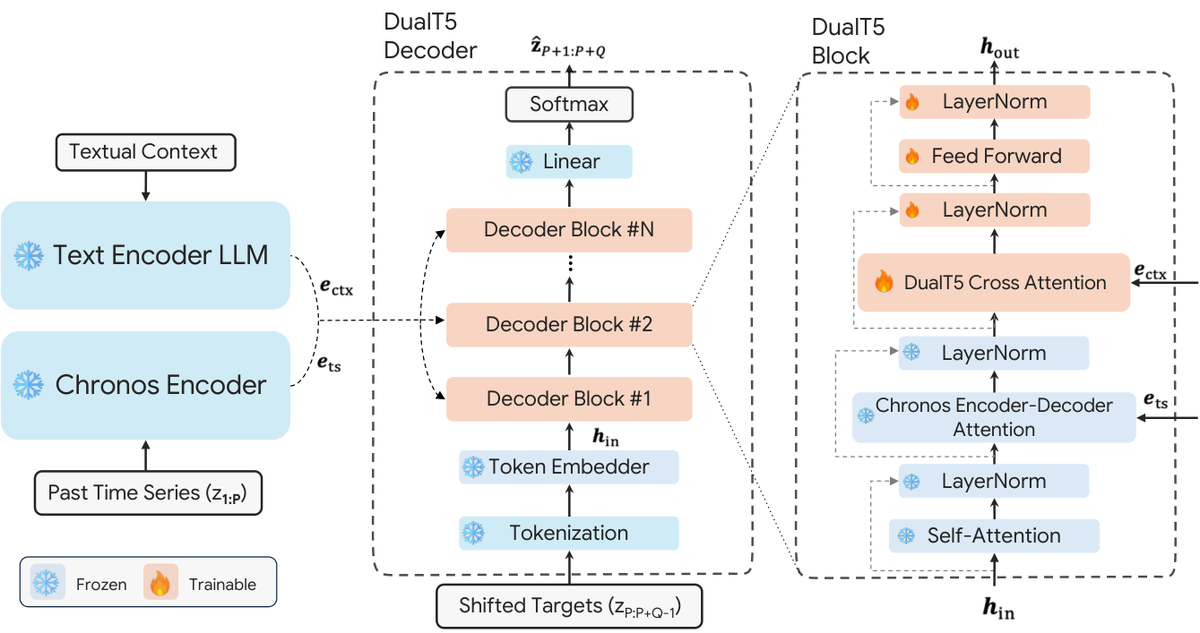
To validate that the dataset actually trains useful models, the team built DoubleCast. The architecture keeps Chronos frozen and adds a text conditioning pathway. It has three components:
- A time series encoder inherited from Chronos that produces embeddings from the numerical history
- A pretrained text encoder (Qwen3-14B) that encodes the context, with embeddings pulled from the second-to-last hidden layer
- A DualT5 decoder where each block adds a second cross-attention layer that attends to the text embeddings, on top of the standard Chronos encoder-decoder attention
Only the newly added cross-attention layers, their layer norms, and the FFN sublayers in the dual blocks are trained. Everything else is frozen. Training runs for 400,000 steps on a single H100 with AdamW, a cosine schedule, and a learning rate of 1e-4.
The numbers
On the CAF-7M test set, DoubleCast reaches a CRPS of 0.231, coming in second only to Direct Prompt with GPT-5.2 at 0.217, which happens to be the same model used to filter the test set in the first place. Chronos, its unimodal counterpart, sits at 0.278. More importantly, DoubleCast wins against Chronos on 71% of windows.
The real evidence that DoubleCast actually reads the context comes from ablations. DoubleCast actively uses the context since both metrics are markedly worse when context is missing or swapped, with the CRPS increasing from 11.1% to 26.5% and the Win Rate decreasing from 21.5% to 41.9%. By contrast, TimeLLM trained on the same data sometimes performs better when context is removed, suggesting it never learned to use the text properly.
On the real-world CGTSF benchmark used to train ChatTime, a fine-tuned DoubleCast beats both Chronos and ChatTime on nearly every dataset and prediction length combination. Even without fine-tuning, DoubleCast trained purely on the synthetic CAF-7M generalizes to two of three real-world CGTSF splits, which is the strongest evidence yet that simulated-to-real transfer works for context-aided forecasting.
Where it breaks
The authors are honest about failure modes. The verifier is an LLM, so accepted contexts are biased toward patterns that the specific verifier can exploit. Filtering is also too expensive to run on the full 7 million training set, leaving training contexts potentially noisy. And DoubleCast has a specific weakness with time-local grounding: when context specifies precise temporal localization like a disruption occurring during the first two days of the horizon, the cross-attention can diffuse the signal across the entire prediction window, smearing the effect.
The dataset ships on Hugging Face and the model code is on GitHub. If you have been trying to build multimodal forecasters and consistently failing to beat a good unimodal baseline, this work offers a straightforward alternative starting point.