
SERN Keeps Robot Digital Twins Accurate Within 5 cm During Network Blackouts
A cross-reality framework keeps a Unity virtual twin locked to a physical robot within 5 cm even when communication drops for 30 seconds.
 Pro
Takeaways
- SERN couples a Unity virtual twin to a physical Clearpath robot through a bandwidth-adaptive ROS bridge
- Predictor-corrector synchronization keeps position error under 5 cm and rotation under 2 degrees
- Cuts end-to-end ROS latency 15 to 25 percent and processing load about 15 percent versus standard ROS
- Navigation success rate hits 95 percent versus 85 percent real-only and 70 percent sim-only across 20 trials
- Survives a 30 second communication blackout with 5 cm drift, versus over 20 cm for fixed PD baseline
- Multi-metric cost function picks bridge settings at runtime for teleoperation or mapping profiles
Robots operating far from base stations rarely enjoy the clean, low latency networks assumed by most middleware. Links drop, bandwidth shrinks, and any digital twin running back at the operations center quickly drifts from what the robot is actually doing. A team from UMBC, Stormfish Scientific, and DEVCOM Army Research Lab has published SERN, a framework that treats communication and synchronization as a single problem and keeps a Unity twin aligned with a Clearpath Jackal or Husky through packet loss, latency, and full communication blackouts.
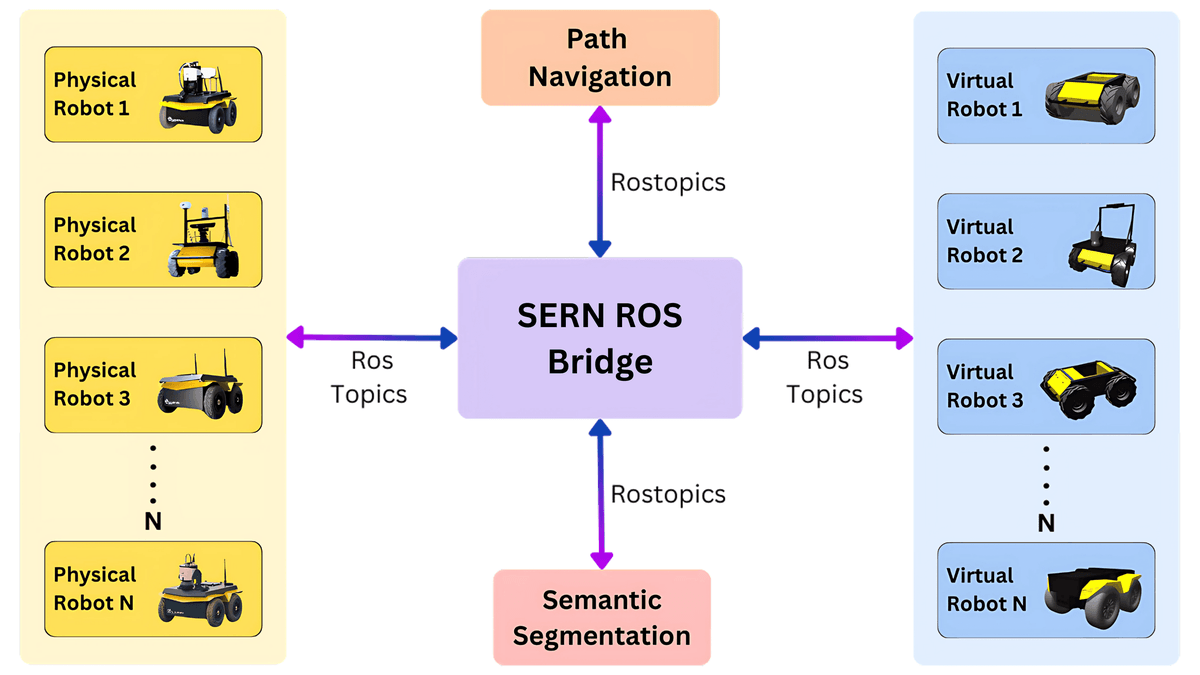
SERN builds a virtual twin from geospatial and sensor data, then continuously corrects it using live robot telemetry through a physics-aware synchronization pipeline that combines predictive modeling with adaptive PD control. On top of that sits a bandwidth-adaptive ROS bridge that decides which topics get through when the pipe narrows. The authors validate the whole thing on a single physical robot navigating an outdoor course while a Unity twin runs on a separate network across an AuroraXR relay server.
Why a twin drifts
A simulation-side twin is only useful when it stays close to the physical robot. SERN builds on an AuroraXR communication path and extends it with bandwidth aware topic scheduling, explicit support for synchronization critical state updates, and a predictor correction mechanism that keeps the twin aligned when the connection degrades. Standard ROS forwards everything equally and snaps state on arrival, which either saturates the link or produces visible jumps in the twin when telemetry finally lands after a gap.

SERN's bridge assigns every message a priority score that combines topic criticality, message size, and how long it has been waiting in the queue. Command messages, pose, and velocity form the highest priority class, obstacle summaries and map corrections sit in the middle, and dense debug streams get dropped first when bandwidth tightens. The bridge also favors compact task-relevant summaries such as occupancy updates over raw point clouds, and it maintains a small replay buffer so that when a dropout ends, the receiver gets the most recent state without waiting for the next full update cycle.
Predicting through the blackout
The synchronization loop is the interesting theoretical piece. Between telemetry packets, the virtual robot advances using a constant-acceleration prediction derived from the last IMU and odometry history plus the most recent motion command. When fresh telemetry arrives, a PD controller nudges the virtual state toward the physical state rather than snapping to it. The proportional and derivative gains decay exponentially with outage duration, so short gaps get corrected sharply while long gaps are corrected gently.
The paper proves a finite-interval error bound: as long as the control mismatch between physical and virtual sides stays bounded during a communication gap, the position error grows in a controlled quadratic fashion rather than diverging. The empirical test is a 30 second blackout with the robot in motion. When the link came back:
- SERN's predictor-corrector held the error to roughly 5 cm
- A fixed-gain PD baseline with no predictive propagation drifted past 20 cm
The numbers
Under moderate delay and loss, SERN reduces end-to-end message latency by 15% to 25% and processing load by about 15% compared with a standard ROS setup, while maintaining tight real-virtual alignment with less than 5 cm positional error and less than 2 degrees rotational error. The navigation task, run 20 times per mode, showed a clearer picture of why coupling helps:
| Mode | Success | Time to goal | Interventions |
|---|---|---|---|
| Real only | 85% | 124.2 s | 1.3 |
| Sim only | 70% | 109.7 s | 1.9 |
| SERN | 95% | 98.5 s | 0.4 |
Sim-only failed frequently because the virtual world contained fallen logs on a bridge that was actually clear in the real environment. Real-only was safer but slower because the robot had no look-ahead of the terrain. SERN used the twin for preview while letting live sensor data override any stale virtual assumption, always favoring physical sensors for safety.
The cost function that ties it together
Bridge behavior is chosen at runtime by a multi-metric cost function that combines normalized latency, reliability, compute, and bandwidth with mission-dependent weights. A teleoperation profile weights latency heavily; a mapping profile weights bandwidth. Against fixed-throughput and fixed-reliability baselines, MMCF achieved the lowest total operational cost on both profiles (0.39 vs 0.43 and 0.56 for teleoperation; 0.32 vs 0.38 and 0.63 for mapping).
Where it fits and where it does not
This is a systems paper rather than a model release, so there is no downloadable checkpoint. There is a video demonstration but no public code repository referenced in the paper. The framework is worth studying if you are building:
- Remote operations centers that visualize field robots over unreliable links
- Digital twin pipelines that need to survive intermittent WiFi or cellular
- Sim-to-real workflows where the virtual scene needs live corrections from real telemetry
- Multi-network ROS deployments where a single ROS master is not practical
The limitations are honest. The field validation used one physical robot, with additional load synthesized through replayed ROS bag streams under separate namespaces. The finite-interval error bound assumes bounded control mismatch, which can break under sharp maneuvers or extended outages. The semantic segmentation piece relies on a domain adaptation step to align virtual and real LiDAR features, a known fragile bridge in itself. As a template for building twins that survive contact with degraded networks, SERN gives a clean recipe: prioritize by criticality, predict through gaps, correct on return.