
Serbia's AI Institute Cuts Factory Robot Bandwidth Without Losing 90% Accuracy
New research shows wireless robots can classify 3D objects reliably even when the transmitted point cloud reconstruction falls apart under channel noise.
 Pro
Takeaways
- End-to-end semantic communication framework transmits 3D point clouds by compressing them to a single latent vector.
- PointNet++ encoder feeds parallel geometric reconstruction and object classification heads at the receiver.
- Multi-class classification hits ~90% accuracy even as reconstruction Chamfer distance degrades an order of magnitude.
- Trained across SNR from -4 to 8 dB with latent dimensions of 64 or 256 on real industrial data.
- Custom dataset captured with a Zivid 3D camera over a welding workbench, six object classes.
- No code released; channel modeled as clean AWGN, leaving multipath and hardware validation for future work.
Industrial robots increasingly rely on 3D point clouds streamed over wireless links, which raises an awkward question: how much of that geometry actually needs to survive the trip? A new paper from researchers at the Institute for AI Research and Development of Serbia argues that the answer, for most factory tasks, is a lot less than you would think. Their end-to-end semantic communication framework shows that object classification stays near 90 percent accurate even when the reconstructed point cloud has visibly degraded.
The bandwidth problem on the factory floor
High-resolution 3D perception has become a cornerstone of modern industrial automation, enabling collaborative robotics, inspection, and precision manufacturing. The catch is that point clouds are huge, latency budgets are tight, and wireless spectrum in a factory is finite. Conventional point cloud compression techniques primarily target geometric rate-distortion optimization. While effective for storage and visualization, such methods treat point clouds as purely geometric signals and overlook the ultimate objective of many industrial systems: reliable task execution.
In other words, standard codecs like MPEG's V-PCC and G-PCC try to preserve every millimeter of coordinate detail, even when the downstream robot only needs to know whether it's looking at an L-shaped pipe or a T-shaped one. The authors argue this is wasted bandwidth.
One latent vector, two jobs
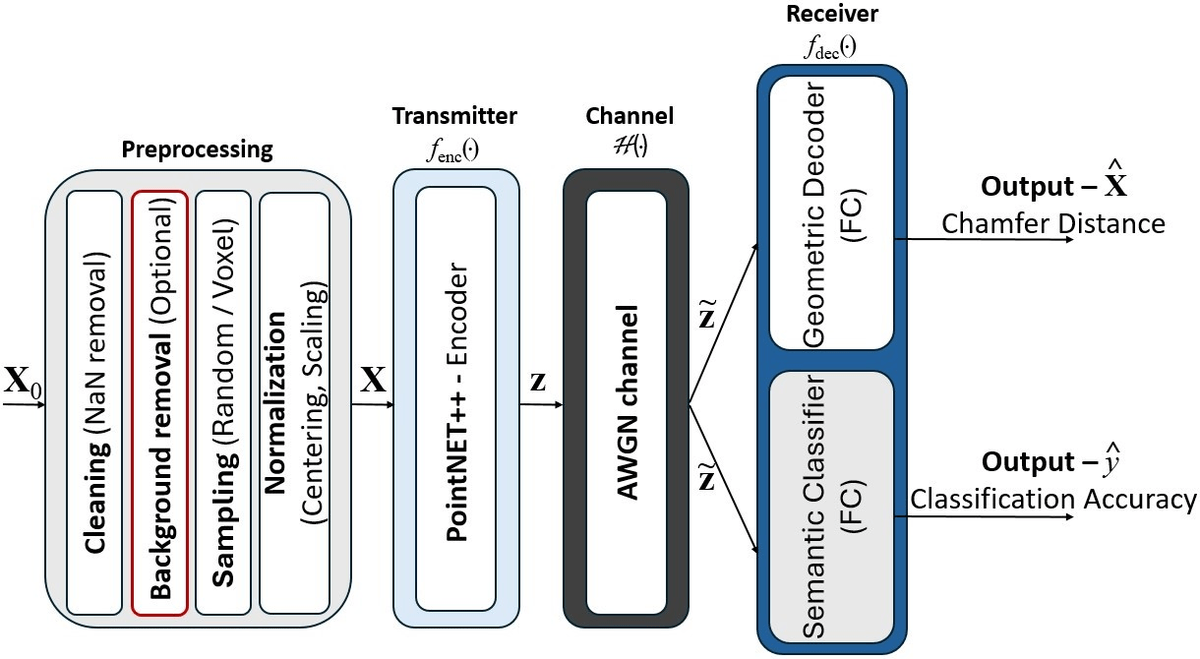
The proposed system is a jointly trained encoder-decoder that transmits a single compressed vector across a noisy wireless channel, then splits into two parallel heads at the receiver. Here is the pipeline in plain terms:
- Encoder: A PointNet++ network with three set-abstraction layers reduces a 2048-point cloud to a compact latent vector of dimension 64 or 256.
- Channel: The latent is normalized to unit power and passed through a simulated additive white Gaussian noise channel that acts as a differentiable layer during training.
- Geometric decoder: A fully connected network that regenerates 2048 3D points from the noisy latent.
- Semantic decoder: A lightweight classifier head that predicts the object class from the same noisy latent.
During training, the SNR is randomly sampled from {-4, -2, 0, 2, 4, 6, 8} dB on a per-batch basis to enforce robustness against channel variations and improve generalization to mismatched operating conditions. The training loss combines Chamfer distance for reconstruction with categorical cross-entropy for classification, letting the encoder learn what to preserve rather than being told upfront.
A welding bench as a benchmark
Instead of leaning on generic point cloud datasets like ModelNet, the team built their own. Point clouds are captured using a Zivid structured-light 3D camera rigidly mounted above a welding workbench, emulating a fixed overhead sensing configuration commonly used in industrial inspection and robotic manipulation. The dataset contains six classes of welding and assembly components, split evenly between scenes with and without clamps present to introduce realistic occlusions.

The asymmetry that matters
Now the interesting part. When the researchers swept SNR from -4 dB to 8 dB and measured both branches, they found the two metrics tell very different stories.
When background removal is applied, accuracy approaches 90% at high SNR and degrades gradually as SNR decreases, indicating stable semantic robustness. Binary clamp detection stays near-perfect across essentially the entire SNR range. Meanwhile, geometric reconstruction quality is far more fragile: After removing the background, the Chamfer distance increases by approximately one order of magnitude across all SNR values, reflecting a more challenging and realistic object-centric reconstruction scenario.
The takeaway is a decoupling that conventional communication engineering usually assumes doesn't exist. Small coordinate-level deviations that increase Chamfer distance do not necessarily alter high-level semantic cues required for classification. This asymmetry is particularly evident in the multi-class setting: despite a noticeable drop in reconstruction quality after background removal, semantic accuracy remains high, approaching 90% at favorable SNR levels.
When to reach for this approach
This is a useful design pattern if you are building perception pipelines where the endpoint is a decision, not a display. Good fits include:
- Robotic pick-and-place where the arm needs a class label and rough pose, not a museum-quality mesh.
- Quality inspection stations classifying parts on a conveyor.
- Wireless collaborative robotics operating in bandwidth-constrained or interference-heavy factory RF environments.
Where it falls short is anywhere geometric fidelity is the product itself: teleoperation with human-in-the-loop visualization, digital twin construction, or precision measurement tasks. The Chamfer distance degradation is real and visible in the reconstruction branch.

The catch
A few caveats keep this from being a drop-in solution. The dataset is small at 360 samples across six classes, and the channel model is a clean AWGN link rather than a realistic multipath or fading channel. There is no released code or pretrained model in the paper, so anyone wanting to reproduce this will need to reimplement the PointNet++ encoder, dual-head decoder, and channel layer from the description. The authors note that Future work will focus on real-world wireless implementation of the proposed framework and comprehensive system-level analysis including latency, bandwidth efficiency, and energy consumption.
Still, the underlying result is a practical design principle worth internalizing: if your wireless perception system exists to make decisions, optimize the channel for decisions, not for pixels or points.