
Seoul National University's ECKConv Beats Rotation-Blind 3D Models With 91% Accuracy
ECKConv brings full SE(3) equivariance to point cloud networks with a coordinate-based kernel that finally scales to real-world scenes.
 Pro
Takeaways
- ECKConv is a new point cloud convolution that is exactly equivariant to continuous SE(3) rotations and translations.
- It defines the kernel over a double coset space parameterized by three geometric invariants per neighbor.
- An explicit kernel using coordinate-based MLPs cuts backprop memory from O(AKC_inC_out) to O(A(KC_in + C_inC_out)).
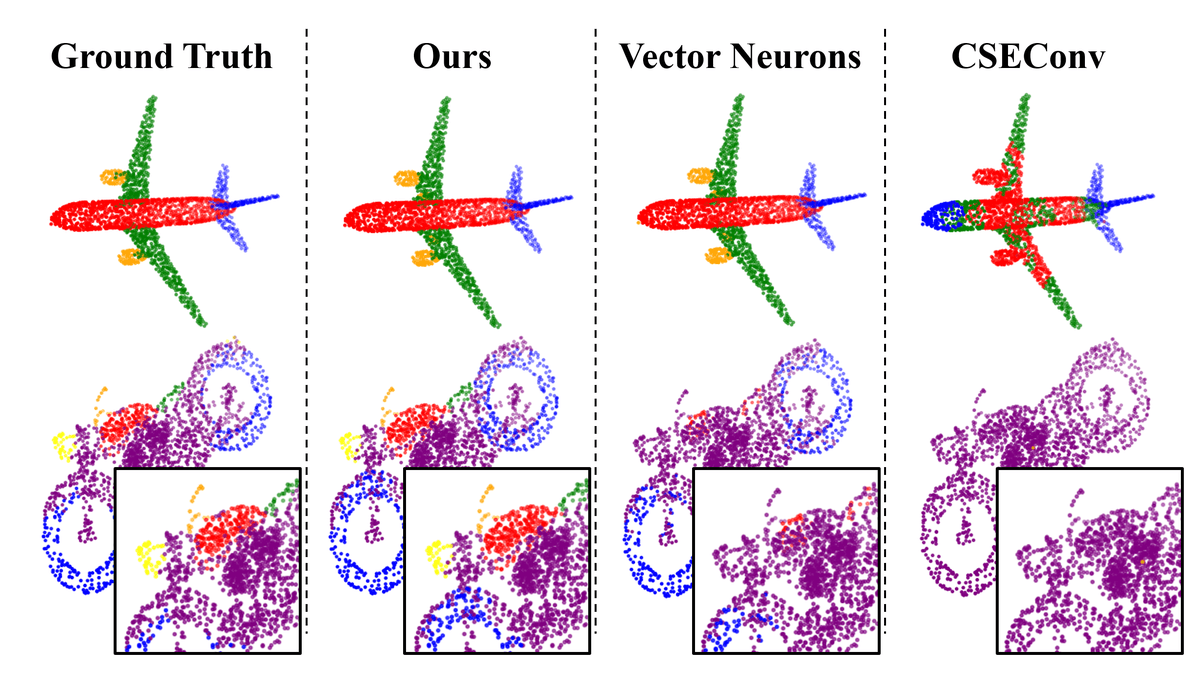
- It hits 91.37% on ModelNet40 rotated classification and 61.80% mIoU on S3DIS, state of the art for rotation-invariant methods.
- Pose registration reaches 0.63 degree mean error versus 11.70 degrees for E2PN under full SO(3) sampling.
- Read the paper on arXiv for full theory and experiments.
Point clouds from lidar scans or 3D sensors arrive in the world without a preferred orientation, yet most deep learning models assume inputs are already aligned to a canonical pose. The usual fix, throwing rotated copies into the training set, is a blunt instrument. A new architecture called ECKConv bakes rotation and translation symmetry directly into the convolution itself, and does so in a way that finally scales to real indoor scenes with hundreds of thousands of points.
Why equivariant networks have been stuck
Group convolutions are the canonical way to build networks that respect symmetries, but for 3D point clouds they have been stuck between two bad options. Prior work either failed to achieve complete SE(3) symmetry or failed to scale to large problems, motivating the need for a more advanced kernel architecture. Methods like TFN and SE(3)-Transformers use steerable convolutions that are exactly equivariant to the continuous group of rigid motions but are computationally heavy. Methods like E2PN instead buy scale by discretizing rotations, combining group convolutions with quotient representations, discretizing SO(3) to finite groups for simplicity while using SO(2) as the stabilizer subgroup to form spherical quotient feature fields that save computation. Fast, but the symmetry is only approximate.
SE(3), the group of 3D rotations and translations, is what you actually want. A truly SE(3)-equivariant network guarantees that if you rotate and translate the input point cloud, the internal features transform in a predictable, structured way, without any augmentation tricks. The catch has been that continuous SE(3) convolutions blow up in memory and compute.
A kernel that lives on a double coset space
ECKConv is built on the intertwiner framework, a piece of representation-theory machinery that lets you rewrite group convolutions as operations on quotient spaces rather than the full group. The team from Seoul National University, ENS, and Imperial College London proposes a continuous SE(3)-equivariant convolutional network with scalability using the intertwiner kernel framework.