
Seoul National University's CAQ Stops 4-bit Models From Forgetting Safety Rules
A new post-training quantization method preserves RLHF safety guardrails at 4-bit precision by contrasting the aligned model against its pre-trained base.
 Pro
Takeaways
- Standard PTQ minimizes reconstruction error, which silently erases RLHF safety guardrails at 4-bit precision.
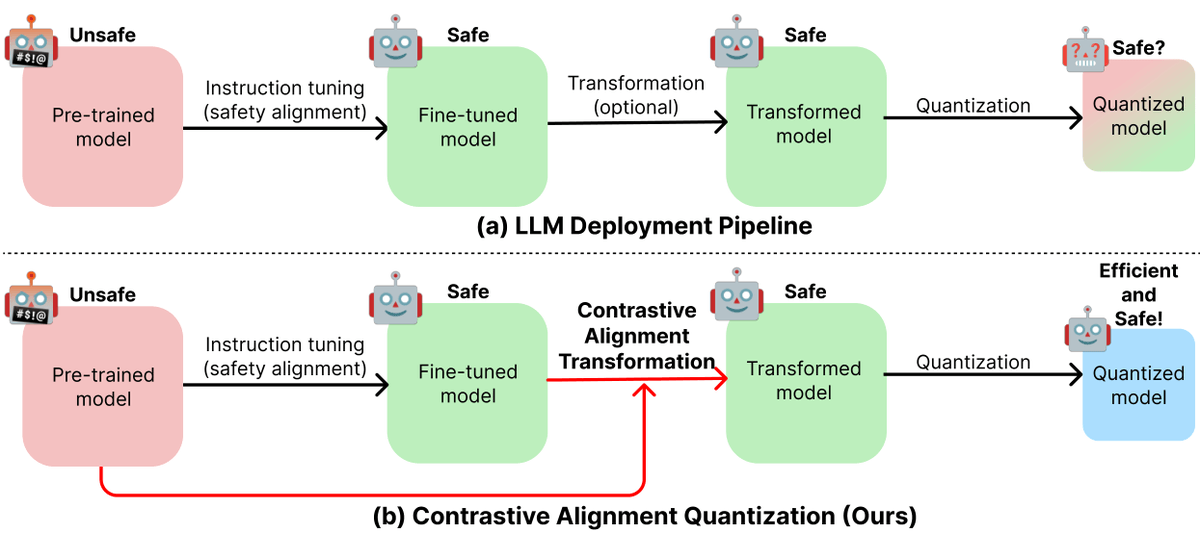
- CAQ adds a Contrastive Alignment Loss that pulls toward the fine-tuned model and pushes away from the base.
- Uses two top-k vocabulary subsets: highest fine-tuned probabilities and largest |p_FT minus p_PT| differences.
- At W4A4, CAQ achieves 60.1 SafetyBench on LLaMA3.1-8B versus 57.5 for OSTQuant, with matching zero-shot accuracy.
- Requires only 128 unlabeled WikiText samples, no safety data, and adds about 4 minutes over OSTQuant on an A100.
- Limitations include reliance on the base model and evaluation capped at 13B parameters.
Squeezing a large language model down to 4 bits is standard practice for deployment, but a growing body of research shows something unsettling: the quantized model may still sound fluent while quietly forgetting how to refuse harmful prompts. A new paper from Seoul National University proposes Contrastive Alignment Quantization (CAQ), which reframes the quantization objective itself so that safety behaviors survive the compression.
The core argument is that the field has been optimizing the wrong thing. Standard post-training quantization methods minimize reconstruction error such as MSE or KL divergence between full-precision and quantized outputs. These objectives preserve perplexity and task accuracy well, but they leave a critical question unanswered: is reconstruction error a sufficient PTQ objective for deployment-ready models? The authors demonstrate it is not, and they offer a lightweight fix that plugs into existing transformation-based pipelines.
When 4-bit models forget their manners
Modern chat models get their safety behaviors from reinforcement learning from human feedback (RLHF) and instruction tuning. These behaviors are subtle, encoded in shifts of probability mass over specific tokens. Reconstruction-based quantization has no notion of them.
Kharinaev et al. recently demonstrated that PTQ can silently erase safety guardrails instilled by RLHF, causing models to revert to unsafe behaviors despite maintaining low perplexity, a phenomenon they call alignment degradation. Related work goes further: certain safety vulnerabilities remain dormant in full-precision models but become exposed only after 4-bit quantization, and models can recover up to 83% of previously unlearned sensitive information post-quantization.