
Seoul National University's BINDER Gives Robots Eyes That Never Blink
A dual-brain robot framework pairs a slow planner with a fast video watcher, cutting task time and boosting success rates on messy real-world jobs.
Takeaways
- BINDER splits robot cognition into a slow LLM planner (DRM) and a fast Video-LLM monitor (IRM) running in parallel.
- Hits 63% success on 3-step pick-and-place versus 15% for DynaMem in office tests with moving objects.
- In real homes, SR jumps to 0.70 and 0.80 with SPL up to 3.8x higher than the best baseline.
- Uses GPT-5 for planning and Qwen2.5-VL 3B for continuous video monitoring at 8 fps on a single A6000.
- Bidirectional coordination lets the IRM trigger replans on demand while the DRM steers the IRM's attention.
- See the project page and arXiv paper for videos and details.
Most household robots that follow open-ended language instructions still act like they are checking a paper map every few minutes. They stop, scan, plan, then move, blind to whatever changes between snapshots. A team from Seoul National University built BINDER to close that gap by splitting the robot's brain into two cooperating processes: one that thinks slowly with a 3D map, and one that watches the video feed continuously and interrupts when something changes.
On a Hello Robot Stretch SE3 running three-step pick-and-place jobs where objects and receptacles get moved mid-task, BINDER hits a 63% success rate against 15% for the strongest baseline, and finishes those runs in about 22 minutes instead of 34.
Why robots go blind between waypoints
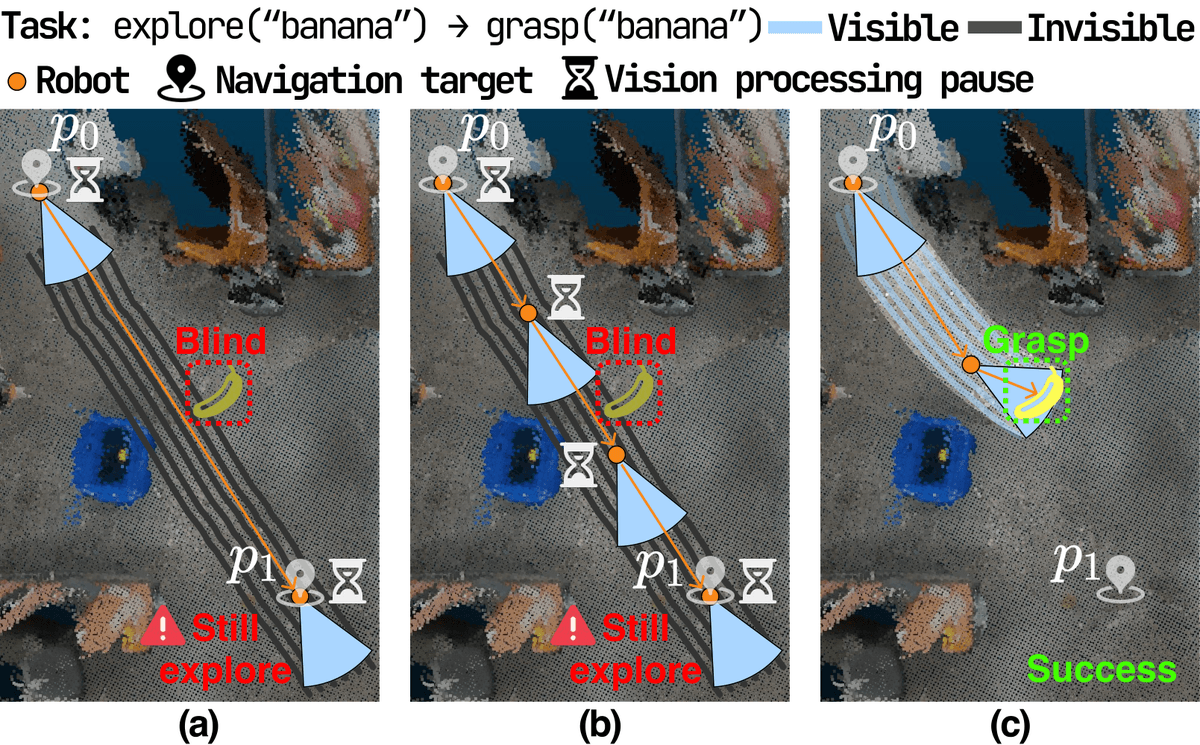
Open-vocabulary mobile manipulation, or OVMM, asks a robot to follow language instructions, navigate an unknown space, and manipulate objects while the world keeps changing around it. The dominant approach builds a rich 3D semantic map, then refreshes it at discrete milestones like navigation targets or after each grasp. That works fine in a static lab. It fails badly the moment a human walks by, slides a mug, or puts a can somewhere new.
The authors frame this as intermittent scene perception, and the tradeoff behind it is unavoidable with monolithic pipelines. Full 3D semantic reconstruction can take tens of seconds to minutes per update. Update often and the robot stalls constantly. Update rarely and it misses a banana sitting right on its path.

Two brains, one robot
BINDER borrows from dual-process cognitive theory, the idea that human thinking splits into fast automatic responses (System 1) and slow deliberate reasoning (System 2). The framework maps that onto two modules running in parallel: