
Senna-2 Cuts Self-Driving Collision Rates 30% by Fixing AI Brain Disagreements
A new dual-system driving policy fixes the mismatch between what a VLM decides and what the end-to-end planner actually does behind the wheel.
 Pro
Takeaways
- Senna-2 aligns a vision-language model with an end-to-end driving planner to fix decision-following gaps in autonomous driving stacks.
- Three-stage training: driving pre-training, open-loop consistency alignment, then closed-loop hierarchical RL in 3DGS environments.
- Uses Qwen2.5-VL-3B plus a decision adapter feeding a diffusion transformer planner via AdaLN conditioning.
- Reports 19.3% F1 gain on decision-planning consistency, 5.7% FDE reduction, and 30.6% at-fault collision rate reduction.
- Achieves 86.6 EPDMS on NAVSIM v2, beating the previous best method by 1.1 points.
- Main limitation: VLM cannot hit 10 Hz real-time inference on onboard edge devices yet, requiring async operation.
Bolting a vision-language model onto an end-to-end driving stack has become a favorite recipe for autonomous driving research. The VLM handles high-level reasoning ("there's a cyclist, slow down") while a specialized end-to-end (E2E) planner turns that intent into a trajectory. The problem is that these two brains often disagree with themselves. A team from Huazhong University of Science & Technology and Horizon Robotics has released Senna-2, a follow-up to their earlier Senna system, explicitly designed to close that gap.
The dual-system disagreement problem
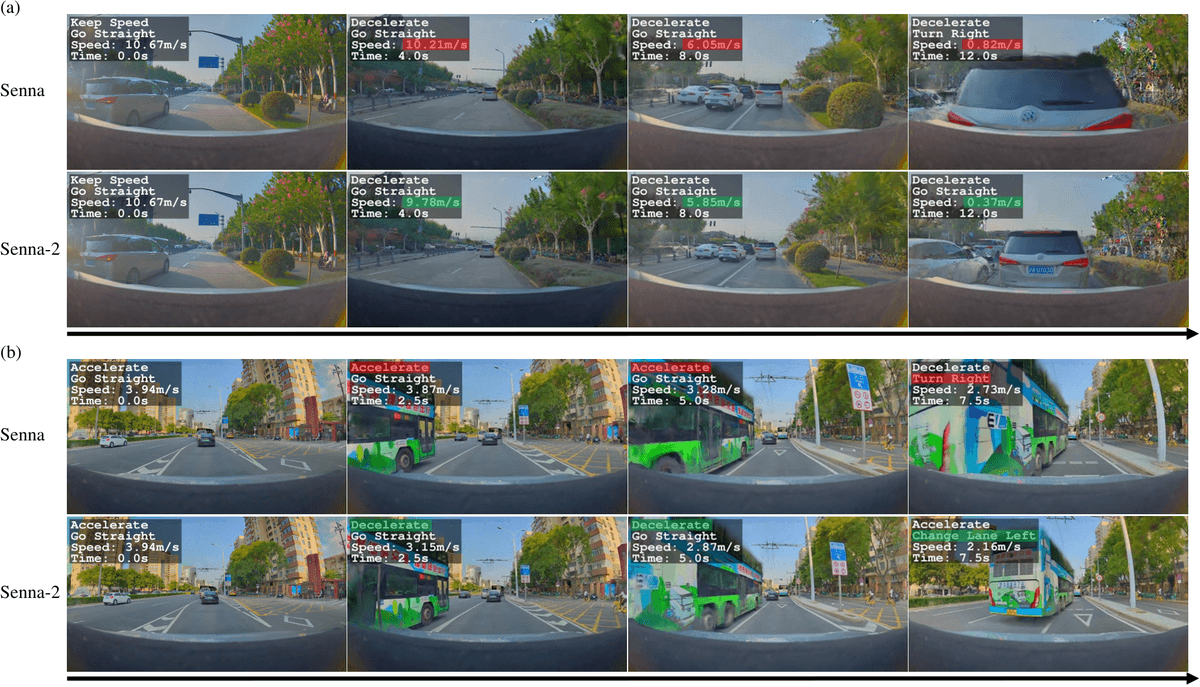
Existing approaches often overlook the dual-system consistency between VLM's high-level decision and E2E's low-level planning. As a result, the generated trajectories may misalign with the intended driving decisions, leading to weakened top-down guidance and decision-following ability of the system. In practice this means the VLM might correctly say "decelerate," but the E2E planner still produces a trajectory that accelerates into the vehicle ahead.

The authors visualize this by plotting the relative speed ratio (planned speed at 3 seconds divided by initial speed) under three fixed commands: accelerate, keep, decelerate. On the original Senna, the three distributions overlap heavily. On Senna-2, they separate cleanly, which is what you actually want from a system that claims to follow high-level intent.
Architecture: adapter as translator
The stack has three components: a VLM, a decision adapter, and an E2E planner. A decision adapter transmits VLM decisions to the E2E policy in the form of implicit embeddings. The VLM is Qwen2.5-VL-3B, chosen for a reasonable performance-efficiency tradeoff. It ingests a front-view frame, a system prompt, a navigation command, and ego speed, then predicts a structured meta-action covering speed control (accelerate, keep, decelerate, stop) and direction control (straight, turn left/right, change lane left/right).
The adapter produces two token types. VLM tokens come from projecting the final hidden states through an MLP to preserve reasoning context. Decision tokens are learnable category embeddings for the specific speed and direction meta-actions. Both feed the E2E planner, which uses a DiT (diffusion transformer) architecture and injects the VLM condition through AdaLN so the high-level decision globally modulates the denoising process.
Three-stage training pipeline

The interesting engineering is in the training recipe:
- Driving pre-training. The VLM learns to predict meta-actions via QA supervision. The E2E planner is trained separately as a diffusion model predicting residual trajectories (the difference between expert path and a reference extrapolated from initial speed). Then the adapter is added and trained while the VLM is frozen.
- Open-loop alignment. The team runs a kinematic mapping function that converts a planned trajectory back into a meta-action category, then compares it to the VLM decision. When they agree, the model reinforces itself. When they disagree, expert supervision kicks in to correct the gap. This is inspired by negative sample reinforcement ideas from LLM reasoning research.
- Closed-loop alignment with hierarchical RL. The policy is further optimized in closed-loop 3DGS environments via online HRL. Composite rewards jointly consider safety and efficiency. The policy is optimized hierarchically: the E2E planner is refined first through longitudinal scaling penalties, then the VLM is updated accordingly.
The closed-loop stage uses 3D Gaussian Splatting to reconstruct real driving clips into interactive digital environments, borrowing from the group's earlier RAD framework. Time-to-collision under 3 seconds triggers a safety penalty; going substantially below the reference demonstration speed triggers an efficiency reward that encourages longitudinal extension.
The numbers
Training used roughly 10,000 hours (360M frames) of expert human driving demonstrations, with 1,300 high-risk clips reconstructed as 3DGS environments for the RL stage. Compared to the original Senna baseline:
- Decision-planning consistency: 19.3% average F1 score improvement, with the biggest gains on the "keep" speed category (0.550 to 0.754).
- Open-loop planning: 5.7% reduction in Final Displacement Error (0.633m to 0.597m) and lower collision rates.
- Closed-loop safety: 30.6% reduction in At-Fault Collision Rate (0.111 to 0.077).
- NAVSIM v2 benchmark: An EPDMS score of 86.6, beating the previous best by 1.1 points.
Ablation studies confirm the pieces are complementary. Adding the VLM alone gives a 27.4% collision rate drop over a pure E2E baseline. Removing either the VLM tokens or the discrete decision tokens hurts performance by roughly 10% on FDE, which suggests both the free-form semantic context and the structured decision category are needed. Similarly, each training stage contributes: stage 2 mainly boosts consistency (+9.0 F1), stage 3 mainly boosts closed-loop safety (34.7% AF-CR reduction).
Notably, Senna-2 outperforms RAD, another closed-loop RL-trained system, which suggests the gains stem from the alignment strategy rather than closed-loop reinforcement alone.
The catch
The honest limitation the authors note is that the VLM can't hit real-time inference (10 Hz) on onboard edge hardware. In their setup, the VLM and the E2E planner run asynchronously with a memory bank caching VLM features, which means the high-level decision isn't strictly fresh at every planning step. Fully synchronous cooperation would require further hardware optimization, and this remains an open problem for shipping this kind of dual-system stack in a production vehicle.
What is actually new here
Prior work on VLM-guided driving mostly focused on feature-level or data-level alignment: aligning perception features, or generating better QA datasets. Senna-2's contribution is behavior-level alignment - it explicitly checks whether the trajectory the planner produced would classify back to the same meta-action the VLM decided on, and treats that comparison as an optimization signal. The kinematic mapping function that converts trajectories to discrete decisions serves as the bridge, both for supervision and for the closed-loop reward.
The project page hosts video comparisons across six failure modes of the original Senna, including rear-end collisions, cut-in scenarios, and aborted lane changes. Code is available through the original Senna GitHub repository. For anyone working on VLM-augmented planning stacks, the training recipe is probably more transferable than the specific model, particularly the trick of using kinematic decoding to close the loop between symbolic decisions and continuous trajectories.