
SemiTooth Beats Top AI Methods Segmenting Teeth From Scarce, Multi-Source Scans
A new multi-teacher, multi-student framework tackles the messy reality of dental CBCT scans collected from different hospitals with mostly unlabeled data.
 Pro
Takeaways
- SemiTooth introduces a multi-teacher, multi-student semi-supervised framework for tooth segmentation on multi-source CBCT scans.
- New MS3Toothset combines 98 labeled and 438 unlabeled dental CBCT volumes from three different institutions.
- Data is split into main, other, and mixed subsets using Wasserstein distance to bridge domain gaps.
- Stricter Weighted-Confidence loss gates pseudo-labels by cubic region, then weights voxels by teacher confidence.
- Achieves 76.67 mIoU and 85.69 Dice, beating Mean Teacher, UA-MT, CMT, and Uni-HSSL baselines.
- No public code release; training uses V-Net backbone on four NVIDIA A4500 GPUs for 300 epochs.
Training a segmentation model on medical scans usually runs into two brick walls: barely anyone has labeled data, and the scans you do have come from different machines that produce subtly different images. A new paper called SemiTooth takes on both problems at once for a very specific but clinically important task: cutting individual teeth out of Cone-Beam CT (CBCT) scans, the 3D X-ray volumes used in orthodontics, implant planning, and lesion analysis.
The team introduces a semi-supervised framework built around multiple teacher and student networks, along with a new multi-source dataset. On their benchmark, it beats a stack of prior semi-supervised and domain-adaptation methods including Mean Teacher, UA-MT, and the more recent CMT and Uni-HSSL.
Why tooth segmentation is harder than it looks
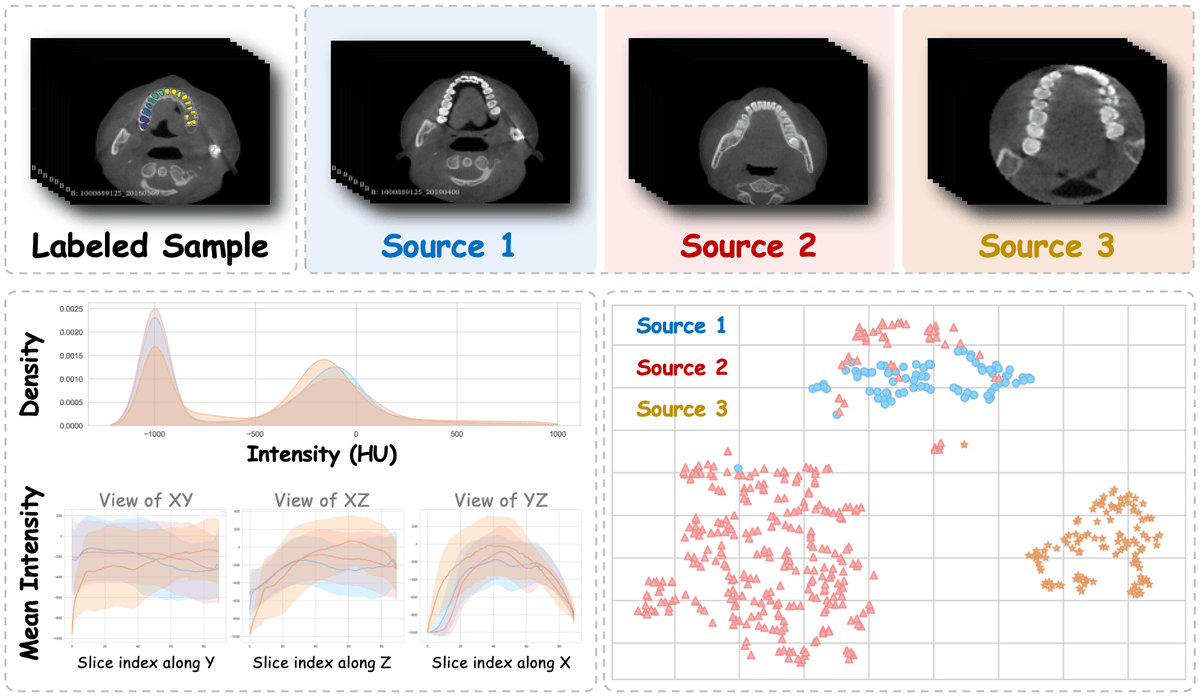
Fully supervised CBCT methods have advanced clinical applications, but voxel-level annotations and large data requirements make the task labor-intensive and costly. The result is that hospitals sit on piles of unlabeled scans they cannot use. Semi-supervised medical image segmentation (SSMIS) is the obvious answer, but most SSMIS approaches are designed for single-source data, while dental CBCT from different institutions and devices exhibits substantial distribution gaps, limiting cross-source generalization.
In practice, a scanner in one clinic produces voxel intensities and anatomical framing that a model trained elsewhere may not recognize. The authors visualize this with t-SNE embeddings and Hounsfield Unit intensity profiles, showing three obvious clusters for their three data sources. That gap is what breaks naive semi-supervised training.
Inside the multi-teacher, multi-student setup
SemiTooth reorganizes the data into three subsets before training even starts. All sources are reconstructed into three subsets: main (label), other (unlabel), and mixed. The mixed subset contains unlabeled samples that are distributionally similar to the main source, as measured by inter-source Wasserstein distance. That mixed bucket acts as a bridge between the labeled main source and the more distant unlabeled sources.

On top of that, the framework runs three student networks and two teacher networks. Each student is assigned to one subset, ensuring that different sources are effectively utilized. The two teachers supervise the students on the mixed and other sources, to stabilize learning and improve pseudo-label quality. Each teacher is updated as an exponential moving average of its student's weights, with a decay rate of 0.99. This is a step beyond the classic Mean Teacher paradigm, which uses one teacher-student pair and has no mechanism for handling source shifts.
Stricter Weighted-Confidence: filtering noisy pseudo-labels
The other main ingredient is the Stricter Weighted-Confidence (SWC) constraint. Standard consistency losses in semi-supervised learning trust pseudo-labels uniformly, which is a problem when CBCT scans from different scanners produce noisy predictions. SWC works in two stages:
- Each 3D sample is chopped into non-overlapping cubic regions.
- The mean confidence of each region is computed from the teacher's softmax output.
- Regions below a threshold (tau = 0.9) are discarded entirely.
- In the remaining regions, individual voxel confidences act as weights on the cross-entropy alignment loss between teacher and student.
This combines a hard region-level gate with soft voxel-level weighting, so noisy edges and low-confidence patches stop poisoning the training signal.
The dataset and the numbers
Alongside the method, the authors compiled MS3Toothset. Experiments are conducted on the MS3Toothset, which combines semi-annotated data from ShanghaiTech with proprietary unlabeled data from PKU-SS and AFMC. The final set has 98 labeled samples (20 held out for testing) and 438 unlabeled samples. Training used V-Net as the backbone on four NVIDIA A4500 GPUs.
The head-to-head results on the multi-source benchmark:
| Method | mIoU | Dice | Recall | Acc |
|---|---|---|---|---|
| V-Net baseline | 61.36 | 73.65 | 70.77 | 66.75 |
| Mean Teacher | 67.69 | 78.72 | 78.06 | 73.68 |
| UA-MT | 68.37 | 79.18 | 80.42 | 76.17 |
| ASDA | 73.75 | 83.63 | 80.93 | 78.79 |
| MLRPL | 72.86 | 83.29 | 79.75 | 77.39 |
| CMT | 76.14 | 85.07 | 87.14 | 84.32 |
| Uni-HSSL | 75.76 | 85.42 | 84.26 | 81.88 |
| SemiTooth | 76.67 | 85.69 | 88.66 | 86.44 |
The ablation study is arguably more informative than the leaderboard. Starting from a Mean Teacher baseline at 67.69 mIoU, adding just the SWC constraint pushes it to 69.94. Swapping in the multi-teacher/multi-student structure without SWC jumps to 75.37, and combining both components lands at 76.67. The multi-branch architecture is doing most of the heavy lifting; SWC then sharpens boundaries and cleans up recall.
Where this fits and what it doesn't solve
The framework is useful for a narrow but real scenario: you have a small pile of labeled CBCT scans from one institution and a much larger pile of unlabeled scans from other clinics or devices, and you want a single model that generalizes across all of them. It is a template that could plausibly transfer to other multi-institution medical imaging tasks with similar source-gap problems, such as MRI or ultrasound segmentation.
A few caveats worth flagging:
- The paper does not publish code or pretrained weights; MS3Toothset itself uses partially proprietary data from PKU-SS and AFMC, so full reproduction is not straightforward.
- Only three sources are tested. Scaling to N sources would require more student branches or a different design.
- The 76.67 mIoU number, while state-of-the-art here, still means meaningful boundary errors on real tooth roots and adjacent teeth, which the authors acknowledge in their qualitative comparisons.
- Everything is built on V-Net; whether the gains hold with modern transformer-based 3D backbones is untested.
Still, as a recipe for making semi-supervised training actually work across heterogeneous medical data sources, the combination of source-aware branching and confidence-gated consistency is a clean, transferable idea worth watching in adjacent segmentation domains.