
SelfOrg Lets AI Agents Rank Each Other Without Any Training
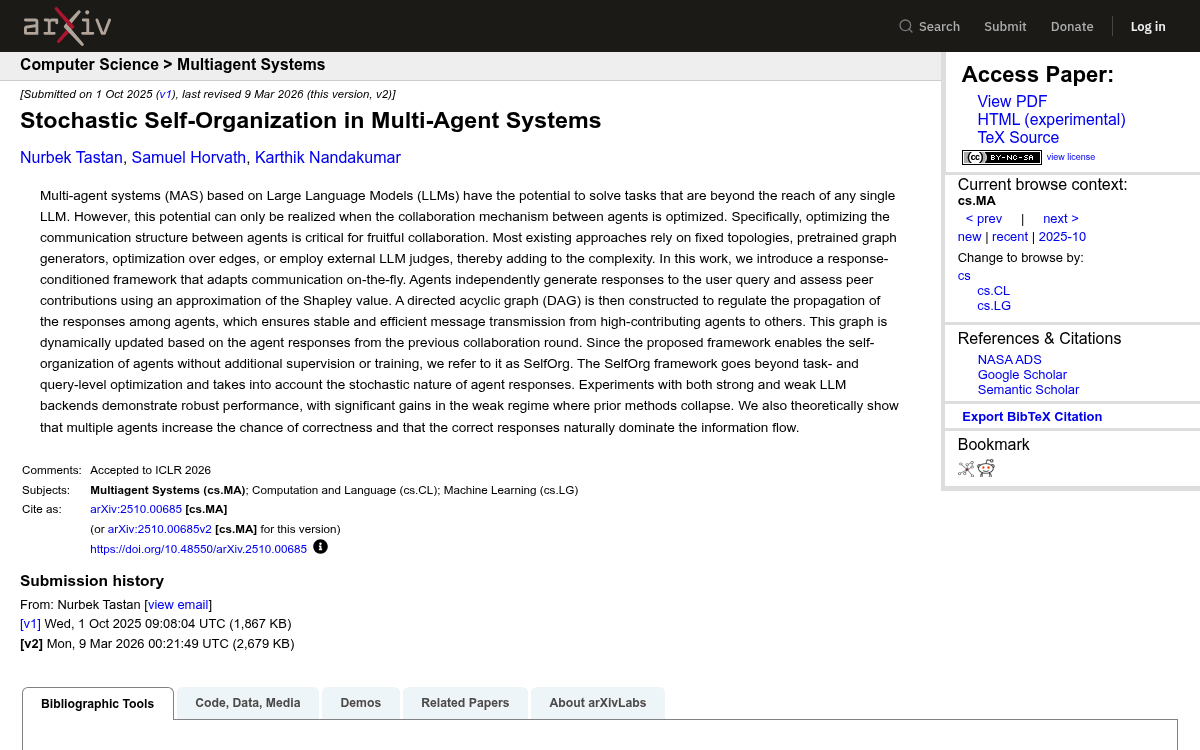
SelfOrg lets LLM agents self-organize their own communication graph using game-theory scores, with no training or external judges required
 Pro
Takeaways
- SelfOrg (ICLR 2026) introduces a training-free framework for multi-agent LLMs that dynamically builds a communication graph each round.
- Each agent scores peers using a Shapley value approximation in embedding space -- no external judge or pretrained graph model needed.
- A directed acyclic graph (DAG) routes information from high-contributing agents to lower-contributing ones, updated every round.
- Biggest gains come with weak or mid-size LLMs (1.5B--7B), where prior topology methods collapse; tested on AQUA-RAT, MMLU-Pro, MATH, and MMLU.
- Works with heterogeneous agent pools (Qwen, Falcon, Llama, Mistral) and automatically surfaces the most reliable model per query.
- Code is open on GitHub under CC BY 4.0; includes theoretical proof that correct responses dominate information flow as agents scale.
SelfOrg, accepted at ICLR 2026, tackles one of the messiest unsolved problems in multi-agent AI: how should a group of LLMs decide who to listen to? The answer the paper proposes is elegant -- let the agents figure it out themselves, round by round, using a concept borrowed from cooperative game theory.
The problem with fixed wiring
Multi-agent systems based on LLMs have the potential to solve tasks beyond the reach of any single model, but that potential only materializes when the collaboration mechanism between agents is optimized -- and the communication structure is the critical piece. Yet most existing approaches rely on fixed topologies, pretrained graph generators, optimization over edges, or employ external LLM judges, thereby adding to the complexity.
A common hypothesis in this literature is that there exists a "best" topology per task category (e.g., math vs. coding), and this idea has evolved toward finer granularity -- that the query itself should determine the topology. The authors argue that both views are ultimately brittle, because LLM agents are inherently stochastic: what matters for coordination is not the static task label nor the problem identity, but the state the agents are actually in -- their concrete responses.
Shapley values as a contribution meter
The core insight of SelfOrg is to score each agent's answer using a Shapley value approximation. The Shapley value, originally from cooperative game theory, distributes the total payoff among players based on their expected marginal contribution across all possible orders in which they could join a coalition. In plain terms: it asks, "how much does this agent's answer actually improve the group's collective output?" Agents that consistently push the group toward the right answer get a high score; agents that add noise or repeat what others said get a low one.
Crucially, SelfOrg computes this approximation in embedding space rather than by running exponentially many LLM calls. This makes it tractable at runtime without needing a separate judge model.

How it works, step by step
A query is distributed to N agents, each producing a response. Responses are embedded, contributions estimated via Shapley-based valuation, and a directed acyclic communication graph is formed where edges reflect contributions and high-contribution agents lead. The process is iterated for T rounds.
More concretely, the pipeline runs as follows:
- Decentralized initialization: Every agent independently answers the query with no knowledge of what others said.
- Contribution scoring: Each agent's response is embedded and scored using the Shapley approximation -- measuring how much that response shifts the group's collective embedding toward the consensus.
- DAG construction: A directed acyclic graph (DAG) is constructed to regulate the propagation of responses among agents, ensuring stable and efficient message transmission from high-contributing agents to others. A DAG (a graph with no cycles) guarantees that information flows in one direction -- from the best answers down to the weaker ones -- preventing feedback loops or circular reasoning.
- Iterative refinement: The graph is dynamically updated based on the agent responses from the previous collaboration round. Agents that improve over time get promoted; those that stagnate get demoted in the flow.
Here is a simplified sketch of what the contribution scoring step looks like in practice:
import numpy as np
def shapley_approx(embeddings):
    # embeddings: (N, D) array of agent response embeddings
    N = len(embeddings)
    mean_emb = embeddings.mean(axis=0)
    scores = []
    for i in range(N):
        # marginal contribution: how much does agent i shift the mean?
        leave_one_out = np.delete(embeddings, i, axis=0).mean(axis=0)
        scores.append(np.linalg.norm(mean_emb - leave_one_out))
    return np.array(scores)  # higher = more influential
The real breakthrough: response-conditioned topology
The SelfOrg framework goes beyond task- and query-level optimization and takes into account the stochastic nature of agent responses. Experiments with both strong and weak LLM backends demonstrate robust performance, with significant gains in the weak regime where prior methods collapse.
That last point is the headline result. Prior topology-optimization methods are trained or tuned for specific task types. When you hand them a weak backbone model -- say, a 1.5B or 7B parameter LLM instead of a 70B+ -- they tend to fall apart because the signal they were trained on no longer holds. SelfOrg has no such dependency: agents independently generate answers and assess peer contributions using a Shapley value-inspired approximation, and a DAG is constructed to route information from high-contribution agents to others, ensuring stable and efficient message passing without the need for additional supervision or training.

Benchmarks and scaling behavior
The authors analyze how SelfOrg scales with model size by evaluating Qwen-2.5-X-Instruct models ranging up to 72B parameters on AQUA-RAT and MMLU-Pro. Across most sizes, SelfOrg consistently improves over the single-agent baseline, with gains most pronounced in the weak-to-medium regime. At larger scales, improvements persist but become smaller, reflecting that strong single agents already achieve high reliability.
This suggests diminishing returns when base models are sufficiently strong that agreement across agents offers limited additional signal. Nevertheless, SelfOrg never underperforms substantially, and its advantages are clearest when individual models are weak or moderately strong, confirming the theoretical expectation that multi-agent collaboration amplifies correctness most in the low-resource regime.
The paper also tests heterogeneous agent pools -- mixing different model families in the same system. Agents are instantiated with heterogeneous backbones: Qwen2.5-7B, Falcon3-7B, Llama-3-8B, and Mistral-7B. Although similar in parameter count, these models differ substantially in ability, with Qwen strongest, Mistral weakest, and Falcon serving as the second-best. SelfOrg's contribution ranking naturally surfaces the stronger models as dominant information sources, without any hardcoded role assignment.
Where it shines -- and where it doesn't
SelfOrg is best suited for:
- Cost-constrained deployments using smaller open-source models, where multi-agent gains matter most
- Heterogeneous agent pools where you want the system to self-discover which model is most reliable per query
- Zero-shot generalization across task types, since no topology training is required
- Any reasoning-heavy pipeline (math, QA, logic) where answer quality can be compared in embedding space
The main limitation is that the Shapley approximation in embedding space is a heuristic -- it measures semantic similarity rather than ground-truth correctness. In domains where two very different-looking answers can both be correct (e.g., open-ended generation or creative tasks), the contribution signal becomes noisy. The paper also notes diminishing returns at the frontier: when your backbone is already a strong 70B+ model, the multi-agent overhead may not be worth it.
Availability
The code is available on GitHub, tagged as an ICLR 2026 paper, implemented in Python. The OpenReview page is public under a CC BY 4.0 license. The paper also includes theoretical proofs showing that, under mild assumptions, correct responses naturally come to dominate the information flow as the number of agents grows -- giving SelfOrg a formal correctness guarantee that most heuristic topology methods lack.
For teams already running multi-agent pipelines with frameworks like AutoGen or CrewAI, SelfOrg's approach is modular enough to be dropped in as a communication layer. The key requirement is that agent responses can be embedded -- which is true for virtually any text-based task. The absence of any training step means there is no dataset to curate, no fine-tuning budget to justify, and no topology to re-tune when you swap out your backbone model.