
See, Learn, Assist Teaches Rehab Robots Therapy From a Single Video
A new framework lets therapists teach a robot rehab exercises through a single RGB-D video, then supervises safety and effort during patient sessions.
 Pro
Takeaways
- New framework lets therapists teach robot rehab exercises remotely via a single RGB-D video demonstration.
- Demos encoded as body-centric 6-DoF trajectories using Cartesian Dynamic Movement Primitives for cross-patient generalization.
- Hybrid controller enforces a compliant virtual tunnel around the path while patient force drives timing.
- Same trajectory supports Passive, Active-Assisted, and Active-Resistive modes without re-recording.
- Per-patient Gaussian Mixture Regression detects abnormal forces and reverses motion to prevent injury.
- Reported 3.7 cm trajectory error and 5.5 degree range-of-motion error on a UR5e arm.
Robot-assisted rehabilitation has a chicken-and-egg problem. The machines that could help stroke survivors, post-surgical patients, and people with mobility impairments do their most useful work when a therapist physically guides the motion, but there are nowhere near enough clinicians to sit beside a robot for every repetition. A new preprint on arXiv, See, Learn, Assist, proposes a framework where the clinician teaches the robot once on video, then supervises instead of performing each session.
The team behind the paper, led by Ali Alabbas with Camillo Murgia, Joanne Regan, and Philip Long, encodes a therapist's demonstration into a reusable motion plan and hands execution to a collaborative arm that adapts to whoever is sitting in front of it. Their system targets three standard rehab modalities and builds a live safety model from the patient's own limb rather than population averages.

Teaching a robot with one RGB-D clip
The pipeline starts with a therapist performing the exercise on camera. An RGB-D sensor (color plus depth) captures the movement, and the system extracts a 6-DoF trajectory. Here 6-DoF means position in X, Y, Z plus the three rotations of the limb, so the robot learns not just where the hand goes but how the forearm is oriented along the way.
Instead of storing raw coordinates, the trajectory is fitted with Cartesian Dynamic Movement Primitives (DMPs), a well-established way of representing a motion as a stable dynamical system that can be started, stopped, rescaled, or retargeted without losing its shape. The important twist is that everything is expressed in a body-centric frame anchored to the patient's shoulders and torso, so the same demonstration generalizes across different arm lengths and seating postures without a fresh recording.
A virtual tunnel with a stretchy timeline
Executing a learned trajectory on a real person is where most systems either become too rigid (fighting the patient) or too soft (letting them drift off the target path). The authors decouple these concerns with what they call a hybrid architecture. Spatially, the robot enforces a compliant virtual tunnel around the demonstrated path, allowing small deviations but pushing back against large ones. Temporally, progression along the path is driven not by a clock but by how much force the patient contributes in the direction of motion.
That temporal dilation mechanism is what makes the same demo work across three rehab regimes:
- Passive: the robot moves through the full trajectory on its own, useful when a patient cannot generate force.
- Active-Assisted: the robot advances only when the patient pushes in the right direction, giving credit for effort.
- Active-Resistive: the robot pushes back, requiring the patient to overcome resistance to progress.
Switching modes is a matter of changing how the tangential force term feeds the phase variable, not rerecording the exercise.
Safety learned from the patient's own arm
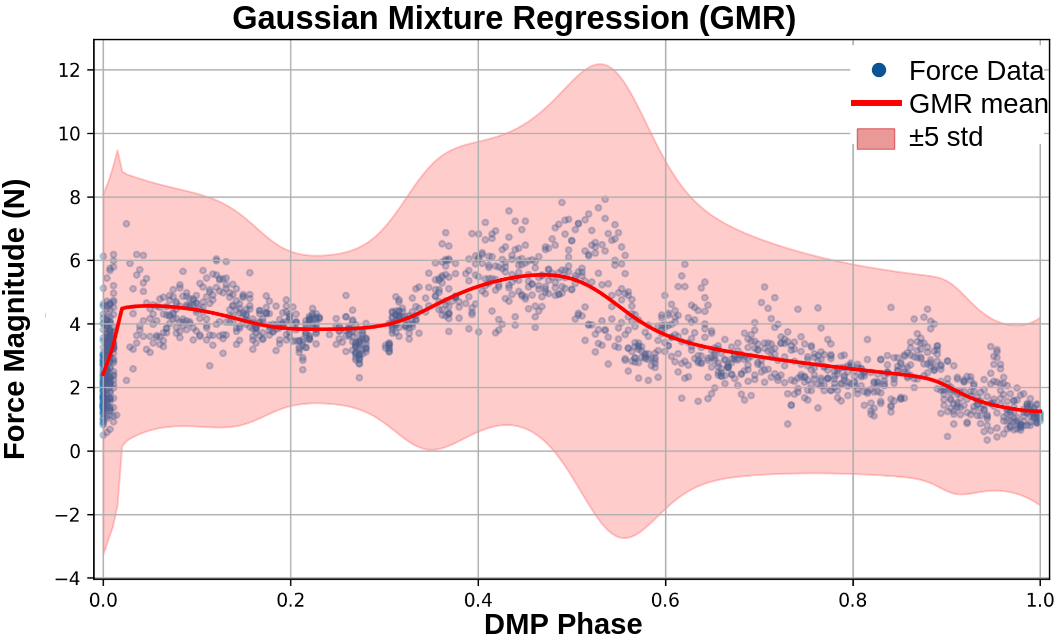
Before a session, the robot briefly interacts with the patient's limb and fits a Gaussian Mixture Regression (GMR) model on the fly. GMR learns the expected relationship between motion and interaction force as a probability distribution, so at runtime the system knows what a normal force reading looks like at each phase of the exercise for this specific person.

If the measured force falls outside that distribution, the controller treats it as a spasm, a snag, or a limit of range of motion, and reverses the trajectory to back out of the situation. Because the model is built per-patient rather than from a generic dataset, it accommodates people whose baseline stiffness or pain thresholds differ significantly from average.
How well it actually tracks
The experimental validation reports an average trajectory reproduction error of 3.7 cm and a range-of-motion error of 5.5 degrees, measured against the original therapist demonstration. Under dynamic disturbance trials, where a human pushes on the robot mid-exercise, the controller holds the spatial path while still letting patient effort dictate how fast the exercise advances.
Some caveats are worth naming:
- Validation is on a UR5e collaborative arm with able-bodied subjects, not a clinical trial with patients.
- The 3.7 cm spatial error is fine for gross upper-limb exercises but would be too coarse for fine motor tasks.
- The framework assumes an RGB-D capture of a therapist who is competent to demonstrate the exercise, so clinical judgment is still upstream of everything the robot does.
- No code, model weights, or dataset release is mentioned in the preprint.
Why this framing matters
The interesting claim in this paper concerns reproduction, not replacement. A single video demonstration, combined with body-centric DMPs and a per-patient safety model, is enough to reproduce three different therapy modalities on hardware that already exists in many labs. If the approach holds up in clinical evaluation, it points toward tele-rehabilitation setups where a clinician prescribes and reviews exercises remotely while a cobot handles the repetitions, rather than home-use gadgets that operate without medical oversight.