
scout-matter Steers Crystal AI Generators Without Retraining Any Model Weights
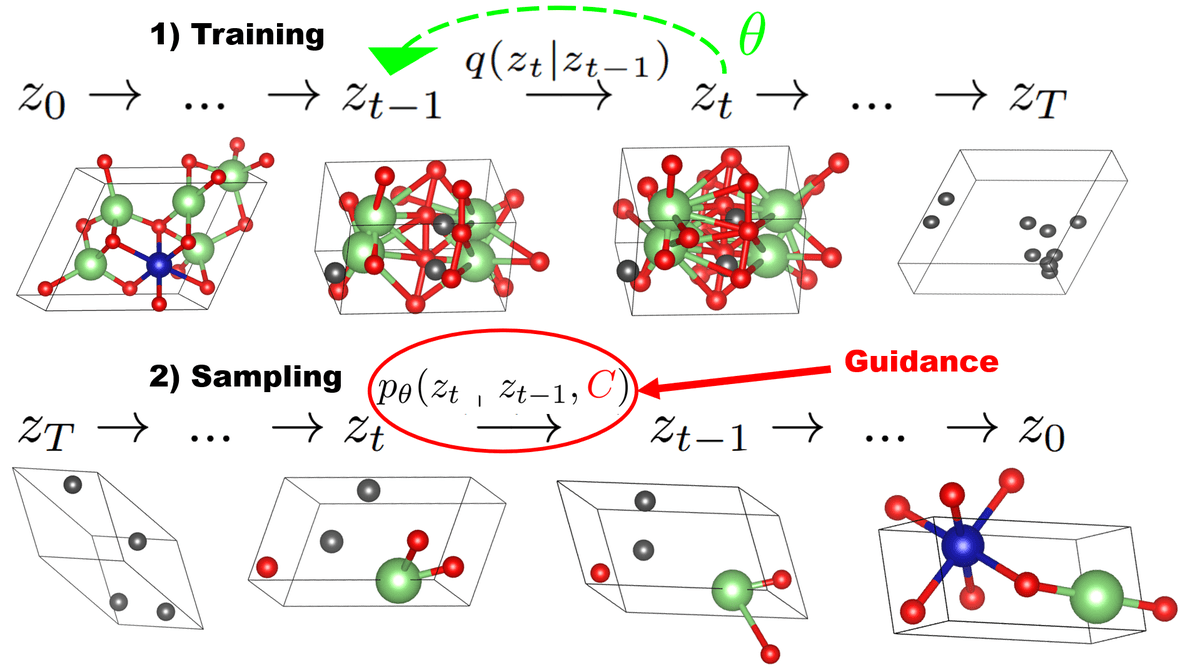
A new framework bolts differentiable constraint guidance onto pre-trained crystal diffusion models, letting chemists steer generation without any retraining.
Takeaways
- Fine-tuning-free adaptive guidance steers pre-trained crystal diffusion models toward user-defined constraints without retraining.
- Built on Universal Guidance with differentiable losses for volume, coordination numbers, and multi-motif targets.
- Validation pipeline uses GRACE GNN potential, convex hull analysis, and deduplication against Alexandria, OQMD, and Materials Project.
- Cu-P=4 case study lifted SCOUT metric from 0.308 to 0.718 for retained constrained candidates.
- Recovered known motifs and proposed new metastable candidates in Fe-Nd-B, Li-Co-O, and Cu-Si-P-Ca systems.
- Open-source implementation released at github.com/link-lab3629/scout-matter.
A team of researchers has released a plug-in guidance mechanism that steers pre-trained crystal diffusion models toward specific structural targets without touching the underlying model weights. The framework, packaged as an open-source tool called scout-matter, addresses an awkward gap in generative materials science. You have a powerful diffusion model that samples plausible crystals, but nudging it toward the coordination number, atomic volume, or bonding motif you actually care about typically demands retraining on a fresh conditional dataset.
The proposed framework integrates adaptive constraint guidance into a pre-trained crystal diffusion model, generating candidates that satisfy targeted structural and chemical requirements without retraining. The paper uses MatterGen as the backbone, but the contribution is the guidance methodology itself, not a modification of any specific model.
Why steering crystal generators is hard
Large materials generators have had a mixed track record. Splashy announcements of millions of new crystals turned out to include many combinatorial rehashes of known compounds, and follow-up analyses raised concerns about autonomous synthesis claims. Raw sample counts do not equal useful chemistry, and expert intuition needs a way into the loop.
Classifier-free guidance, the standard trick used inside models like MatterGen, requires retraining whenever you introduce a new condition. Miss the training distribution and the model wanders off manifold. The authors instead build on