
Scorio Stress-Tests 72 Ranking Rules to Fix AI Leaderboards
A new framework compares 72 ranking methods across 20 reasoning models to reveal which techniques stay reliable when compute budgets shrink.
 Pro
Takeaways
- New library Scorio implements 72 statistical ranking methods for reasoning LLM benchmarks.
- At 80 trials per question, 19 to 34 different methods recover identical model orderings.
- At single-trial evaluation, best methods reach Kendall's τb around 0.86 versus the gold standard.
- Using greedy decoding as an empirical prior cuts variance 16 to 52 percent at N=1.
- Greedy priors bias rankings on hard benchmarks where sampling and greedy decoding disagree.
- High self-consistency does not imply agreement with accuracy-based rankings.
Benchmarking a reasoning model used to be simple: run it once, count the correct answers, sort the leaderboard. Test-time scaling breaks that workflow. When a model samples dozens of chains of thought per prompt and aggregates them, every evaluation number becomes a random variable, and the ranking you publish depends on how you aggregate. A new paper formalizes this problem and stress-tests 72 different ranking rules to figure out which ones survive the transition from single-shot to repeated-sampling evaluation.
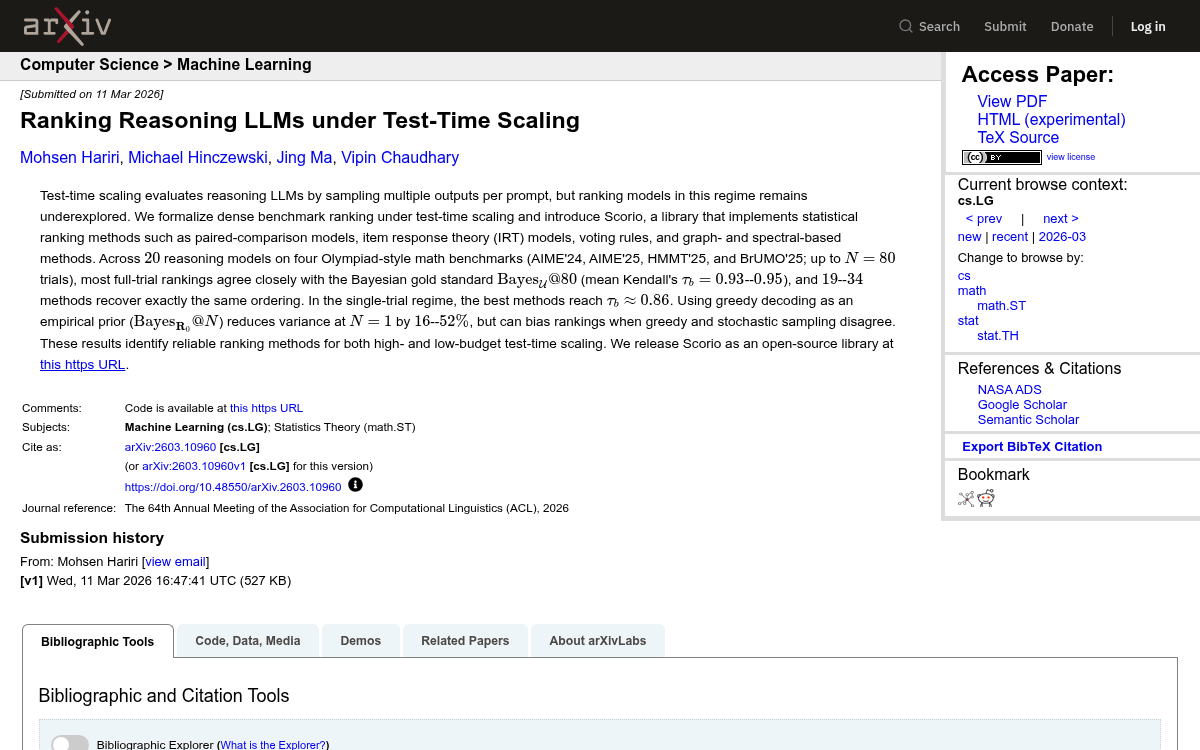
The authors introduce Scorio, an open-source Python library that implements the full zoo of statistical ranking methods, and use it to run what is essentially the largest controlled comparison of LLM ranking techniques to date. Across 20 reasoning models on four Olympiad-style math benchmarks (AIME'24, AIME'25, HMMT'25, and BrUMO'25) with up to N=80 trials, most full-trial rankings agree closely with the Bayesian gold standard (mean Kendall's τb = 0.93 to 0.95), and 19 to 34 methods recover exactly the same ordering.
Why single-run leaderboards stopped working
The core issue is that reasoning models don't produce a single answer per question anymore. Test-time scaling allocates additional inference compute by sampling multiple outputs per prompt and aggregating them, turning evaluation into a repeated-sampling problem. That leaves you with a three-dimensional outcome tensor of shape (models × questions × trials), and a genuine methodological question: how do you collapse it into a ranking?
Different ranking methods can produce noticeably different model orderings, and their agreement can vary with benchmark difficulty. The paper makes the case that this matters for anyone doing model selection, leaderboard maintenance, or preference-based alignment, because the choice of aggregation rule silently changes which model looks best.

The gold standard trick
Classical statistics has no canonical way to declare one ranking method correct. The authors sidestep this by exploiting a property of test-time scaling itself. Because each model-question pair can be sampled repeatedly, it lets us evaluate ranking methods by how stable they are in low-budget settings and how quickly they converge as more trials are observed.
They define the reference as Bayes_U@80, the Bayesian posterior mean with a uniform prior computed from all 80 trials. This ordering is equivalent to plain mean accuracy but gives you priors and uncertainty estimates for free. Every other method gets measured by how well it matches this target using Kendall's tau-b, a rank correlation that handles ties.
What actually works at low N
The interesting results appear when you slash the budget to a single trial per question. This is the regime most practitioners actually operate in, and it's where ranking methods diverge sharply. The paper compares methods along two axes:
- Gold-standard agreement: how close a single-trial ranking gets to the full 80-trial Bayesian reference.
- Self-consistency: how close a single-trial ranking gets to the same method's own full-trial ranking.
In the single-trial regime, the best methods reach τb ≈ 0.86. The winners depend on which target you care about. Across the pooled benchmarks, Bayes@1 matches the gold standard best, while Nanson's rule with tie averaging is most self-consistent. Critically, these are not the same method: high self-consistency does not imply agreement with correctness-based ordering. A method can converge quickly to its own opinion while that opinion drifts away from accuracy.
The greedy prior trap
One of the more practical findings concerns using a single greedy decode as an empirical prior. Using greedy decoding as an empirical prior reduces variance at N=1 by 16 to 52 percent, but can bias rankings when greedy and stochastic sampling disagree.
The mechanism is intuitive once stated: the greedy prior acts as a shrinkage estimator that pulls rankings toward the greedy ordering. On easier benchmarks where greedy decoding tracks the sampling-induced ordering, this reduces variance without introducing bias. On HMMT'25, the hardest benchmark tested, greedy and stochastic sampling disagree more, and the prior actively hurts. The authors suggest checking greedy-sampling alignment on a small pilot sample before deploying the empirical prior, and defaulting to the uniform prior otherwise.
The ranking method zoo
Scorio implements far more than the usual Bradley-Terry and Elo suspects. The library groups methods into families that operate on different representations of the outcome tensor:
- Pointwise: mean accuracy, inverse-difficulty weighting, Bayes@N
- Pairwise probabilistic: Bradley-Terry with Davidson and Rao-Kupper tie extensions
- Sequential rating: Elo, Glicko, TrueSkill
- Voting rules: Borda, Copeland, Schulze, Kemeny-Young, Ranked Pairs, Nanson, Baldwin, Majority Judgment
- Listwise/setwise: Plackett-Luce, Davidson-Luce
- IRT-inspired: Rasch (1PL), 2PL, 3PL with MLE, MAP, and MML/EAP estimation
- Graph and spectral: PageRank, Rank Centrality, HodgeRank, SerialRank, alpha-Rank, Nash-based scoring
Every method exposes the same interface: pass the outcome tensor R of shape (L, M, N), optionally get scores back alongside rankings.
import numpy as np
from scorio import rank
# L=20 models, M=30 questions, N=80 trials
R = np.random.randint(0, 2, size=(20, 30, 80))
rankings = rank.avg(R)
rankings, scores = rank.bayes(R, return_scores=True)
rankings = rank.bradley_terry(R)
Practical takeaways
The bottom line for anyone shipping evaluation pipelines: when trial budgets are large, most reasonable methods converge to nearly the same ordering, making the uniform-prior Bayesian mean a strong and interpretable default. When budgets are tight, uncertainty-aware estimators help, and empirical priors offer a variance-bias tradeoff that only pays off when the auxiliary signal actually correlates with your sampling distribution.
The library is available on GitHub and installable via pip install scorio. For teams building leaderboards or running preference-based alignment, it turns a set of methodological choices that were previously ad hoc into something you can actually measure.