
SatReg Shrinks Satellite AI Models 4x While Cutting Energy Use in Half
A new arXiv paper proposes SatReg, cutting CM-UNet latency by up to 38.6% and energy by 51% on a Jetson Orin Nano using two-variable surrogate search.
 Pro
Takeaways
- SatReg is a regression-based NAS framework for lightweight satellite image segmentation, published on arXiv.
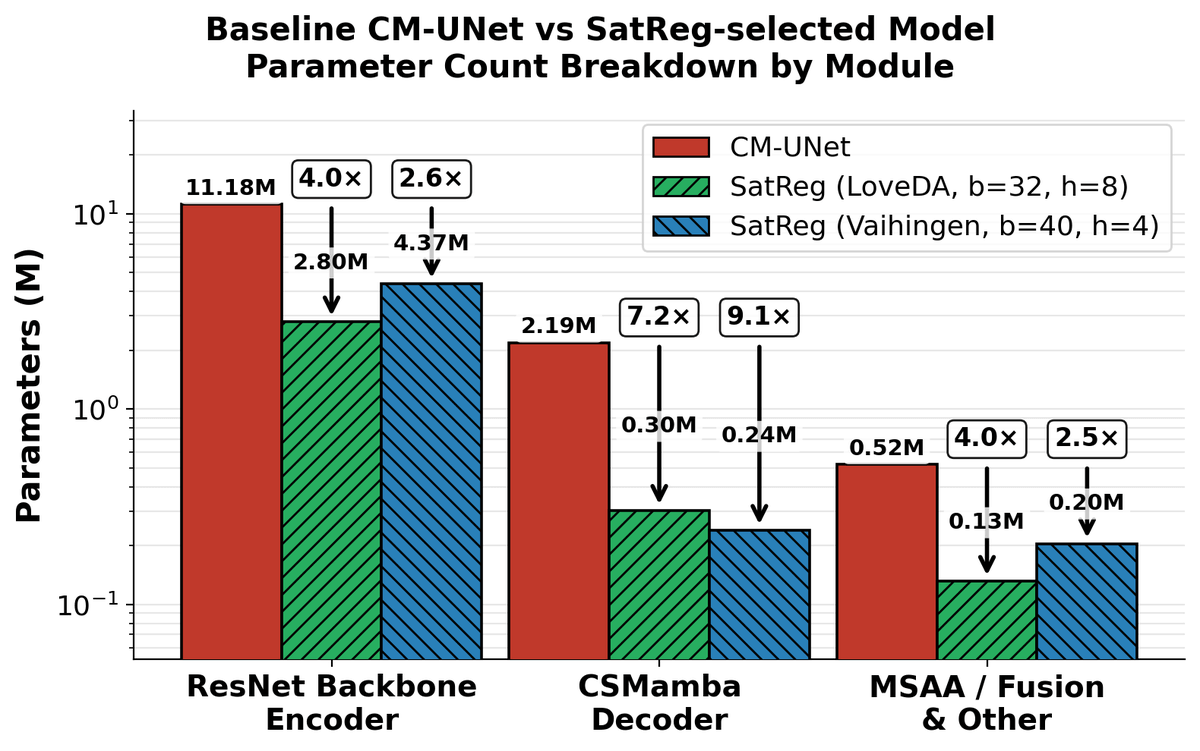
- Reduces CM-UNet latency 32.9-38.6% and energy 43.3-51.0% on NVIDIA Jetson Orin Nano.
- Search space collapsed to two width variables: encoder base width b and decoder bottleneck width h.
- Quadratic surrogates for latency/power and rational-form model for mIoU, fit from just 16 samples.
- Uses Channel-Wise Knowledge Distillation from full CM-UNet teacher to recover student accuracy.
- Evaluated on LoveDA and ISPRS Vaihingen; targets DAC '26 conference.
Running semantic segmentation onboard a small satellite sounds simple until you try to fit a modern hybrid CNN-Mamba model into a few watts of power budget. A new preprint from Edward Humes and Tinoosh Mohsenin, accepted to DAC '26, tackles this squeeze with SatReg, a regression-guided architecture tuning framework that shrinks CM-UNet down to embedded-friendly sizes without the usual brute-force neural architecture search.
The pitch is pragmatic. Rather than searching over dozens of architectural knobs, the authors identify the two width parameters that dominate the accuracy versus hardware tradeoff, sample a small handful of configurations, and fit low-order polynomial surrogates that predict segmentation quality, latency, and power. Design-space exploration then runs in minutes rather than GPU-weeks.
Why onboard segmentation hurts
As Earth-observation workloads move toward onboard and edge processing, remote-sensing segmentation models must operate under tight latency and energy constraints. Recent hybrid architectures like CM-UNet mix convolutional backbones with Mamba-style selective state-space blocks (a linear-time alternative to attention) to combine local detail with long-range context. They score well on aerial imagery benchmarks, but their inference cost is punishing on the kind of low-power silicon that flies on a CubeSat.