
Samsung's QCT Transformer Pushes Quantum Error Decoding to 18.1% Threshold
A new transformer decoder shifts attention from stabilizers to physical qubits, hitting an 18.1% surface code threshold that nearly matches the theoretical ceiling.
 Pro
Takeaways
- QCT is a transformer decoder for surface codes that uses one token per physical qubit instead of per stabilizer
- Achieves an 18.1% depolarizing-noise threshold, close to the 18.9% theoretical bound
- Beats BP+OSD (17.00%) and MWPM (14.7%), plus prior FFNN and CNN neural decoders
- Structure-aware attention mask restricts tokens to attend only to qubits sharing a stabilizer
- Ablations show the qubit-centric perspective, not just the mask, drives the gains
- Evaluated on code capacity depolarizing noise; circuit-level noise and hardware tests still open
Quantum error correction sits between where quantum computing is today and where it needs to go. Without a fast, accurate decoder, the qubits underneath any promising algorithm will drown in noise long before they finish computing anything useful. A team from POSTECH, the University of Ulsan, and Samsung has just proposed a transformer architecture that pushes surface code decoding within a hair of its theoretical limit, and the trick is a subtle rethinking of what the model should actually be looking at.
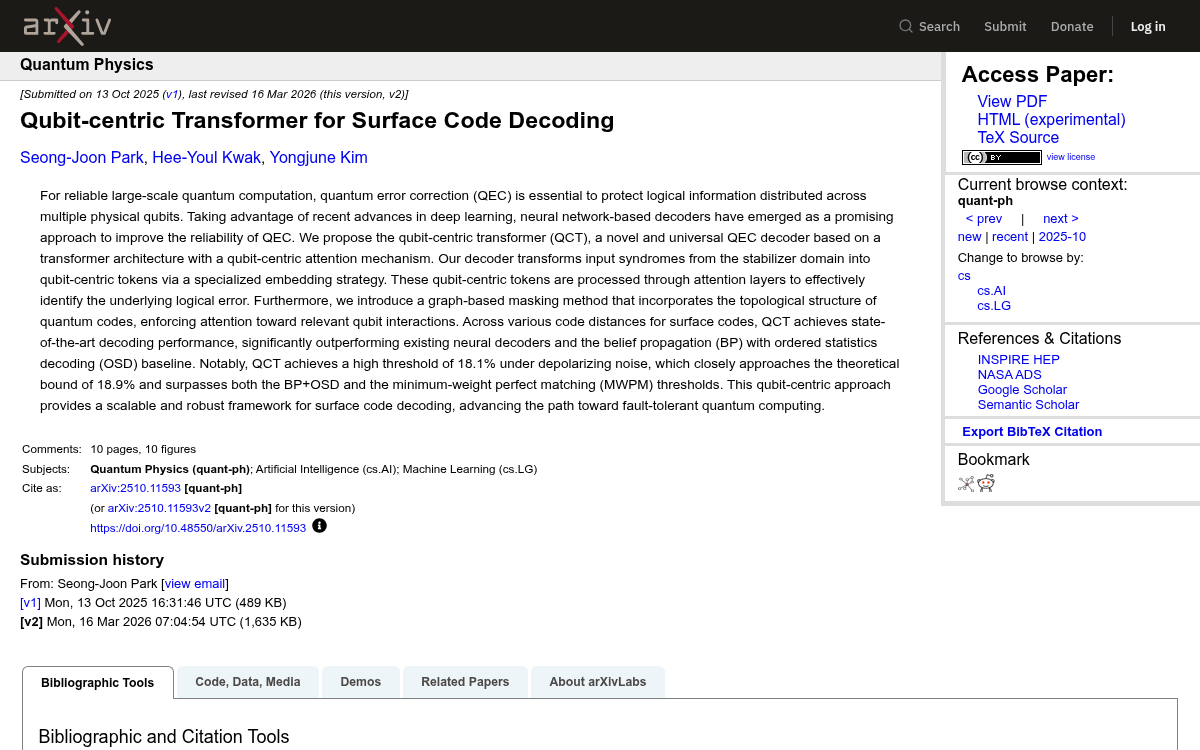
The new decoder, called the Qubit-centric Transformer (QCT), reframes the problem so that each token in the sequence corresponds to a physical qubit rather than a stabilizer measurement. These qubit-centric tokens are processed through attention layers to identify the underlying logical error, with a graph-based masking method that incorporates the topological structure of quantum codes, enforcing attention toward relevant qubit interactions. The payoff is a decoder that beats every neural and classical baseline the authors threw at it.
Why decoders are the bottleneck
A quick primer for anyone who has not spent time in the QEC weeds. Because you cannot copy a quantum state or peek at it directly, error correction relies on indirect measurements of operators called stabilizers. The bit string those measurements produce is called a syndrome, and the decoder's job is to guess which physical errors caused it, so the system can apply a correction that reverses the damage without collapsing the encoded qubit.
For the surface code, which encodes one logical qubit into a lattice of physical qubits, this is typically framed as a four-way classification over the logical Pauli operators {I, X, Z, Y}. The threshold is the physical error rate below which adding more physical qubits actually reduces the logical error rate, and any decoder pushing that threshold higher makes fault-tolerant machines cheaper to build.
The industry has explored two broad families of decoders. Classical algorithms like minimum-weight perfect matching (MWPM) and belief propagation with ordered statistics decoding (BP+OSD) offer strong guarantees but have variable runtimes, which is a problem when the global system clock is bound by the decoder's worst case. Neural decoders offer deterministic latency and have moved from feed-forward networks to CNNs to, most recently, transformer-based architectures like Transformer-QEC and DeepMind's AlphaQubit.
The stabilizer-centric blind spot
Here is the observation that drives the paper. Previous transformer decoders feed syndrome bits into the model as tokens, one token per stabilizer measurement. But logical errors do not live in the syndrome space. They live on the physical qubits themselves, and the syndromes are just an indirect fingerprint. QCT is a transformer with a qubit-centric attention mechanism that transforms input syndromes from the stabilizer domain into qubit-centric tokens via a specialized embedding strategy.

The architecture has three components worth understanding:
- Qubit-centric embedding. For each physical qubit, the model builds two sparse localized syndrome vectors, one from the adjacent Z-stabilizers and one from the adjacent X-stabilizers. Each is projected through a fully connected layer with a learnable positional embedding to produce a dense feature vector for that qubit.
- Merging layer. The two per-qubit vectors get concatenated and passed through another FC layer, fusing them into a single unified token per physical qubit. These tokens are the actual input to the transformer stack.
- Structure-aware mask. The self-attention is not allowed to be fully global. Two qubit tokens can attend to each other only if the physical qubits share at least one stabilizer, which encodes the surface code's local topology directly into the attention pattern.

The masked attention modifies the standard scaled dot-product with an additive matrix M whose entries are 0 for allowed pairs and negative infinity elsewhere:
attn = softmax((Q @ K.T) / sqrt(D_h) + M) @ V
# M[i,j] = 0     if qubits i,j share a stabilizer
# M[i,j] = -inf  otherwise
Everything else is a fairly standard transformer stack, eight blocks deep in the reported configuration, with embedding dimension 64 and merged token dimension 128. The final tokens are mean-pooled and passed through a fully connected layer to produce logits over the four logical error classes.
Approaching the theoretical ceiling
The headline result is a threshold under depolarizing noise. QCT achieves a threshold of 18.1% under depolarizing noise, significantly surpassing the thresholds of BP+OSD (17.00%) and MWPM (14.7%). The theoretical bound for the surface code under this noise model is 18.9%, so QCT is closing most of the remaining gap to what is information-theoretically possible.
On pseudo-thresholds, which measure the physical error rate at which encoded qubits start outperforming uncoded ones, QCT also pulls ahead as the code grows:
| Decoder | d = 3 | d = 5 | d = 7 |
|---|---|---|---|
| MWPM | 8.28% | 10.36% | 11.94% |
| FFNN | 9.77% | 11.35% | 12.49% |
| CNN | 9.80% | 12.15% | 13.26% |
| QCT | 9.80% | 13.27% | 14.31% |
The gap between QCT and the other methods widens as the code distance increases, highlighting the scalability of the proposed structure-aware architecture. That is meaningful because larger code distances are exactly where real fault-tolerant machines will operate, and where existing neural decoders have historically struggled.
What the ablations tell us
The authors ran three ablations at distance 11 that clarify which pieces of the architecture actually matter:
- Depth. Performance improves noticeably from 2 to 8 transformer blocks, then saturates. Eight is the sweet spot.
- Structure-aware masking. A vanilla transformer with global attention still learns the task, but the masked version consistently outperforms it. The topology matters, and hardcoding it beats forcing the model to rediscover it.
- Merging layer. Removing the FC layer that fuses the Z and X qubit embeddings hurts performance measurably, even though the layer is a small fraction of the total parameter count. Even without it, though, the qubit-centric approach still beats the baselines, suggesting the perspective shift is doing most of the heavy lifting.
Caveats and open questions
A few things are worth flagging honestly. The evaluation is on code capacity noise (a depolarizing model applied to data qubits), not the circuit-level noise that AlphaQubit and Google's experimental work target. Circuit-level noise adds measurement errors, spatial and temporal correlations, and leakage, and it is where hardware actually lives. The paper does not report circuit-level or experimental hardware numbers.
The paper also does not appear to include a public code release, so reproducing the results will require reimplementing the embedding and masking scheme from the described architecture. And while the deterministic latency argument for neural decoders is real, the paper does not report wall-clock inference times or hardware requirements for running QCT at distances that matter for fault tolerance.
Still, the direction is compelling. Most transformer applications in physics have been reskins of vision or language architectures, with the domain structure treated as something the model should learn from data. QCT is a reminder that when you know the graph, telling the attention mechanism about it explicitly can pay off in a big way, especially at the scale where the underlying physics starts to bite.