
Samsung's PuzzleCraft Trains Vision AI With Jigsaw Puzzles, Beating Labeled Datasets
Samsung's PuzzleCraft trains vision language models on jigsaw puzzles with an exploration-aware curriculum, boosting Qwen2.5-VL and Qwen3-VL without a single label.
 Pro
Takeaways
- PuzzleCraft trains VLMs with three auto-verified puzzles (Jigsaw, PatchFit, Rotation) using no labels or external judges. Paper
- An exploration-aware curriculum downweights collapsed rollout groups using solution-space dispersion, not just reward variance.
- Qwen2.5-VL-7B Jigsaw reaches 67.78 average across 9 image benchmarks, +2.2 over the strongest puzzle baseline.
- Qwen3-VL Jigsaw variants add +2.60, +2.91, +1.87 to the 2B, 4B, and 8B instruct checkpoints.
- Reasoning-Answer Consistency (RAC) metric shows vanilla GRPO drifts late in training even as reward keeps rising.
- Models available on Hugging Face; project page at puzzlecraftgrpo.github.io.
A team from Samsung AI Center Toronto, the University of Toronto, Vector Institute, and York University has released PuzzleCraft, a supervision-free post-training recipe that pushes vision language models further using nothing but automatically-graded visual puzzles. The pitch is straightforward: forget curated math datasets and external judge models, generate jigsaw puzzles on the fly, and train the policy with a curriculum that actively resists rollout collapse.
The framework instantiates three tasks inspired by classic pretext objectives for visual pretraining: PatchFit, Rotation, and Jigsaw. The puzzle environments are fully unsupervised, require no external verifiers or teacher models, and provide automatic rewards at scale. On the strongest configuration, Qwen2.5-VL-7B trained on Jigsaw hits 67.78 average across nine image benchmarks, beating the best puzzle baseline by 2.2 points, and the same approach lifts Qwen3-VL by up to 2.9 points without touching a single labeled example.
Why puzzle-based RLVR keeps stalling
RL with verifiable rewards (RLVR) has become the standard way to elicit chain-of-thought reasoning in language models, but doing it for vision is harder. Obtaining vision-centric, reliably verifiable reward signals is costly and noisy, and often requires curated supervision or external verifiers. Puzzles are attractive because the verifier is the puzzle itself, but existing pipelines have three chronic issues that the authors explicitly diagnose:
- Sparse or flat rewards. Most puzzle setups return binary success, so easy and hard prompts contribute the same gradient signal.
- Vanishing advantages from rollout collapse. When rollouts within a group become homogeneous, group-relative advantages shrink toward zero and updates become weak. Sparse rewards can further worsen this behavior by pushing groups toward all-success or all-failure regimes.
- Reasoning-answer drift. A recently highlighted failure mode of CoT is reasoning-answer inconsistency, where the final answer is not supported by the reasoning trace.
The paper's core observation is that difficulty-based curricula alone cannot fix collapse. Two rollout groups can share the same mean reward while behaving very differently: one is nine identical wrong guesses plus one lucky right answer, the other is a genuinely diverse exploration. GRPO treats them the same, but only the second actually teaches the model anything.
Three puzzles, one graded reward
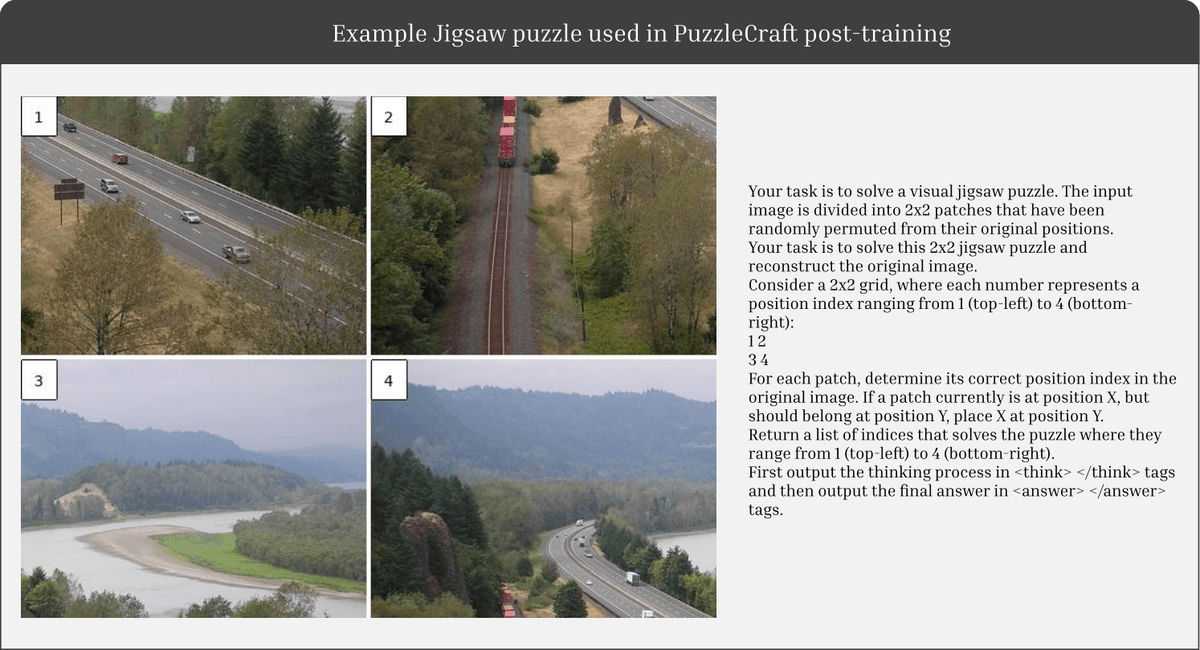
PuzzleCraft builds puzzles from COCO training images. Rotation predicts an angle from a fixed set, PatchFit identifies a masked patch among confusable candidates, and Jigsaw assigns tiles to grid positions under a valid permutation. Rotation and PatchFit give binary rewards, but Jigsaw is different and this turns out to matter.

Jigsaw naturally supports partial credit enabling graded supervision without process-level labels. The reward is the fraction of tiles placed correctly, which rewards intermediate progress and penalizes localized errors without collapsing the entire rollout to failure. Difficulty is controlled via a single knob per puzzle: grid size for Jigsaw (up to 3x3), angle-set cardinality for Rotation, and distractor hardness for PatchFit.
An exploration-aware curriculum
The curriculum weight combines two terms. The first is the classic difficulty band d(x)(1-d(x)), which peaks at medium difficulty and vanishes when every rollout succeeds or fails. The second is a solution-space dispersion signal that is puzzle-specific:
- Rotation and PatchFit use normalized entropy over selected discrete options. Collapse to one option drives it toward zero.
- Jigsaw tracks diversity in permutation space directly. A useful side effect of partial grading is that multiple distinct permutations can yield the same reward, so reward statistics alone can miss whether the model is collapsing to a single arrangement. The dispersion score is simply
(M-1)/(G-1), where M is the number of unique permutations across the G rollouts.
The two terms multiply into a single group weight applied to a token-level GRPO objective. Notably, the KL-to-reference coefficient is set to zero because strong KL anchoring can over-constrain exploration in GRPO-style post-training.
Watching the reasoning drift in real time
The second contribution is a diagnostic called Reasoning-Answer Consistency (RAC). The team periodically samples rollouts and prompts a fixed open-source judge (Qwen2.5-VL-72B in inference mode) with each rollout's rationale and final answer, and asks whether the rationale explicitly supports the emitted answer. Crucially RAC is only a monitor, not a training signal.
The pattern they observe is striking: vanilla GRPO shows RAC climbing early and then degrading even as puzzle reward keeps rising. The exploration-aware curriculum flattens that decline, and layering in GRPO-CARE, a consistency-aware add-on from prior work, holds RAC high through most of training. Higher puzzle reward turns out to be a bad proxy for downstream accuracy.
What the numbers actually say
Trained on 82,783 COCO images with 8xA100s, the recipe delivers consistent gains across scales and backbones:
| Backbone | Setup | Image Avg. (9 benchmarks) | Gain vs. base |
|---|---|---|---|
| Qwen2.5-VL-7B | Jigsaw | 67.78 | +2.90 |
| Qwen2.5-VL-3B | Mix | 60.44 | +3.87 |
| Qwen3-VL-2B | Jigsaw | 56.22 | +2.60 |
| Qwen3-VL-4B | Jigsaw | 63.32 | +2.91 |
| Qwen3-VL-8B | Jigsaw | 64.64 | +1.87 |
The Qwen2.5-VL-7B Jigsaw model reaches 53.93 average on 7 video reasoning benchmarks without using any video data during post-training, which is +1.47 over the strongest puzzle baseline VisualSphinx at 52.46, and it comes close to the video-supervised Video-R1 score of 55.11. That is unexpected transfer from static images to temporal reasoning.
What is Jigsaw good at, and what falls flat
Not every puzzle transfers equally. Jigsaw performs best overall, which the authors attribute in part to its graded, partial-credit reward. Rotation also transfers well, but its gains are benchmark-dependent and complementary to Jigsaw. PatchFit transfers weakly on both math and vision-centric benchmarks. Mix is a robust choice across tasks.
There is also a curious ceiling in inter-puzzle transfer. Training on a specific puzzle consistently improves performance on that puzzle, but gains do not transfer to others. A model trained only on Jigsaw actually gets worse at Rotation. Mixed-puzzle training papers over the problem, but the paper is honest that no reliable signal predicts which skills will transfer where.
Another caveat: RLVR gains largely evaporate in direct inference mode. Direct-mode results are generally close to the base model, suggesting that most RL gains in this setting emerge when the model is prompted to produce an explicit reasoning trace. If a deployment forces no-CoT prompting, PuzzleCraft's improvements shrink significantly.
Availability
The project page hosts a Hugging Face collection of the trained checkpoints, and the authors state that exact puzzle-generation details will be provided in the released code. The training builds on the public VLM-R1 codebase for GRPO, with GRPO-CARE plugged in from the authors' released implementation.
The takeaway from PuzzleCraft is less about the specific puzzles and more about training dynamics. Chasing higher puzzle reward can actively degrade the reasoning trace, and standard difficulty-only curricula miss when a policy has collapsed. Combining a partial-credit reward, an entropy-style exploration term, and an explicit consistency diagnostic gives a cleaner recipe for scaling supervision-free RLVR, one that seems to hold up across both Qwen generations.