
Salesforce's VIBEPASS Catches Frontier AI Failing to Debug Its Own Code
A new benchmark called VIBEPASS shows that frontier LLMs can write valid tests but fail to expose bugs, breaking autonomous debugging pipelines.
 Pro
Takeaways
- VIBEPASS is a new arXiv benchmark evaluating whether LLMs can self-diagnose and repair subtle bugs in their own code.
- The benchmark uses 173 instances across 76 hard LiveCodeBench problems, each with a buggy and silver solution.
- Across 12 frontier models, 86% of generated test inputs are valid but only 61% actually expose the bug.
- Fault hypothesis generation is the dominant bottleneck, roughly 2.7x larger than output validation errors.
- Self-generated tests beat externally provided ones by 6.4 points when both witness the fault.
- Data and code available at GitHub and Hugging Face.
A new arXiv paper introduces VIBEPASS, a benchmark designed to answer a specific question that most coding benchmarks skip: when an LLM produces code that looks correct and passes visible tests, can the model itself find the subtle bug and fix it? The authors evaluated 12 frontier models including GPT-5.2, Gemini-3 Pro, Claude Opus-4.6, and open-source systems like GPT-OSS-120B, and the answer is largely no. The dataset and evaluation code are available on GitHub and Hugging Face.
The hidden gap in agentic coding
Recent systems surpass 90% pass rates on established benchmarks, but this performance reflects generation under ideal conditions: producing correct solutions from clear specifications. Real agentic workflows demand something different. A coding agent has to notice that its own output is wrong, invent an input that proves it, and then patch the code. The paper calls this chain of skills fault-targeted reasoning, and argues it has never been evaluated end-to-end.
Existing work evaluates its components in isolation: test generation research uses syntactic validity and branch coverage as proxies for fault exposure, while repair research assumes a declared fault location, short-circuiting diagnosis entirely. VIBEPASS argues that this omitted middle step, actually constructing an input that discriminates a buggy program from a correct one, is where models fall apart.
How the benchmark is built
VIBEPASS consists of 173 instances spanning 76 algorithmically challenging problems from LiveCodeBench, each paired with a model-generated buggy solution and a platform-accepted human-authored solution. Buggy solutions pass 10 to 90% of official test cases, ensuring bugs are non-trivial and require semantic reasoning to detect. This design point matters: the bugs are near-misses, not syntax errors or runtime crashes.

The benchmark decomposes autonomous debugging into two tasks:
- Fault-Triggering Test Generation (FT-Test): given a problem spec and a buggy program, produce an input where the buggy code disagrees with a reference (silver) solution. A test is a FT test if the buggy solution and the silver solution produce different outputs on the same valid input.
- Fault-Targeted Program Repair (FPR): fix the bug under three guidance conditions , no test, an externally provided fault-triggering test, or one the model generates itself.
Tests are scored on a strict hierarchy: V_I (valid input), V_IO (also matches the silver output), D_I (valid and actually discriminates buggy from silver), and D_IO (the full fault-triggering pair). The gap between V_I and D_I isolates failures in fault hypothesis generation, meaning the model cannot imagine what kind of input would trip the bug. The gap between V_I and V_IO isolates failures in output validation, meaning the model gets the expected answer wrong.
Where frontier models collapse
The headline result is a wide gap between surface competence and diagnostic ability. On average across 12 models, 86.4% of generated inputs are syntactically valid, but only 61.3% are actually fault-triggering. Individual models diverge sharply. GPT-5-Nano achieves 92.5% valid inputs but collapses to 57.8% discriminative inputs, and Gemini-3.1-Flash-Lite falls to 31.8% discriminative inputs despite 89.6% validity. Opus-4.6 leads the discriminative test metric at 79.8, well above much stronger raw code-generators.
The paper decomposes failures on two axes and finds a clear culprit. The fault hypothesis gap averages roughly 23 points while the output validation gap averages about 8 points, making fault hypothesis generation roughly 2.7 times larger and the dominant bottleneck. Put plainly, models can predict what a correct program would print on an input far better than they can invent an input that would break a buggy one.
Self-generated tests: helpful only when they actually witness the bug
The repair results contain the most surprising finding. Averaged naively, feeding the model a test before repair hurts. Mean Pass@1 drops 6.8 points from NoTest (58.6) to IntTest (51.8), suggesting that self-generated test scaffolding introduces more noise than signal for most models. A wrong test actively misleads repair below the unguided baseline.
But when the researchers restrict to cases where both the external and self-generated tests are actually valid corner cases, self-generated tests win. Across 12 models on this filtered set, NoTest achieved 63.9% success, ExtTest 57.8%, and IntTest 64.2%, with IntTest outperforming ExtTest by 6.4 points with statistical significance. The implication is that a test the model constructed itself is more aligned with its own internal reasoning trace than one handed to it, even when both are technically correct.
The pipeline cliffs
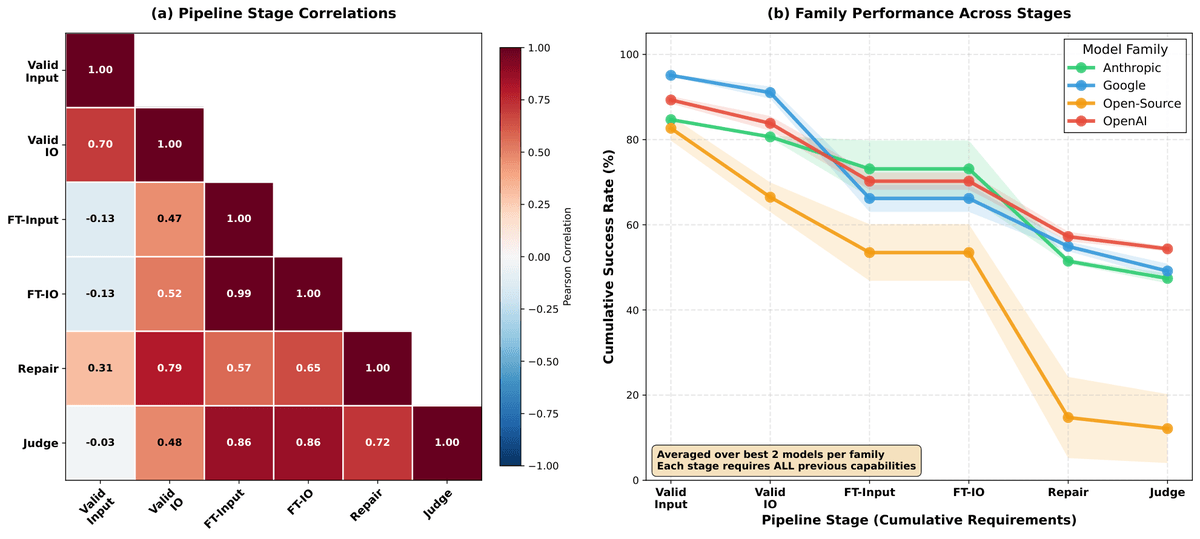
Correlation analysis across pipeline stages tells a clean story about which capabilities actually matter. Fault-triggering input and output metrics are almost perfectly correlated (r = 0.988) and strongly predict repair performance (r = 0.794), while valid-input generation alone weakly predicts downstream results (r = 0.311). Syntactic fluency is essentially free at this point; it does not signal that a model can debug.
The sharpest performance drops occur at Valid IO to FT-Input (-14.7 points) and FT-IO to Repair (-21.2 points), marking the transitions from general execution to fault localization and code modification. Family-level trends show OpenAI models degrade most gracefully, while open-source models drop hardest at the repair stage.
Why this benchmark is worth watching
For anyone building coding agents, VIBEPASS gives a concrete diagnostic for the middle of the debugging loop that pass@1 numbers hide. A few takeaways worth pulling out:
- Raw code-generation Pass@1 is a poor proxy for repair ability. GPT-5.2 and its Codex variant are indistinguishable on FPR metrics, and Sonnet-4.6 outperforms much stronger generators on discriminative test quality.
- Blindly injecting model-written tests into a repair pipeline can make it worse. Filtering for tests that actually witness the fault before using them for repair is the higher-leverage design choice.
- Weaker models benefit from being told a bug exists; stronger models can lose calibration when forced to test known-buggy code, because they can no longer abstain.
The authors frame fault-targeted reasoning as the binding constraint for autonomous debugging, and the numbers back that framing across every model tested. If you are shipping a coding assistant that claims to self-repair, this benchmark is the one that will tell you whether that claim survives contact with subtle semantic bugs.