
Salesforce AI Boosts a Weak Model's Accuracy 87% Without Touching Its Weights
A Salesforce and UIUC team shows a strong builder model can hand-craft inference-time scaffolds that nearly double a weaker model's accuracy without touching its weights.
Takeaways
- Salesforce and UIUC researchers propose strong-to-weak scaffolding, transferring capability at test time without weight updates. Paper
- Best builder-target pairing lifted GPT-5.4-mini accuracy from 0.488 to 0.912, an 87 percent relative gain across four ToM benchmarks.
- Gains come from deterministic code offloading, benchmark routing, and format enforcement, not longer chains of thought.
- Builder identity dominates platform choice, and reasoning effort improves scaffold quality monotonically (Spearman 0.77).
- A headroom law governs uplift: strong targets gain less, and over-scaffolding can regress accuracy on saturated tasks.
- Residual errors concentrate in deep belief recursion and Bayesian goal inference where reasoning resists compilation into rules.
Traditional model distillation compresses a big teacher into a smaller student by retraining that student on rationales, traces, or reward signals. A new paper from Salesforce AI Research and the University of Illinois Urbana-Champaign asks a different question: what if the strong model never touches the weak model's weights at all, and instead writes the inference-time code that surrounds it? Their answer, published on arXiv, is that this test-time transfer works surprisingly well, lifting a weak model's average accuracy on Theory-of-Mind tasks from 0.49 to 0.91.
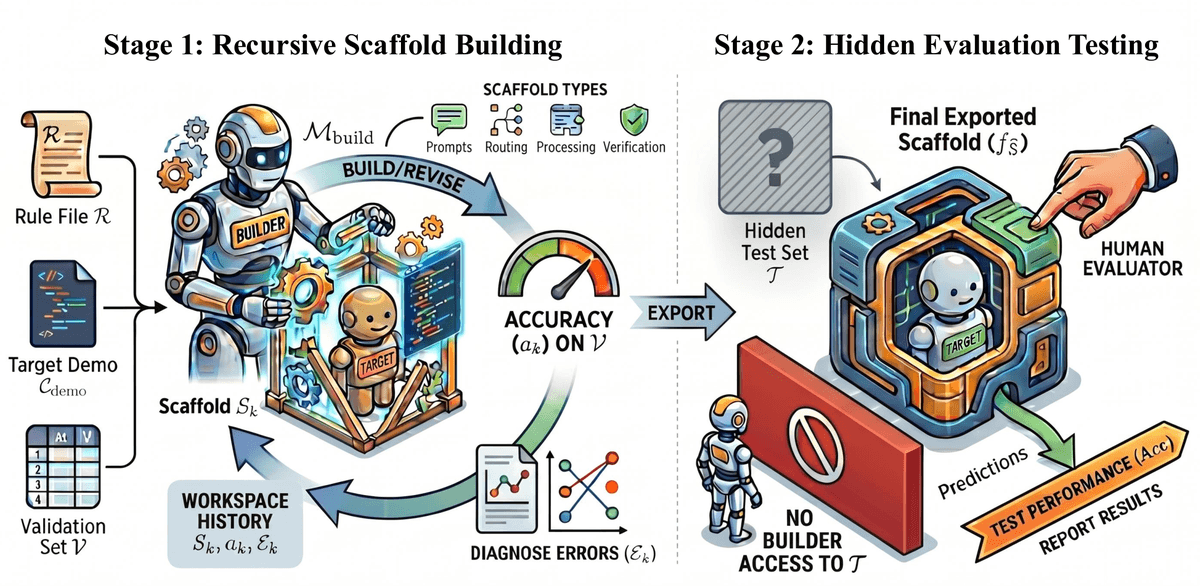
The setup they call strong-to-weak scaffolding pairs a capable builder model, running inside an agentic coding environment like Cursor, Claude Code, or GPT Codex, with a fixed weaker target that will actually answer the questions. The builder constructs a scaffold: any combination of task routing, prompt templates, deterministic solvers, few-shot exemplars, verification passes, or format enforcement designed to improve the weaker target on a hidden test set. The target is not trained, and the builder never observes the full test set. Its only feedback signal is a 5% validation slice, which it can query iteratively while refining its code.
Builder writes the harness, target answers the questions
The authors evaluated this on four Theory-of-Mind benchmarks, which are useful stress tests because they force models to reason about nested beliefs, hidden information, and perspective shifts:
- BigToM (1200 items): binary belief, goal, and action questions that hinge on whether an agent observed a world change.
- Hi-ToM (1200 items): nested belief questions with recursion depth 0 to 4, including deception and multi-room object tracking.
- MMToM-QA (600 items): binary Bayesian goal and belief inference from action traces.
- MuMA-ToM (900 items): three-choice multi-agent belief and social-goal questions.