
SAKE Benchmark Reveals Most AI Audio Editing Methods Barely Work
A new benchmark tests whether knowledge editing tricks that work on text-only LLMs actually transfer to audio-language models, and most fail.
 Pro
Takeaways
- SAKE is the first benchmark for editing perceptual auditory knowledge in large audio-language models.
- Eight editing methods tested on DeSTA2.5-Audio, Qwen2-Audio, and Audio Flamingo 3 across four evaluation axes.
- Most methods hit high reliability but fail on audio generalization and connected reasoning.
- Fine-tuning the modality connector emerges as the most balanced and robust baseline.
- Sequential edits cause severe forgetting and, for MEND and KE, full model collapse.
- Portability scores fall below the 27.5% random baseline for most methods, showing edits do not propagate.
Knowledge editing has become a popular way to patch specific facts inside large language models without paying the cost of retraining. But almost every method in the literature was designed for one thing: swapping declarative text facts like "Paris is the capital of France." A new benchmark called SAKE asks a harder question: can these techniques also edit how a model perceives audio, such as the emotion in a voice or the sound of an animal? The short answer is that most existing methods struggle badly.
SAKE (Speech and Audio Attribute Knowledge Editing) is the first benchmark aimed at editing perceptual auditory knowledge inside large audio-language models (LALMs). Unlike text or vision editing, which typically modifies isolated subject-relation-object facts, auditory attribute editing requires modifying acoustic generalization rather than isolated facts. Editing that a specific frog clip should be labeled "dog" is easy. Getting the model to generalize that change across every frog-like sound it might encounter, without breaking unrelated knowledge, is the actual challenge.

Why auditory editing is a different beast
Most knowledge-editing research targets factual triplets. Visual editing benchmarks like MMEdit and VLKEB largely kept the same paradigm, just grounding entities in images. Audio breaks the pattern because attributes like emotion or speaker gender arise from perceptual abstractions over signals with substantial intraclass variability across speakers, prosody, and recording conditions. Editing them is closer to changing a style than swapping a fact.
SAKE covers four attribute types: speaker gender, speaker emotion, spoken language, and animal sounds. The benchmark contains 4,000 training instances with 31,000 audio inputs and 35,000 QA pairs, plus 1,200 test instances with 10,500 audio inputs. Every edit is scored on four axes:
- Reliability: does the edit stick on the exact target instance?
- Generality: does it hold on paraphrased questions and different audio clips with the same attribute?
- Locality: is unrelated knowledge preserved, both within the same attribute and across other tasks?
- Portability: does the edit propagate to connected reasoning? For example, after editing a frog's sound to that of a dog, the model's knowledge of the animal's diet should also update from "Insectivore" to "Omnivore."
Eight methods, three models, one messy picture
The authors evaluate eight editing techniques spanning the main paradigms in the field: fine-tuning the last LLM layer (FT-LLM), fine-tuning the modality connector (FT-Audio), the hypernetwork-based Knowledge Editor and MEND, the neuron-optimization method UnKE, two in-context editing variants (I-IKE and IE-IKE), and the dual-memory WISE approach. These are applied to three LALMs: DeSTA2.5-Audio, Qwen2-Audio, and Audio Flamingo 3.
Reliability numbers look great on the surface. Parameter-updating methods almost all achieve high reliability (mostly at or above 95% and often around 100%), with WISE consistently attaining the best performance. The problems appear when you push further.

A few patterns stand out from the full results table:
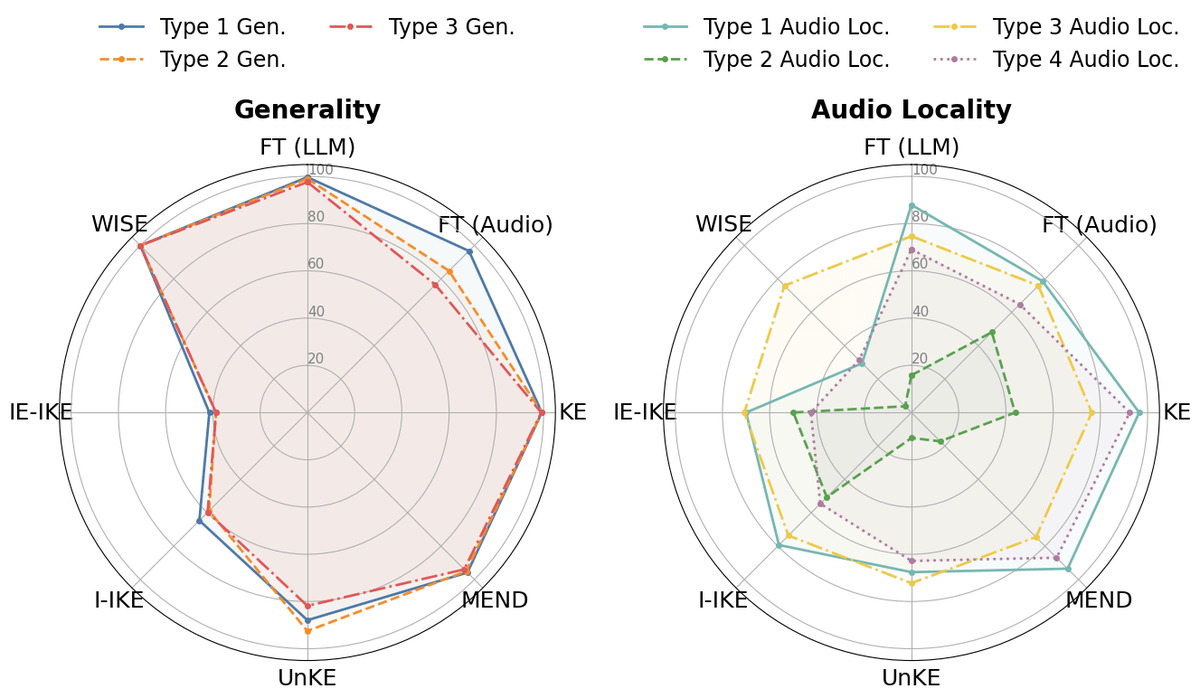
- Generality falls off a cliff on audio. Methods handle paraphrased text questions fine, but generalizing to a different audio clip with the same attribute is much harder. Combining both modalities is the worst case.
- Intra-attribute locality is fragile. Editing one emotion label often bleeds into other emotions. The authors attribute this to shared acoustic and semantic structure between labels within the same attribute.
- In-context editing barely works. The authors attribute this to LALMs' limited in-context learning ability: they struggle to handle multi-audio inputs and leverage examples, unlike in LLMs and LVLMs where such methods are effective.
- Portability is essentially broken. Under sequential editing, most methods perform below the 27.5% random baseline, meaning edited knowledge does not propagate to connected reasoning at all.
The surprise: fine-tune the connector, not the LLM
The most useful practical finding is that a simple baseline outperforms most of the fancy editing machinery. Fine-tuning the modality connector, the small module that bridges the audio encoder and the LLM backbone, gives the most balanced results across all four metrics. It preserves text-only capabilities perfectly because the LLM weights are untouched, and it consistently delivers stronger portability than any competing method on all three models.
Sequential editing exposes another failure mode: model collapse. Some methods exhibit degeneration, characterized by repetitive or nonsensical outputs, observed for example with MEND on DeSTA and Qwen, KE on all models, and UnKE on Audio Flamingo 3. After a handful of edits, MEND on DeSTA drops from 100% reliability to essentially zero, producing outputs like repeated words or endless newlines. FT-Audio and the in-context methods hold up much better under sequential pressure, though they trade off some single-edit strength.
What this means in practice
If you are trying to correct systematic errors in an audio model, debias speaker perception, or personalize a voice assistant, the results suggest a clear starting point: fine-tune the modality connector with a small edit set and skip the more elaborate parameter-surgery approaches. They enforce the specific edit reliably but tend to damage nearby knowledge and fail to propagate updates through downstream reasoning.
The paper also makes clear how far the field has to go. Even the best method leaves portability near random, meaning an edit to "this speech is sad" will not reliably update the model's inferences about what facial expression or social context matches. The authors state that all resources will be publicly released after review, which should give the community a shared testbed for auditory-specific editing methods. Until then, SAKE mostly delivers a warning: text-editing tools do not automatically transfer to sound.