
Sakana AI's SAIL Lets Robots Search and Fix Their Own Mistakes Before Moving
SAIL uses Monte Carlo Tree Search and VLM scoring to let robots 'think longer' at test time, jumping from 25% to 73% average success across manipulation tasks
 Pro
Takeaways
- SAIL applies Monte Carlo Tree Search to robot trajectory generation, letting VLMs iteratively refine motion plans at test time before execution.
- Average task success jumps from 25% (single rollout) to 73% (45 MCTS nodes) across six manipulation tasks in the ALOHA simulator.
- Three key components drive performance: a similarity-based trajectory archive, a VLM scorer that watches rollout videos, and step-level waypoint feedback.
- Real-world validation on a physical robot arm achieved 5/6 success using a Real2Sim digital twin pipeline.
- MCTS rollouts can be distilled into a fast policy (ACT), cutting execution time from 644s to 72s while maintaining the same success rate.
- No code or weights released yet; paper available at arxiv.org/abs/2603.08269.
Robot imitation learning has a dirty secret: give a model a new scene it hasn't seen before, and its carefully learned trajectory often falls apart. A slightly different object position, a new camera angle, a changed lighting condition -- any of these can cause a cascading failure that the model has no way to recover from. A new paper from researchers at the University of Tokyo and Sakana AI proposes a fix borrowed from a surprising place: the same test-time compute scaling ideas that transformed LLM reasoning.
The framework is called SAIL (Scaling In-context Imitation Learning), and its core insight is simple but powerful: instead of asking a vision-language model (VLM) to generate one perfect robot trajectory and hoping for the best, let it search, fail, learn from its mistakes, and try again -- all before the robot moves a single joint.
Why one-shot trajectory generation keeps breaking
In-context imitation learning is a paradigm where a robot learns a new skill at inference time from just a handful of demonstrations, without any retraining. Think of it as few-shot prompting, but for physical manipulation. The model sees a few example trajectories and generates a new one adapted to the current scene.
In-context imitation learning allows robots to acquire skills from demonstrations, yet one-shot trajectory generation remains fragile under environmental variation. The fundamental problem is that robot trajectories are extremely high-dimensional and sensitive to small errors. Even mild changes in scene geometry or context -- clutter, support-surface shifts, different object layouts -- can cause sharp degradation, because policies learn correlations between action and training context and do not reliably produce constraint-satisfying behaviors when the environment departs from the training distribution.
Recent efforts have attempted to mitigate this fragility by either distilling procedural reasoning into more robust visual representations, or employing retrieval mechanisms to provide the model with richer context from successful historical demonstrations. However, these methods typically focus on improving the quality of a single prediction rather than enabling the system to systematically explore and refine the continuous motion space itself.
Thinking longer with a search tree of trajectories
SAIL reframes trajectory generation as a search problem. Rather than producing one trajectory and committing to it, the system runs Monte Carlo Tree Search (MCTS) -- a classical planning algorithm famous for powering AlphaGo -- but with an unusual twist: each node in the tree is a complete robot trajectory, and edges correspond to trajectory refinements. The robot effectively explores a tree of possible motion plans in a simulator before executing anything in the real world.

Three components make this search work in practice:
- Trajectory Archive with Similarity Retrieval: As the system finds successful trajectories for different scene configurations (seeds), it stores them in a shared archive. When tackling a new scene, it retrieves the most visually similar past successes using LPIPS distance -- a perceptual similarity metric -- and feeds them as in-context examples to the policy VLM. The archive grows over time, making the system smarter as it solves more scenes.
- VLM-based Trajectory Scoring: After executing a candidate trajectory in simulation, a scoring VLM watches the rollout video and estimates progress through an ordered list of subtasks (e.g., reach, grasp, lift, handover). This produces a scalar reward for each node in the MCTS tree, guiding the search toward more promising branches without requiring any hand-crafted reward function.
- Step-Level Feedback: The scoring VLM doesn't just produce a single final score -- it annotates individual waypoints in the trajectory with per-step progress scores. The policy VLM then receives this annotated trajectory as feedback and is instructed to preserve high-scoring segments while fixing low-scoring ones. This is the key to targeted refinement rather than blind re-generation.
The numbers tell a clear story
Experiments across six diverse manipulation tasks in simulation and real-world validation clearly demonstrate that increasing test-time compute consistently improves success rates, achieving up to 95% on complex tasks. The six tasks -- HandOverBanana, HandOverPen, BowlOnRack, DrawerOpen, LaptopClose, and MarkerRemoveLid -- were run in the ALOHA manipulation simulator with 20 different random scene configurations each.
The scaling behavior is striking:
- A single VLM rollout (no search): 25% average success
- SAIL with 6 MCTS nodes: 55% average success
- SAIL with 15 MCTS nodes: 65% average success
- SAIL with 45 MCTS nodes: 73% average success
For comparison, breadth-first search (expanding 15 trajectories in parallel with no feedback loop) hits 51%, and depth-first search (15 sequential refinements) hits only 37%. MCTS with step-level feedback outperforms both by combining wide exploration with targeted correction. The ablation study is equally revealing: similarity-based retrieval with just one retrieved demo (65%) beats random retrieval with three demos (53%), showing that relevance matters more than quantity when it comes to in-context examples.
From simulation to the real world
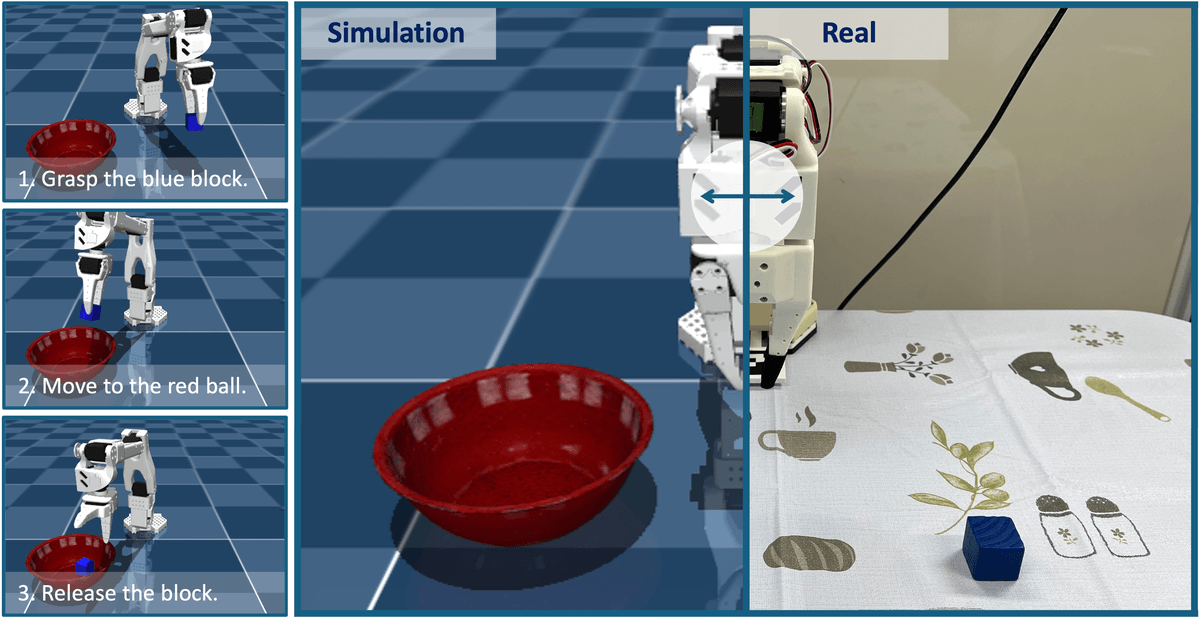
The team validated SAIL on a physical robot -- a LeRobot SO-101 arm -- using a BlockIntoBowl task where the robot must pick up a block and drop it into a red bowl. The pipeline works through a Real2Sim step: an Intel RealSense depth camera scans the scene, GroundingDINO and SAM2 localize the objects, and a digital twin of the workspace is reconstructed in simulation. SAIL then searches for a successful trajectory in this digital twin and transfers it to the real robot.
The result: 5 out of 6 trials succeeded. The single failure was attributed to depth estimation errors and unmodeled contact dynamics -- the classic sim-to-real gap.
The team also explored a second deployment mode: using MCTS as an automated data collection engine. They generated 120 successful trajectories in simulation and trained an ACT (Action Chunking with Transformers) policy via behavior cloning on that data. This distilled policy also achieved 5/6 real-world success, while cutting average execution time from 644 seconds down to 72 seconds -- a 9x speedup.
What this unlocks -- and where it still struggles
The real breakthrough here isn't just better success rates. It's the demonstration that test-time compute scaling, a principle that transformed LLM reasoning, applies to physical robot trajectories. You can trade more compute at inference time for higher task success, and the scaling curve keeps improving rather than saturating early.
There are practical limitations to keep in mind:
- SAIL requires a physics simulator that closely mirrors the real environment. The Real2Sim pipeline adds complexity and is a potential failure point.
- The MCTS search is slow -- 644 seconds on average per task. The distillation workaround helps, but adds its own pipeline steps.
- Some tasks plateau: LaptopClose, which requires fine positional adjustments, benefits more from breadth-first exploration than MCTS at lower compute budgets.
- The current setup uses
gemini-robotics-er-1.5-previewas the VLM backbone, so performance is tied to that model's spatial reasoning capabilities.
No code or model weights have been released alongside the paper at this time. The work was conducted as part of an internship at Sakana AI, with the full pipeline built on top of the LeRobot ecosystem for real-world deployment. The authors note that integrating SAIL with Gaussian Splatting-based digital twins is a natural next step -- one that could close the remaining visual fidelity gap and enable zero-shot real-world transfer.