
SAGE Trains Itself on 500 Examples to Beat Math and Code Benchmarks
SAGE trains four agents inside a single LLM to co-evolve their own reasoning curriculum, lifting Qwen-2.5-7B by 10.7 points on OlympiadBench.
 Pro
Takeaways
- SAGE trains four role-specialized agents (Challenger, Planner, Solver, Critic) from a single shared LLM backbone.
- Uses only 500 seed examples and grows its curriculum to over 20,000 verified questions during training.
- Qwen-2.5-7B gains 10.7 points on OlympiadBench and 8.9 points on LiveCodeBench versus base.
- Correctness is judged by external verifiers (symbolic math grading, code test execution), not by the Critic.
- Trained with Task-Relative REINFORCE++ and LoRA rank 128, built on the VeRL RLHF library.
- Limited to verifiable domains and shows over-specialization after roughly 140 training steps.
Reinforcement learning has become the go-to recipe for making language models better at math and code, but it usually depends on mountains of human-labeled problems with verified solutions. A new framework called SAGE (Self-evolving Agents for Generalized reasoning Evolution) tries to sidestep that bottleneck by letting a single model play four roles against itself, generating its own problems, plans, and solutions from a seed set of only 500 examples.
The paper reports that this closed-loop training improves the Qwen-2.5-7B model by 8.9% on LiveCodeBench and 10.7% on OlympiadBench, with consistent gains across three different backbones.
Why self-play keeps stalling
Self-play sounds like the obvious escape from the data-labeling treadmill: let a model invent problems and grade itself. In practice, most attempts drift. Existing approaches struggle with open-ended domains lacking robust verification and often fail to integrate planning for complex, multi-step tasks. Without a planning step, models tend to shortcut their way through long reasoning chains. Without quality control, the self-generated curriculum degrades into nonsense problems or trivially easy ones.
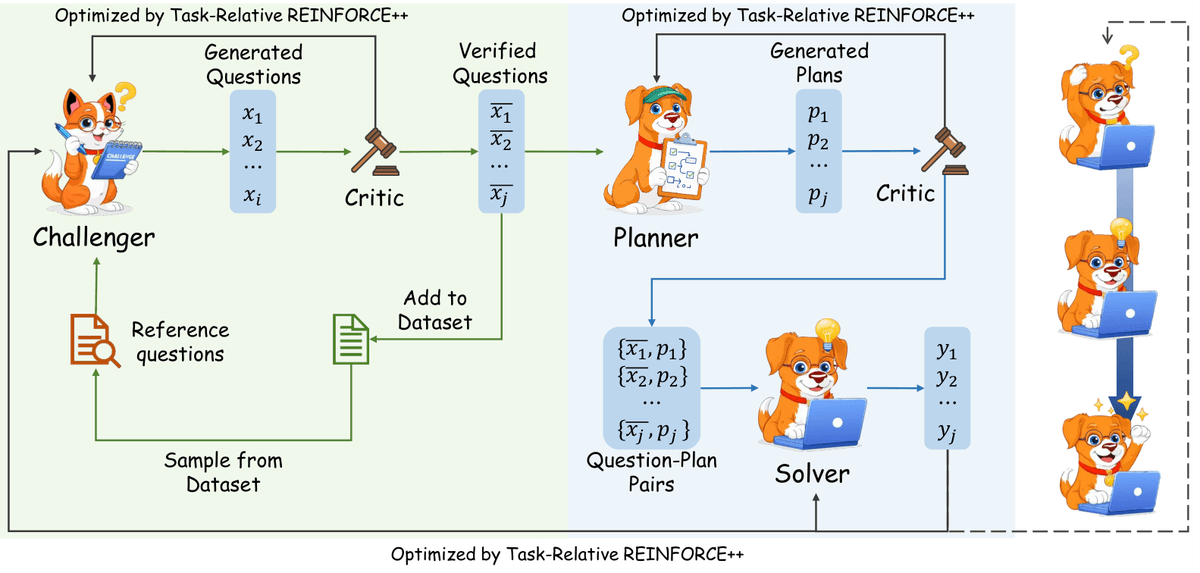
SAGE addresses both issues by splitting the work across four specialized roles that share a single LLM backbone and get trained jointly.

Four roles, one model
Each agent is the same base model prompted into a different job:
- Challenger writes new problems and their verifiers (ground-truth answers for math, executable tests for code), using seed problems as references.
- Planner turns each problem into a structured, step-by-step plan wrapped in
<plan>tags. - Solver follows the plan to produce a final answer.
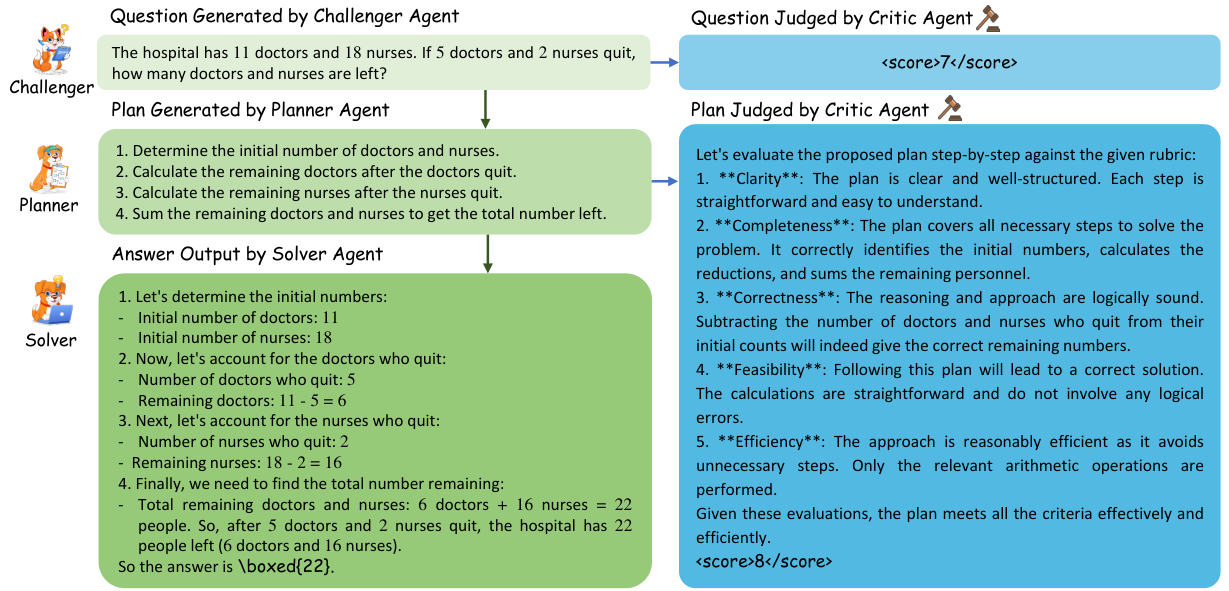
- Critic scores the questions and plans on a 1-10 scale, and enforces the output format.
Correctness is not judged by the Critic. In the verifiable setting, correctness is determined by the external verifier rather than the Critic, meaning math answers get graded symbolically and code is checked against tests. That keeps the reward signal honest even as the model trains itself.
The adversarial loop that pushes difficulty
The interesting mechanic is how the Challenger and Solver co-evolve. The Solver is rewarded for verified correctness, while the Challenger gets a difficulty bonus whenever the Solver fails. This pushes the curriculum toward problems that are hard but still solvable, without human intervention.
To stop this from collapsing into garbage, the Critic gates everything. Questions must clear a quality threshold of 0.7 before entering the training pool, and low-quality items have their difficulty reward suppressed so the Challenger cannot game the system by producing incoherent "hard" problems. Plans below a score of 0.3 are dropped, and the Solver answers directly from the question.
All four roles are updated together using Task-Relative REINFORCE++, a critic-free policy gradient method that normalizes advantages within each role separately. This matters because the Challenger, Planner, and Solver receive rewards on different scales, and a shared normalization would let one role's noise drown out the others.
The numbers
SAGE was tested on Qwen-2.5-3B-Instruct, Qwen-2.5-7B-Instruct, and Qwen-3-4B-Base, trained with LoRA at rank 128 and a learning rate of 3e-6. Compared with two recent self-play baselines, Absolute Zero Reasoner and Multi-Agent Evolve, SAGE wins on overall average across all three backbones. On Qwen-2.5-7B, it hits 26.4% on LiveCodeBench (up from 17.5% base) and 38.7% on OlympiadBench (up from 28.0%).
Out-of-distribution generalization is where the gap widens. SAGE improves OOD Avg. by 4.2% over the base model while preserving strong in-distribution performance on the 7B model, whereas AZR actually hurt Qwen-3-4B math performance by nearly 10 points.
Ablations confirm every role earns its keep. Disabling Challenger training results in a notable drop in code benchmarks, particularly on LiveCodeBench (16.9% to 9.0%), indicating that curriculum generation is essential for out-of-distribution generalization. Similarly, removing Solver training causes the largest overall decline.
The catches
SAGE only works where correctness can be checked automatically. Extending the framework to open-ended tasks with subjective evaluation criteria, potentially through learned reward models, remains an interesting direction for future work. It also over-specializes eventually. Training dynamics show accuracy peaks around step 100-140 on Qwen-2.5-3B and then declines, so early stopping is required.
The paper does not currently link to a public code release or model checkpoints. The framework is built on top of VeRL, the HybridFlow RLHF library, which is open source, so reproducing the pipeline should be tractable for anyone willing to wire the four agents together.